The Dynamic UK MGA Insurance Market
The UK insurance market is experiencing a period of significant evolution, and at its heart lies the vibrant and increasingly pivotal MGA sector. These agile entities, known for their specialised underwriting expertise and operational flexibility, are not merely intermediaries but true innovation hubs. Their ability to respond swiftly to evolving market needs makes them indispensable partners for brokers and capacity providers alike. The UK MGA sector is truly dynamic, showcasing the positive current state of the UK MGA innsurance market.
The sector has demonstrated impressive resilience and growth, solidifying its position as a significant contributor to the UK’s £47 billion general insurance premiums. This positive trajectory is fuelled by a confluence of factors, including a demand for niche products, an influx of private capital, and a profound embrace of technological advancements.
The outlook for the coming years remains exceptionally bright, promising continued dynamism and expansion within the MGA market. This positive outlook for the UK insurance market is largely due to the agility of MGAs.
A Landscape of Growth and Specialisation
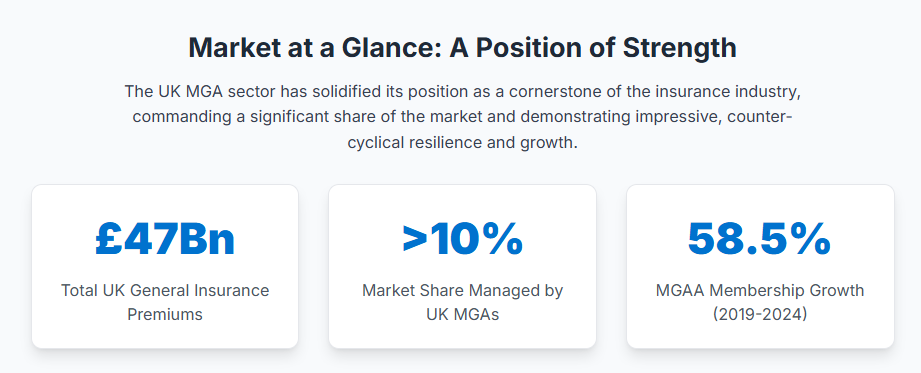
The UK MGA market is currently experiencing a robust period of expansion, driven by its unique ability to address specific market demands. As of 2024, there are over 350 MGAs operating across the country, collectively managing more than 10% of the UK’s substantial £47 billion general insurance premiums (Insurance Edge).
This significant market share underscores their growing influence and importance within the broader UK insurance market. The UK MGA landscape is thriving.
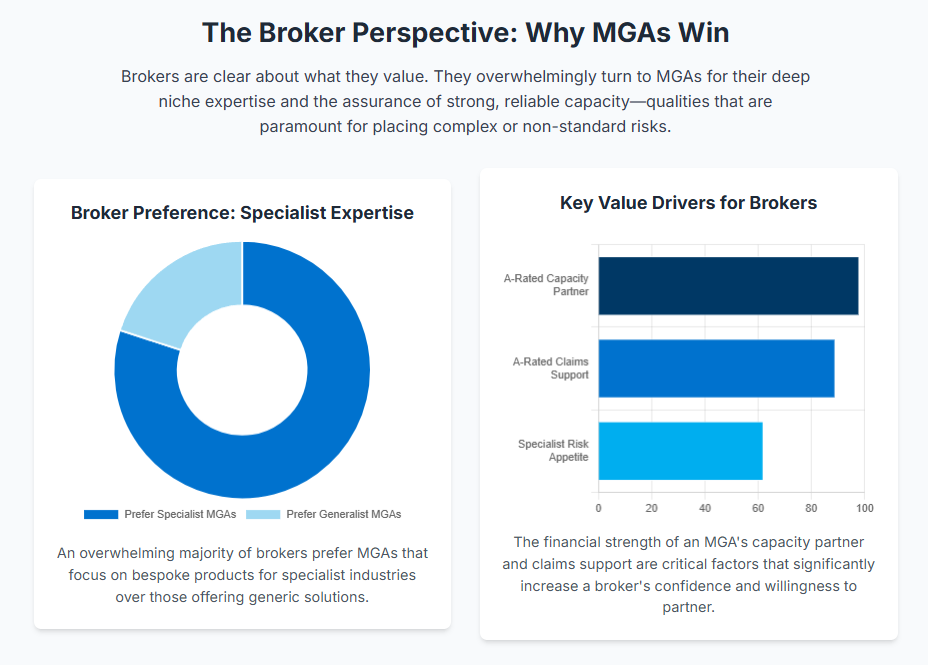
This growth is further evidenced by the Managing General Agents’ Association (MGAA)‘s membership, which saw a remarkable 58.5% increase since 2019, reaching 233 MGA members by 2024 (Insurance Edge). This surge in membership reflects a healthy, expanding ecosystem and a collective commitment to professional standards within the sector. The MGA market is clearly maturing, shifting from early expansion to a more developed phase (Gallagher Re).
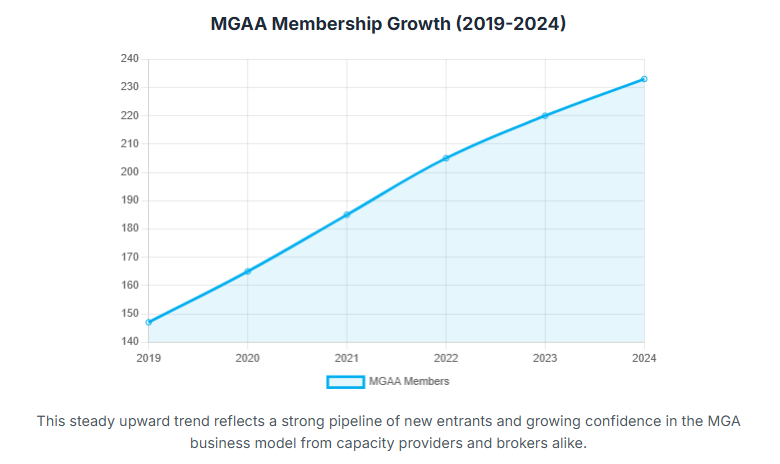
Brokers are increasingly turning to MGAs for their specialist risk appetite and capacity strength, particularly in high-hazard industries. A survey by Corin Underwriting revealed that 62% of brokers consider it “very significant” for MGAs to provide targeted solutions for sectors like roofing, scaffolding, haulage, waste, and steel (Insurance Times). This highlights the MGA’s critical role in filling gaps left by traditional insurers. This demonstrates how MGAs are evolving in the UK.
Furthermore, 80% of brokers expressed a strong preference for MGAs that concentrate on bespoke products tailored to specialist industries, rather than offering broader market solutions (Insurance Times). This demand for bespoke offerings underscores the MGA’s value proposition: deep expertise in niche areas combined with the agility to craft precise coverage.
The financial strength of an MGA’s capacity partner is paramount for brokers, with 98% stating that capacity from A-rated or highly rated providers significantly increases the attractiveness of a partnership (Insurance Times). This emphasis on robust backing ensures stability and confidence in the long-term viability of MGA insurance products.
A prime example of an MGA excelling in specialisation is Moonrock Underwriting, which focuses on drone insurance for hobbyist, commercial, and bespoke needs (Moonrock Underwriting). They offer cover options from £1m to £50m in public liability and insure drones valued between £500 and £5,000,000, demonstrating deep expertise in a highly specific and emerging risk area (Moonrock Underwriting).
The MGA Market’s Counter-Cyclical Resilience and Value Proposition
The data indicates a notable trend: while the broader UK insurance market has experienced competitive pricing in various lines (Marsh), the MGA market continues its robust upward trajectory. This suggests that MGAs are not merely growing within a universally favourable market. Instead, they are demonstrating a unique ability to thrive even when broader market conditions become more competitive.
This positive performance stems from the MGAs’ strategic positioning. As traditional insurers reduce their exposure in certain classes of business, particularly those deemed high-risk or niche, MGAs step in to fill these critical gaps (Insurance Edge).
Their specialisation allows them to provide essential capacity and tailored solutions for complex or emerging risks that larger carriers might shy away from. This makes MGAs an indispensable, stabilising, and innovating force within the insurance industry, moving beyond a simple distribution function to become crucial partners in risk placement.
The Evolving Definition of “Capacity” in the MGA Market
Securing sustainable underwriting capacity remains a significant consideration for MGAs (Insurance Edge). Brokers consistently prioritise capacity from A-rated or highly rated providers (Insurance Times), underscoring the importance of financial strength. However, the discussion extends beyond mere capital availability to encompass the operational aspects of capacity relationships.
Concerns have been raised about potential “six-month lags” in review processes with capacity partners (Insurance Business Canada), highlighting a need for greater responsiveness and transparency. This indicates that the definition of valuable capacity is evolving to include consistency, speed, and the collaborative nature of the partnership.
MGAs that can demonstrate efficient, real-time data exchange and a clear pathway to profitability for their partners are becoming increasingly attractive, fostering more sustainable and agile capacity deals.
Table 1: UK MGA Market Growth Snapshot (2023-2025)
| Metric | Value (2024 unless specified) | Source |
|---|---|---|
| Total UK General Insurance Premiums | £47 billion (2024) | Insurance Edge |
| % of UK General Insurance Premiums managed by MGAs | >10% (2024) | Insurance Edge |
| Number of UK MGAs | >350 (2024) | Insurance Edge |
| MGAA Membership (2019) | 147 (Calculated from 233 / 1.585) | Insurance Edge |
| MGAA Membership (2024) | 233 members | Insurance Edge |
| MGAA Membership Growth (2019-2024) | 58.5% | Insurance Edge |
| Individual MGA GWP Growth Example | 36% (2024) | Insurance Times |
| Individual MGA GWP Target | £50m (by end of 2025) | Insurance Times |
| Overall UK Insurance Market Growth | 3.2% (2024) | Allianz Economic Research |
| P&C Sector Growth | 14.8% (2023) | Allianz Economic Research |
| P&C Sector Growth | 5.4% (2024) | Allianz Economic Research |
This table provides a quantitative overview of the robust expansion within the UK MGA market. It highlights the significant contribution of MGAs to the overall UK general insurance premiums and the substantial increase in their professional association’s membership.
The growth figures for individual MGAs, such as the 36% GWP growth seen in one example for 2024 (Insurance Times), demonstrate the impressive dynamism of the sector, often outpacing the broader UK insurance market growth rates. This data collectively reinforces the positive trajectory and increasing importance of MGAs.
Technology as the Catalyst for MGA Evolution
Digital transformation is no longer an option but a strategic imperative for modern MGAs, driving efficiency, market expansion, and differentiation (Deloitte’s 2025 Global Insurance Outlook). The divide between tech-enabled MGAs and traditional players is widening, creating significant opportunities for those embracing digital advancements.
This shift is enabling MGAs to operate with greater efficiency, attract capital, and access new markets (Deloitte’s 2025 Global Insurance Outlook). These are key technology trends in UK MGAs.
The UK insurance industry is undergoing rapid digitalisation, with advancements in AI in insurance, growing adoption of agile data platforms, and the promise of Lloyd’s of London’s Blueprint Two. MGAs are at the forefront, leveraging technology to redefine internal operations and enhance both employee and policyholder experiences. This leads to deeper understanding of market trends, more accurate risk profiling, and highly streamlined workflows (Insurance Insider).
The Power of AI in Insurance
AI in insurance and machine learning have become integral to MGA operations, even before the advent of Generative AI (Deloitte’s 2025 Global Insurance Outlook). Modern MGAs thrive on data, using new analytical tools to refine risk selection and pricing (Deloitte’s 2025 Global Insurance Outlook). For instance, MGAs in auto and fleet insurance leverage real-time telematics data for usage-based policies, while cyber insurance MGAs analyse firms’ IT security to tailor coverage (Deloitte’s 2025 Global Insurance Outlook). This highlights the advanced MGA software solutions UK MGAs are adopting.
The rise of Agentic AI, the next evolution of generative AI, is particularly transformative. Unlike traditional AI, Agentic AI can make independent decisions and continuously improve, processing more business transactions with greater accuracy and autonomously managing complex tasks such as risk assessment and policy administration (Deloitte’s 2025 Global Insurance Outlook). This allows human specialists to focus on intricate cases requiring their expert judgment, enhancing underwriting precision at scale (Deloitte’s 2025 Global Insurance Outlook).
AI-driven systems are also being employed to triage claims and flag potential fraud, aligning with the industry’s push for straight-through processing (IBM Think). This not only improves efficiency but also enhances customer service, as some MGAs offer mobile apps or online dashboards for customers to manage policies and file claims (Deloitte’s 2025 Global Insurance Outlook). The broader implication here is that the adoption of AI in insurance by MGAs extends beyond mere operational efficiency.
It serves as a strategic enabler for market expansion and deeper specialisation. By automating routine tasks and providing data-driven insights, AI frees up human underwriters to focus on complex, emerging, or niche risks, allowing MGAs to confidently enter new, potentially underserved markets with highly tailored products. This creates a virtuous cycle where efficiency gains fuel strategic growth and innovation.
Seamless Connectivity and Open Architecture
The pivotal role of connectivity, interoperability, and open architecture is transforming data exchange within the MGA landscape. A traditional pain point for MGAs has been the monthly bordereau, which involves reporting batches of policies and claims via spreadsheets (InsurTech360). This manual process is now being replaced by continuous data exchange with capacity providers.
API connectivity allows an MGA’s platform to feed new policy and exposure data directly to carriers and reinsurers in real time, significantly reducing latency and improving transparency (InsurTech360). Insurers actively encourage this shift as it provides them with better line of sight on portfolio performance and accumulations, fostering stronger, more trusting partnerships (InsurTech360). This move away from manual data flows to automated, real-time systems is a cornerstone of digital maturity.
The adoption of API-driven data exchange is not merely an operational upgrade. It represents a strategic move that fundamentally reshapes the relationship between MGAs and their capacity providers. Real-time data fosters unprecedented transparency, allowing insurers to gain immediate insights into portfolio performance and risk accumulations.
This mutual visibility builds stronger trust, mitigates concerns about data lags (Insurance Business Canada), and facilitates more agile and sustainable capacity partnerships, directly addressing a key challenge for MGAs. This also implies a competitive advantage for MGAs with superior connectivity.
Accelerating Speed to Market with Modern Platforms
MGAs are significantly accelerating speed to market for new products by leveraging flexible technology and widely recognized “MGA-in-a-box” solutions. These ready-built platforms can provide regulatory approvals, access to technology stacks, and distribution networks, fast-tracking market entry (Insurance Edge). This agility allows MGAs to launch niche products faster than large insurers, often in a few months or less (Deloitte’s 2025 Global Insurance Outlook). These are among the best platforms for MGAs.
The ability to quickly adjust coverage or pricing in response to market feedback is a distinct advantage for MGAs with flexible technology, something traditional insurers with legacy systems often struggle to achieve (Deloitte’s 2025 Global Insurance Outlook). This responsiveness is crucial in competitive markets, enabling MGAs to stay ahead of evolving consumer demands and risk landscapes. Efficiency gains are also achieved through automation across policy administration and other operations.
Robotic process automation (RPA) is used for repetitive tasks like policy issuance and regulatory reporting, freeing up teams for higher-value activities (Insurance Insider). Digital workflows, such as submission portals and automated quote-bind systems, have significantly reduced transaction friction, cutting down processing times and operational costs (Deloitte’s 2025 Global Insurance Outlook).
The emergence of “MGA-in-a-box” solutions is not just about faster product launches; it represents a democratisation of market entry for new MGA ventures. By bundling critical operational, regulatory, and capacity components, these solutions lower the capital and time barriers previously associated with launching an MGA. This fosters a more dynamic and competitive MGA market, encouraging a greater diversity of specialist offerings and accelerating overall innovation within the UK insurance sector.
Table 2: Key Technology Adoption Areas and Their Impact on UK MGAs
| Technology Area | Key Applications/Capabilities | Impact on MGAs | Source |
|---|---|---|---|
| Agentic AI & Generative AI | Autonomous risk assessment, policy administration, complex task management, content generation | Increased accuracy, efficiency, human specialists focus on complex cases, enterprise-wide transformation | Deloitte’s 2025 Global Insurance Outlook |
| Enhanced Underwriting | Digital tools, data analytics, algorithmic approaches for specialty risks (cyber, climate) | Improved risk selection, market entry, precision at scale, better loss ratios | Insurance Insider |
| Data-Driven Analytics & ML | Risk assessment, fraud detection, customer profiling, telematics for usage-based policies, algorithmic underwriting | Optimized underwriting, reduced fraud, personalized products, improved customer experience | Deloitte’s 2025 Global Insurance Outlook, IBM Think, InsurTech360 |
| Cloud Computing & API Integration | Configurable core systems, real-time data exchange, seamless integration with external tools | Scalability, operational flexibility, reduced latency, improved transparency with capacity providers | InsurTech360, KPMG |
| Automation & Digital Workflows | Automated submissions, quotes, policy issuance, claims processing, chatbots | Reduced processing times, lower operational costs, increased efficiency, scalability without headcount increase | Deloitte’s 2025 Global Insurance Outlook, Insurance Insider |
| Low-code Platforms | Rapid product development, quick integration with third-party systems for embedded insurance | Agile response to consumer demands, faster market entry for niche products | Deloitte’s 2025 Global Insurance Outlook |
This table summarises the proactive embrace of advanced technologies by MGAs across the UK. It illustrates how these innovations are not merely incremental improvements but fundamental shifts that enhance efficiency, enable new capabilities, and provide a significant competitive edge.
The adoption of cloud computing, for instance, offers scalability and operational flexibility, while AI in insurance and API-driven data exchange are redefining core insurance processes. This comprehensive technological integration underscores the forward-thinking nature of the UK MGA market and its commitment to continuous improvement.
The Embedded Insurance Revolution
Embedded insurance refers to the seamless integration of insurance coverage directly within non-insurance platforms, such as e-commerce websites, travel booking applications, and fintech services (Deloitte’s 2025 Global Insurance Outlook). The market for embedded insurance is projected to reach a substantial $70 billion in Gross Written Premiums (GWP) by 2025 (Deloitte’s 2025 Global Insurance Outlook).
A Q1 2025 industry poll further solidified its importance, identifying embedded insurance as the most likely channel to drive future growth in personal lines. This survey found that 31.6% of respondents cited it as the top distribution model, surpassing both direct-to-consumer approaches and traditional intermediated sales through brokers (Insurance Times).
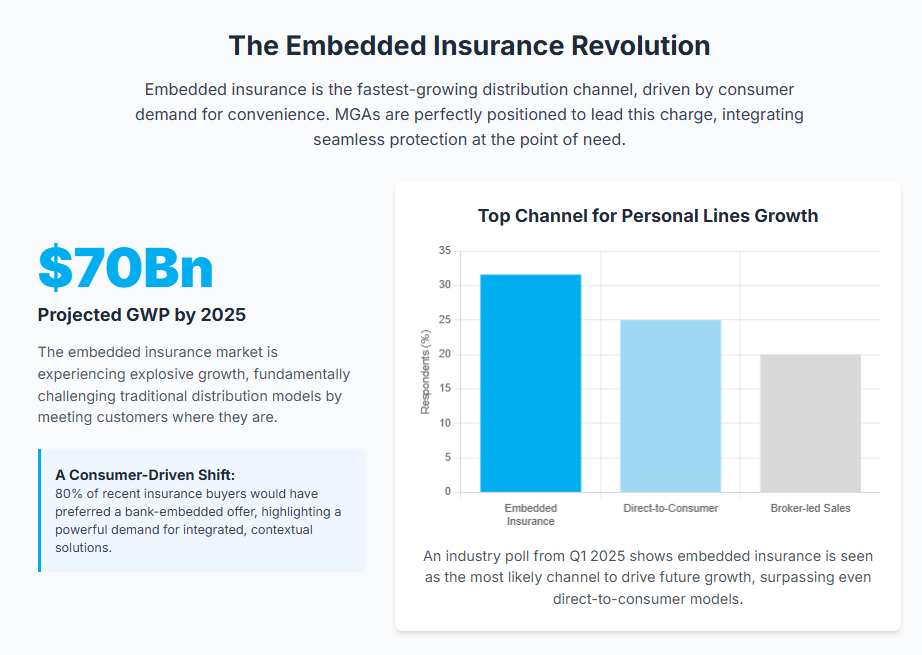
The significant consumer desire for bank-embedded insurance offers indicates that embedded insurance is a consumer-driven revolution, not merely a new distribution channel, and is actively pressuring traditional models. Consumers show high interest in receiving offers based on real-time transaction data within their banking applications. Many would prefer such offers for their next purchase.
The high attach rates, with digital companies embedding insurance witnessing up to a 290% increase in attach rates since the start of the pandemic (Everest Group), demonstrate that embedded insurance fulfills a fundamental consumer need for “protection at the point of sale”. This fundamentally challenges the traditional, often cumbersome, “second step” of insurance distribution and compels incumbents to rethink their acquisition strategies.
Key Distribution Models Driven by MGAs
MGAs are at the forefront of driving this growth through three primary distribution models (Deloitte’s 2025 Global Insurance Outlook):
- Broker-led distribution: This model enhances traditional approaches with digital capabilities to foster more efficient collaboration between MGAs and their broker partners.
- Direct-to-consumer (D2C): This involves fully digital MGAs marketing policies directly to consumers online without the need for intermediaries.
- Embedded insurance: Here, MGAs integrate insurance coverage directly within non-insurance platforms, leveraging their inherent agility to offer relevant protection at the point of sale.
The emergence of “tech-first MGAs” that bundle risk mitigation technology with insurance coverage signifies a strategic shift from a traditional “detect and repair” approach to a “predict and prevent” model. This innovative model aims to reduce losses before they occur (Deloitte’s 2025 Global Insurance Outlook).
By integrating risk management technology directly with insurance policies, UK MGAs simplify decision-making for policyholders and can offer improved pricing. For insurers, this strategy incentivizes proactive risk mitigation, leading to better loss ratios and more competitive pricing structures (Deloitte’s 2025 Global Insurance Outlook).
This “predict and prevent” model represents a strategic evolution beyond traditional risk transfer. Instead of merely transferring financial risk after an event, these MGAs proactively work to reduce losses before they occur. This not only offers policyholders simplified decision-making and better pricing but also leads to improved loss ratios for insurers.
This model represents an evolution of the insurance product itself, integrating proactive risk management as a core offering, particularly valuable for emerging and hard-to-place risks like cyber.
Success Stories and the Role of Low-Code Platforms
Success stories abound, demonstrating the power of embedded insurance. For instance, Uber integrates driver policies through Insurtech providers, and Amazon collaborates with specialists for damage protection. Monese, a prominent UK money application, provides embedded bills and purchase protection to its cardholders (Monese Blog). The convenience and contextual relevance of these offerings resonate strongly with modern consumers.
Low-code platforms are proving particularly valuable in facilitating this evolution, enabling MGAs to rapidly develop and integrate new products with third-party systems, thereby allowing for agile responses to dynamic consumer demands (Deloitte’s 2025 Global Insurance Outlook).
Table 3: Benefits of Embedded Insurance for MGAs
| Benefit | Explanation | Source |
|---|---|---|
| Enhanced Customer Acquisition | Reaches customers at the point of need/purchase, aligns with digital buying habits, accesses individuals not typically seeking insurance. | Deloitte’s 2025 Global Insurance Outlook |
| Improved Customer Experience | Seamless, frictionless experience, relevant offers at the right time and place, increased convenience. | Deloitte’s 2025 Global Insurance Outlook |
| Diversified Revenue Streams | Opens doors for non-insurance entities to distribute, allows MGAs to expand beyond underwriting into distribution. | Deloitte’s 2025 Global Insurance Outlook |
| Better Pricing Models & Loss Ratios | Enables “predict and prevent” model by bundling risk mitigation tech, incentivises risk reduction. | Deloitte’s 2025 Global Insurance Outlook |
| Agility & Speed to Market | Low-code platforms enable rapid product development and integration with third-party systems. | Deloitte’s 2025 Global Insurance Outlook |
This table clearly outlines the multifaceted advantages that embedded insurance brings to MGAs. It illustrates how this innovative approach enhances customer engagement and acquisition by meeting consumers where they are in their digital journeys.
Furthermore, it highlights the strategic benefits of diversifying distribution channels and improving loss ratios through proactive risk mitigation. The agility afforded by low-code platforms in this context allows MGAs to rapidly adapt and launch new products, reinforcing their competitive position in the evolving market.
Strengthening Partnerships and Capacity
The success of UK MGAs is intrinsically linked to robust and collaborative relationships with brokers and capacity providers. Brokers rely on MGAs for high-quality service, from underwriting expertise to efficient claims management, with consistency reinforcing relationships and enhancing broker reputations (Insurance Times). The ability of MGAs to underwrite niche and complex risks makes them indispensable partners for brokers (Insurance Times).
Securing sustainable underwriting capacity remains a key challenge and priority for MGAs (Insurance Edge). The market is seeing increased willingness from capacity providers to experiment with Insurtech UK MGAs, with 81% of respondents in one survey already providing capacity to them (Insurance Times).
This optimism is reflected in expectations that the amount of premium placed through Insurtechs will increase in the coming year (Insurance Times). This highlights the growing influence of Insurtech UK in the capacity landscape.
Factors crucial for attracting capacity include access to the Insurtech’s data, the insurance industry experience of the Insurtech team, and the ability to offer a unique product proposition (Insurance Times). Building trust and a relationship of mutual respect with capacity partners is paramount for progressing deals (Insurance Times). This emphasis on data and expertise highlights a shift towards more sophisticated and informed partnerships.
The influx of private capital is a significant growth driver for the MGA market, enabling investment in technology and expansion (Gallagher Re). This financial backing, combined with increased collaboration with insurers, is fostering a dynamic environment for MGA growth (Gallagher Re). This capital infusion supports the agility and innovation that define the MGA market.
Companies like Accelerant are exemplifying strong partnerships by offering a “Risk Exchange” designed to power connections across the specialty insurance value chain, aligning policyholders, underwriters, distribution, and risk capital providers on a tech-fueled, data-driven platform (Accelerant). This collaborative underwriting approach harnesses collective expertise to craft products that perform brilliantly (Accelerant). This model fosters a shared understanding of risk and performance.
The Interdependence of Trust, Data, and Longevity in MGA Partnerships
The success and sustainability of MGA partnerships are deeply interdependent on a virtuous cycle of trust, data transparency, and long-term commitment. The repeated emphasis on trust (Insurance Times) and data (Deloitte’s 2025 Global Insurance Outlook, Insurance Times) in the context of capacity relationships is not coincidental.
Real-time data sharing, often enabled by APIs, builds trust by providing capacity providers with immediate visibility into portfolio performance. This mitigates concerns about data lags (Insurance Business Canada), which have historically introduced volatility into these relationships.
This enhanced trust, in turn, fosters the “longevity” and “sustainability” that capacity providers and brokers seek, reducing overall volatility and ensuring consistent product availability. This progression signifies a shift from purely transactional interactions to true strategic alliances within the insurance industry, where shared data and mutual understanding drive long-term success.
Navigating the Regulatory Landscape with Confidence
The Financial Conduct Authority (FCA) plays a vital and supportive role in the UK’s financial services sector, ensuring market stability, integrity, and consumer protection (GOV.UK). The FCA operates independently from the UK government, with a mission to protect consumers, maintain financial market integrity, and foster competition (GOV.UK). This regulatory oversight provides a strong foundation for the responsible growth of the MGA market. Addressing regulatory challenges for UK MGAs is crucial for continued success.
Both MGAs and brokers are regulated by the FCA and are bound by similar compliance requirements, including adherence to Consumer Duty principles, ensuring fair treatment of customers, and maintaining robust governance structures (Insurance Times). This shared regulatory framework underscores the importance of collaboration and mutual understanding as they navigate complex compliance landscapes together (Insurance Times). Effective communication and alignment on compliance are paramount.
The FCA views regulation as a bridge, not a barrier, connecting creativity with public trust and enabling firms to invest, experiment, and grow responsibly (FCA & ICO Blog). The FCA and ICO (Information Commissioner’s Office) collaborate closely to help firms navigate data protection and financial regulation, providing clarity and confidence for innovation (FCA & ICO Blog).
For instance, their joint AI in insurance survey showed 33% of firms cited data protection and 20% cited FCA regulations as constraints on AI adoption, prompting roundtables to address these challenges (FCA & ICO Blog). This proactive engagement demonstrates a commitment to facilitating responsible technological advancement.
Regarding delegated authority, the FCA expects insurers to have robust systems and controls, exercise appropriate oversight over outsourced functions, and understand their responsibilities to customers (SX3 Claims Insight). While the FCA is increasingly concerned about delegated authority models, this concern is focused on ensuring proper governance and oversight, rather than limiting the model itself (SX3 Claims Insight).
Firms that proactively demonstrate compliance and strong oversight of their Third-Party Administrators (TPAs) can thrive, ensuring consumer protection remains paramount. This is a key aspect of insurtech for delegated authority.
The BIBA actively supports its members in navigating the use of MGAs, recognising their increasing importance in the UK insurance market (Insurance Business UK). BIBA has released a new guide to help members understand areas such as Terms of Business Agreements, broker responsibilities, termination of delegated authority, and claims (Insurance Business UK). This guidance aims to provide confidence to members new to using MGAs, ensuring they can meet client needs while remaining compliant.
BIBA’s CEO, Graeme Trudgill, highlights the association’s close work with the MGAA, emphasising that MGAs provide essential additional capacity, particularly in challenging markets (Insurance Business UK). BIBA’s 2025 manifesto also outlines plans to streamline reporting requirements and accelerate authorisations, further supporting the efficient operation of the insurance industry (BIBA Press Release). These efforts demonstrate a collaborative approach to regulatory evolution.
Regulation as a Catalyst for Best Practice and Innovation
The regulatory environment in the UK, championed by the FCA and supported by industry bodies like BIBA, is actively shaping a more mature, trustworthy, and innovative MGA market. The FCA’s explicit view of “regulation as a bridge, not a barrier” (FCA & ICO Blog) and its aim to “foster competition” (GOV.UK) underscore this positive approach.
By setting clear expectations for consumer protection and governance in delegated authority, regulators are effectively incentivising MGAs to adopt best practices in data management, internal controls, and customer treatment. This regulatory clarity and support enable MGAs to innovate responsibly, building long-term confidence among brokers, capacity providers, and policyholders. This proactive regulatory stance ultimately fosters sustainable growth and strengthens the integrity of the entire UK insurance market.
Future Trends and Unlocking Further Opportunities
The MGA market is poised for continued evolution, driven by several key emerging trends. Product innovation remains a top priority, with MGAs keenly focused on developing new and tailored offerings to meet the evolving demands of the marketplace (Gallagher Re). This includes addressing increasing risks and creating innovative solutions for both traditional and new needs (Gallagher Re). This points to significant UK MGA growth opportunities 2025.
Market expansion, both within the UK and into less mature European markets, presents significant growth potential for agile MGAs (Insurance Edge, Gallagher Re). Technology and innovation are crucial enablers for these expansion strategies, allowing UK MGAs to adapt to diverse regulatory environments and market entry strategies (Insurance Edge). This ability to scale and adapt quickly is a hallmark of successful MGAs.
The lines between traditional and Insurtech MGAs are increasingly blurring, as established UK MGAs invest heavily in modernising their operations and expanding into new areas like cyber insurance (Deloitte’s 2025 Global Insurance Outlook). This convergence is leading to a more sophisticated and technologically advanced ecosystem as a whole, fostering a dynamic environment for collaboration and shared learning.
Future trends and enhanced Insurtech partnerships will continue to shape the MGA landscape (Gallagher Re). MGAs are recognising the importance of user experience, whether serving brokers or end-policyholders, and are experimenting with omnichannel strategies to expand beyond traditional underwriting into distribution (Deloitte’s 2025 Global Insurance Outlook). This customer-centric approach is vital for future growth.
Continued M&A and consolidation are also anticipated, reflecting a maturing market and the pursuit of scale and efficiency (Gallagher Re). This dynamic environment encourages MGAs to continuously refine their operating models and technology foundations to remain relevant and competitive (Gallagher Re). The drive for optimisation and strategic growth will continue to shape the sector.
The MGA as a Proving Ground for Broader Insurance Innovation
The MGA market is serving as a vital innovation laboratory for the entire insurance industry. MGAs are critical players in testing and validating new technologies (InsurTech360), and the lessons learned in the ecosystem often cascade to the broader insurance industry (InsurTech360).
Their inherent agility and willingness to adopt new technologies, from AI in insurance to no-code product building, allow them to rapidly test and refine new approaches to underwriting, distribution, and claims management. The proven successes and insights gained within the ecosystem are then adopted by larger, more traditional insurers, accelerating the pace of digital transformation across the entire sector and fostering a more customer-centric future for UK insurance. This positions MGAs as true pioneers.
Table 4: Factors Driving MGA Growth & Evolution
| Category | Factor | Explanation | Source |
|---|---|---|---|
| Growth Drivers | Hard Market Conditions | The MGA market fills gaps where traditional insurers reduce exposure, providing specialist capacity. | Insurance Edge, Gallagher Re |
| Influx of Private Capital | Provides funding for technology investment, market expansion, and strategic initiatives. | Gallagher Re | |
| Demand for Specialisation | Brokers prefer bespoke offerings for niche and complex risks, which MGAs excel at. | Insurance Times, Gallagher Re | |
| Increased Collaboration with Insurers | Carriers utilise MGAs to access new markets and leverage their expertise without full operational overhead. | Deloitte’s 2025 Global Insurance Outlook, Gallagher Re | |
| Technology Acceleration | Enables efficiency, data-driven underwriting, rapid product launches, and new distribution models. | Deloitte’s 2025 Global Insurance Outlook, Gallagher Re | |
| Emerging Trends | Product Innovation | Focus on developing new, tailored offerings for evolving risks and market needs. | Gallagher Re |
| Market Expansion | Growth potential in less mature and emerging markets beyond the UK. | Insurance Edge, Gallagher Re | |
| Insurtech Partnership | Blurring lines between traditional and Insurtech MGAs, leading to advanced tech adoption. | Deloitte’s 2025 Global Insurance Outlook, Gallagher Re | |
| Direct-to-Consumer (DTC) Distribution Models | Expanding distribution channels and enhancing client experience through digital platforms. | Deloitte’s 2025 Global Insurance Outlook, Gallagher Re | |
| Regulatory Evolution | Adaptive regulatory environment fostering responsible innovation and consumer protection. | Gallagher Re, FCA & ICO Blog | |
| Continued M&A and Consolidation | Reflects market maturity and pursuit of scale and efficiency. | Gallagher Re |
This comprehensive table provides a dual perspective on the forces shaping the MGA market. The “Growth Drivers” highlight the foundational elements that have propelled the sector to its current robust state, such as its ability to address market gaps and attract significant capital. The “Emerging Trends” section then forecasts the future trajectory, emphasising continuous Product Innovation, strategic market expansion, and the deepening integration of Insurtech partnerships. This structured overview underscores the dynamic and forward-looking nature of the UK MGA market.
A Bright Future for UK MGAs
The UK MGA market stands as a testament to innovation, agility, and strategic adaptation within the broader insurance industry. Its impressive growth, driven by a keen focus on specialisation and a proactive embrace of digital transformation, positions it as a vital and dynamic force. MGAs are not just thriving; they are actively shaping the future trends of insurance by pioneering new technologies and distribution models.
From the transformative power of AI in insurance and seamless API connectivity to the burgeoning potential of embedded insurance and accelerated speed to market, MGAs are consistently raising the bar. Supported by a collaborative regulatory environment and strong partnerships with brokers and capacity providers, the sector is well-equipped to navigate future challenges and capitalise on emerging opportunities. The outlook for UK MGA market is unequivocally positive, promising continued growth, innovation, and a profound impact on the global UK insurance market.