What is Underwriting? A definition
Underwriting is the vital function that serves as the foundation of the insurance industry. It is the sophisticated process through which an insurer evaluates, accepts, rejects, and prices the risks presented by an insurance application. This assessment is critical because it determines whether a potential risk is acceptable and specifies the precise terms and conditions under which coverage will be provided.
The underwriter acts as a crucial gatekeeper, executing the financial agreement on behalf of the insurer. By accepting a premium, the insurer agrees to make good, in a manner stipulated in the policy, any loss or damage suffered by the policyholder as a result of an agreed accident or occurrence, providing the core financial promise of indemnity¹.
The fundamental concept of risk transfer
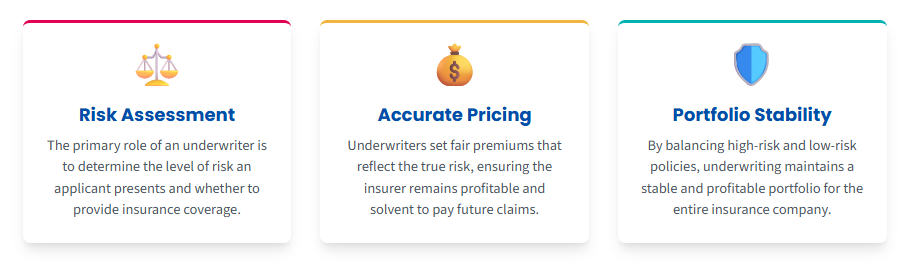
The primary function of underwriting is the diligent management of capital. It ensures that the price charged (the premium) is sufficient to cover the expected cost of future insurance claims, plus a margin to account for volatility, uncertainty, and administrative overhead. This process is complex, making every decision a critical capital allocation choice for the insurer.
The practice focuses on mitigating potential financial imbalance. If a risk is accepted at a premium that fails to cover the predicted losses, the insurer’s reserves are directly eroded. Therefore, the definition of underwriting involves capital preservation, ensuring the firm maintains the solvency required to fulfil its promise of indemnity to all policyholders².
What is to underwrite: The risk selection function
To underwrite is literally to assume financial responsibility for a specific, potential future loss. This involves a rigorous assessment process, often referred to as risk assessment, where the probability and potential severity of a loss are carefully calculated. This assessment relies on both proprietary data and external information sources.
The underwriter’s final decision profoundly influences the insurer’s long-term financial viability and profitability. Effective risk selection shields the insurer from accumulating excessive adverse risks, which could otherwise lead to catastrophic losses that deplete the funds needed to pay legitimate insurance claims.
The underwriting department: Organisational placement
The underwriting department houses the technical specialists responsible for these decisions. This department sits at the centre of the insurer’s operations, working in close collaboration with sales teams, claims adjusters, and crucial financial partners, the actuaries.
To define underwriting in insurance, it is the mechanism that balances exposure against potential financial return. It enforces the company’s defined risk appetite and translates broad corporate strategy into specific policy decisions, ensuring the portfolio of risks accepted remains healthy and diversified.
The symbiotic relationship with actuaries
A critical partnership exists between the underwriter and the actuary. Actuaries are responsible for building the scientific pricing models, using historical loss data and statistical analysis (actuarial data) to forecast future claim costs and determine the appropriate base risk charges².
The underwriter then applies these sophisticated models to the specific, unique profile of an individual insurance application. While the actuary quantifies the risk based on statistical cohorts, the underwriter applies judgement to unique soft risk factors and customises the acceptance parameters.
Historical Roots and the Origin of the Underwriter
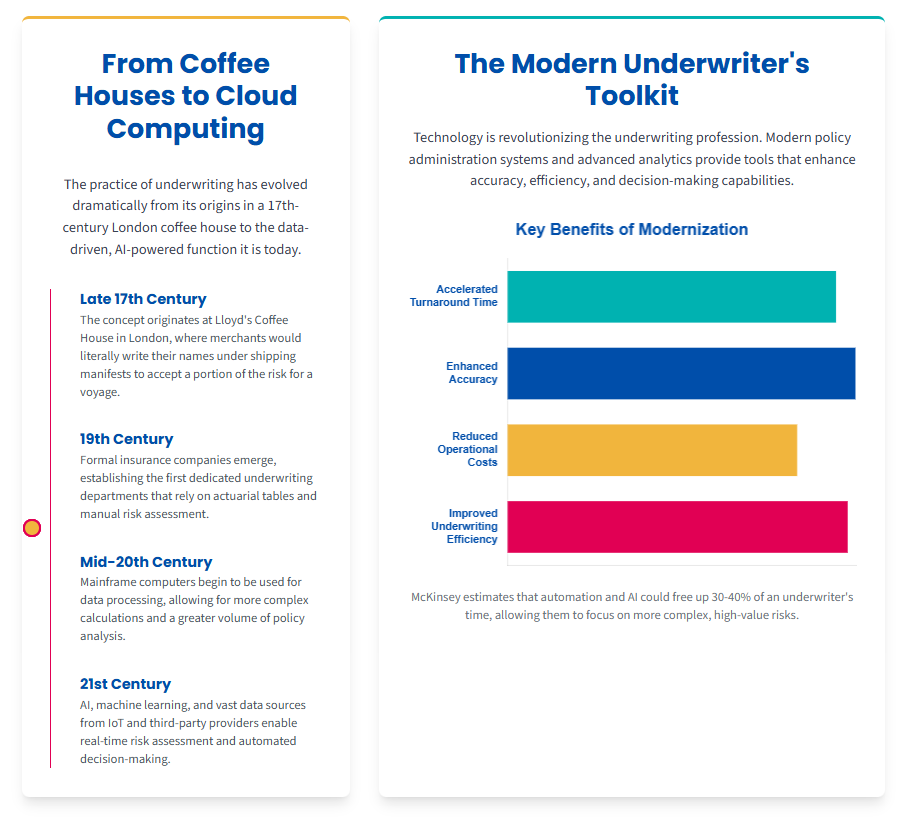
The term and the practice of underwriting are centuries old, tracing their roots back to the maritime commerce centres of 17th-century London. The foundational necessity was the need for merchants to distribute the substantial financial risk associated with global trade and sea voyages.
Where did underwriting and the term originate from
The word underwriting derives directly from the literal practice employed by early financial backers. These risk takers, who would accept a portion of the risk on a voyage in exchange for a premium, would literally write their names beneath the description of the venture on a specially prepared document known as a slip³.
The term is therefore derived from the phrase “written under,” marking the physical acceptance of liability. This practice originated in Edward Lloyd’s coffee house, laying the groundwork for the modern global insurance market⁴.
The Lloyd’s Coffee House foundation: Maritime risks
The genesis of modern underwriting began informally in the 1680s at Edward Lloyd’s coffee house, located near the Thames in London⁵. This location became a critical hub where ship owners, merchants, and those seeking financial guarantees against loss would meet potential financial backers.
When a ship or cargo needed insurance, a document detailing the venture, the vessel, the cargo, and the requested premium was prepared. Financial backers who agreed to assume a portion of the liability would literally write their names, or underwrite, below this text, noting the exact amount of risk they were willing to cover³.
Institutionalisation and the Society of Lloyd’s
This informal risk-sharing arrangement evolved significantly by 1774 when the participating underwriters formed a committee and relocated to the Royal Exchange⁶. This move marked the transition from a casual meeting place to the institutionalised Society of Lloyd’s.
Lloyd’s, incorporated later by the Lloyd’s Act 1871, is legally a society of members, corporate and individual, who underwrite insurance in syndicates, rather than a single insurance company itself⁷. This structure formalised the concept of collective risk pooling, setting stringent financial requirements and standards for those acting as an underwriter¹. The concept, initially confined to marine coverage, expanded steadily to encompass all major forms of specialist insurance globally⁶.
Why Underwriters Are Essential for Financial Stability
The continued financial health of the insurer and, by extension, the stability of the broader economy, hinges on sound underwriting. The function is fundamentally about managing future uncertainty and ensuring that the insurer remains solvent and capable of fulfilling its long-term financial promises.
Protecting capital through risk management
The primary contribution of the underwriting function is the meticulous management of the insurer’s capital reserves. By efficiently screening risks and accurately applying pricing models, underwriters prevent the accumulation of liabilities that could result in unexpected catastrophic losses.
Effective risk management is crucial for maintaining the insurer’s financial resilience. This protects policyholders, ensuring that funds are available when legitimate insurance claims arise, thus safeguarding the integrity of the insurer’s promise of indemnity.
Maintaining a healthy risk portfolio
Underwriters are tasked with balancing profitability and exposure across their entire book of business. This involves strategic oversight, preventing excessive concentration of risk in specific classes, geographies, or industries.
The successful balancing of aggregate risk ensures that the insurer is resilient against large-scale, systemic events such as natural disasters or economic shocks. A robust portfolio requires diverse risks that, ideally, are uncorrelated in their potential for loss.
The relationship between premiums and long-term viability
The long-term sustainability of any insurer is entirely dependent on setting adequate rates. Actuarial models dictate that premiums must be set high enough to cover four major financial elements: the mean cost of expected claims, the cost associated with volatility of those claims, the cost related to uncertainty about the mean and volatility, and the operating costs to service the product².
If the underwriter consistently accepts risks at premiums that do not adequately cover these four required elements, the financial foundation of the insurer will inevitably erode. Robust underwriting is therefore synonymous with long-term financial sustainability.
The underwriter’s role in pricing uncertainty
A significant element the underwriter addresses is the “Cost of Uncertainty,” which applies when the expected likelihood and severity of a loss are difficult to quantify precisely². This uncertainty often applies to nascent or rapidly changing risk categories, such as advanced technology liability or climate-related perils.
Underwriters manage this uncertainty by influencing product design itself. They ensure that policies contain carefully structured mechanisms, such as clear limits on potential payouts, defined non-guaranteed elements, or specific exclusions in the coverage terms.
The Core Mandate of the Modern Underwriter Role
The underwriter role has evolved significantly from the 17th-century signing of a slip, now requiring advanced analytical and interpersonal skills to manage complex, global risks. The modern underwriter sits at the intersection of quantitative science and commercial strategy.
The dual function of risk selection and pricing
The central duty of the underwriter remains two-fold: selecting risks that align precisely with the company’s predefined risk appetite and accurately calculating the necessary premium (rates) to cover the assumed liability. This requires exercising professional judgement based on extensive underwriting criteria and sophisticated actuarial guidance.
The application of this judgement is vital, particularly for non-standard or large commercial risks where automated models may not capture unique qualitative factors, such as the quality of the policyholder’s management or their specific internal risk management protocols.
Setting limits, coverage, and exclusions
The underwriter is responsible for defining the precise contractual boundaries of the insurance policy. This involves establishing three critical parameters: specifying the perils or losses that are protected against (coverage); detailing the maximum financial amount (limits) the insurer is obligated to pay in the event of a claim; and clearly defining specific risks, losses, or properties that are explicitly not covered by the contract (exclusions)⁸.
The meticulous definition of these terms is essential for both the policyholder’s protection and the insurer’s solvency. Clear contractual language in the definitions of limits and exclusions is paramount for effective claims management and avoiding legal disputes regarding the scope of indemnity when a claim is filed.
Assessing exposure and managing aggregate risk
Beyond assessing the individual insurance application, the underwriter must understand how that risk contributes to the company’s overall accumulation of risk (the aggregate exposure). For instance, accepting multiple risks in the same geographical area creates concentration risk.
This strategic exposure management increasingly relies on sophisticated technology and real-time risk assessment tools. These tools allow underwriters to visualise and prevent systemic loss aggregation, ensuring that capital requirements are adequately met across the entire portfolio.
The underwriter role versus the actuary
While both roles are critical to risk assessment, their functions differ fundamentally. Actuaries build the statistical models, using actuarial data to determine the likelihood of loss and establish the mathematically sound risk charges (rates)². Conversely, the underwriter applies these predetermined underwriting criteria and models to the specific, actual risk presented.
The underwriter also brings commercial expertise, negotiating policy terms, applying non-modelled judgement, and structuring policy endorsements. This means the actuary provides the science, and the underwriter provides the commercial customisation and final execution.
Breaking Down the Systematic Underwriting Process
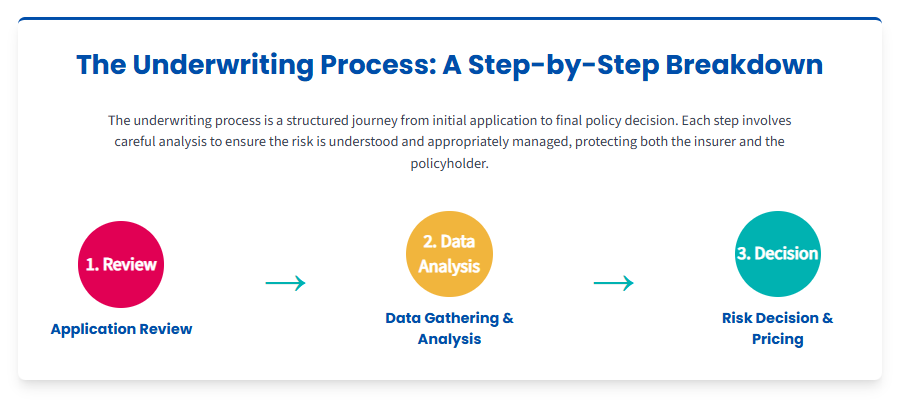
The systematic approach involved in answering what is the underwriting process is a structured flow designed to manage risk efficiently and consistently, moving from a raw application to final contract binding.
What is the underwriting process: An overview of systematic steps
The process involves a rigorous, multi-stage evaluation. This structured approach is essential for maintaining consistency, ensuring adherence to regulatory compliance, and guaranteeing that all decisions align with established underwriting criteria⁸.
This detailed, step-by-step methodology ensures that all necessary information is gathered, analysed, and documented before a decision on policy approval is rendered. This structure is critical for efficiency and auditability.
Insurance application and initial review
The first stage involves the meticulous review of the application submitted by the potential policyholder to evaluate its completeness and factual integrity⁸. Any discrepancies, missing information, or initial red flags concerning the applicant’s background must be identified immediately.
In modern operations, this initial data ingestion often leverages automation. Tools powered by Artificial Intelligence (AI) are now used to extract and classify key data points from unstructured documents, such as emails or PDFs, helping to handle high volumes of submissions efficiently⁹.
Information gathering and data enrichment
Following the initial review, the underwriter collects substantial supplemental data to enrich the risk profile. This often involves gathering information from diverse sources, including public records, detailed inspection reports, and third-party vendor data⁸.
The necessity of comprehensive information gathering requires the insurer to manage vast and diverse data sets (Big Data) to conduct comprehensive risk assessment. This data aggregation must be conducted with strict compliance to legal and privacy requirements.
Risk assessment methods and criteria
This phase is the analytical heart of the underwriting process, where the potential financial exposure of the applicant is quantified. The underwriter considers multiple factors, including the risk location, the industry context, and historical loss experience⁸.
Crucially, this assessment relies heavily on statistical models and actuarial data to predict the likely frequency and severity of future insurance claims⁴. The goal is to move beyond mere descriptive assessment toward accurate predictive modelling.
Risk classification and segmentation
Based on the quantitative and qualitative data gathered, risks are categorised into defined classes (e.g., preferred, standard, or substandard) based on their characteristics and projected loss likelihood⁸. This classification process is directly linked to the pricing models.
Using established underwriting criteria for segmentation ensures that the appropriate base premium rates are applied consistently across similar risks. Highly granular segmentation, facilitated by AI models, aims to reduce pricing dispersion within cohorts, making prices more precise and reflective of individual risk exposures².
The systematic progression of the underwriting function can be clearly defined by six distinct phases:
The Six Phases of the Underwriting Process
Once the risk has been fully assessed and classified, the underwriter’s focus shifts to finalising the financial structure and the contractual terms that govern the relationship between the insurer and the policyholder.
The calculation of rates and risk-based pricing
The premium rates calculated represent the financial embodiment of the assessed risk. As dictated by actuarial data, these rates must not only cover the average expected claim amount (the mean cost of risk) but also the associated costs of operational expenses and the capital required to absorb volatility².
The struggle for highly accurate, granular pricing is a core competitive imperative. Insurers who can leverage sophisticated algorithms and advanced analytics gain a strategic advantage by accurately predicting risk, allowing them to offer the most competitive premiums to the most desirable risks⁴.
Structuring coverage and defining indemnity
The underwriter must ensure that the final contract accurately translates the technical risk decisions into legally binding definitions. This means clearly articulating the exact extent of the financial compensation (indemnity) owed if a covered loss occurs.
Clear articulation of the agreed coverage is essential for preventative claims management. Ambiguous policy language concerning limits or the scope of protection can introduce friction during the claims process, leading to disputes and potentially eroding customer trust.
Applying endorsements and detailing exclusions
For non-standard or commercial risks, the policy is often tailored through endorsements, which are contractual modifications added to the standard policy to specify unique requirements or adjust coverage. These specific adjustments are managed according to highly detailed internal underwriting criteria.
Furthermore, precise drafting of exclusions is critical for managing the insurer’s exposure, particularly against emerging or unforeseen perils. Defining what is not covered provides certainty, allowing the insurer to manage its capital effectively and reduce the cost of uncertainty in the policy structure².
Policy approval and documentation
The final stage is policy approval, where the underwriter formally accepts the risk and binds the contract. Accurate documentation is paramount for the entire life cycle of the policy, including renewals and future insurance claims processing.
This documentation process is supported by efficient policy administration systems, which ensure that every decision, premium calculation, and contractual definition is recorded consistently and can be easily accessed for audit or regulatory review.
Underwriting Capacity Management Through Delegation
In global insurance markets, especially in specialist arenas like Lloyd’s, a significant portion of business is written through a mechanism known as delegated underwriting authority (DUA). This process is vital for accessing specialist expertise and global distribution, but it introduces complex governance and risk oversight challenges.
The concept of delegated underwriting authority (DUA)
DUA is an arrangement where a primary insurer or managing agent delegates its authority to a third party, typically a coverholder or service company, granting them the ability to enter into insurance contracts on the principal’s behalf¹⁰. This mechanism is critical for expanding market reach without establishing a physical presence in every jurisdiction.
DUA enables the capacity provider to leverage the specialised knowledge of local experts, allowing them to write niche risks or enter specific geographical markets efficiently.
The significance of DUA in global markets
The scale of DUA within specialist markets is substantial. For example, delegated underwriting represents approximately 45% of the total premium income generated within the Lloyd’s market¹⁰. This high percentage underscores the financial necessity and strategic importance of this distribution channel.
The high volume of delegated business requires stringent management. Effective underwriting capacity management is essential to ensure that the total risk accepted by all delegated parties does not exceed the financial capital constraints and risk appetite set by the capacity provider.
Governance and compliance frameworks for DUA
Managing DUA is inherently complex because it involves managing the risks assumed by external agents. This relationship, often termed the principal-agent problem, requires rigorous monitoring and oversight to ensure that the risks accepted by the coverholder adhere strictly to the original mandate and underwriting criteria¹¹.
Proportionate oversight and effective risk management are championed by industry bodies to control the exposure delegated through DUA¹¹. Regulators demand robust frameworks to mitigate fraud and ensure that all delegated parties maintain ethical operations and financial stability.
Technological imperative for effective capacity management
The technological capacity to monitor DUA is increasingly vital. To ensure compliance, the primary insurer requires real-time data flow from the coverholder’s systems directly into their own policy administration and analytical platforms.
Legacy systems that restrict reporting and analytics functionality inevitably heighten the risks associated with DUA¹². Without modern, integrated technology, the principal underwriter lacks the timely visibility needed to intervene if the coverholder begins writing risks outside the agreed underwriting criteria.
The Shift to Data-Driven Underwriting Decisions
The role of the underwriter has been fundamentally reshaped by the availability of Big Data and sophisticated computational tools. The function is moving decisively away from subjective intuition toward measurable, data-driven underwriting decisions.
The shift from manual assessment to analytical expertise
Historically, underwriting relied heavily on the accumulated knowledge and subjective judgement of experienced professionals. Today, while judgement remains vital for complex cases, the sheer volume of data, including unstructured text and external feeds, compels the modern underwriter to be an adept interpreter of statistical output and analytical models⁴.
This shift means the focus has moved from merely gathering facts to efficiently synthesising and interpreting complex probabilistic calculations derived from extensive data sets.
The impact of vast data availability on risk accuracy
The use of Big Data and advanced analytics, including AI, permits insurers to achieve an unprecedented level of granularity in risk segmentation. This highly detailed classification dramatically improves the accuracy of loss predictions². Insurers are now able to isolate the true, specific drivers of insurance claims with far greater clarity than traditional methods allowed⁴.
This deep, refined understanding of risk allows insurers to refine their underwriting criteria continuously, leading to more competitive pricing for low-risk policyholders and clearer identification of necessary exclusions for high-risk profiles.
The use of data-driven underwriting decisions
Decisions regarding risk acceptance and pricing are increasingly codified into explicit, quantifiable criteria and automated through algorithms. This systematic approach ensures superior consistency compared to purely human-driven review processes.
This standardisation not only helps to improve underwriting efficiency but also allows insurers to rapidly adjust their rates based on real-time market feedback, emerging loss data, and evolving regulatory requirements.
The growing talent gap and technology as a supplement
The insurance industry currently faces a critical talent gap, driven by an aging workforce and intense competition for young, technologically skilled professionals¹³. Generative AI (Gen AI) and other AI technologies are seen as indispensable supplements to the human workforce.
These tools can efficiently handle routine processing tasks, thereby augmenting the capacity of experienced staff. Accenture research suggests that AI can offer carriers the potential to increase submission processing capacity by 100%¹³.
Data lineage and accountability
The accelerating reliance on complex algorithms and high-velocity, sometimes non-traditional, external data sources raises new questions about accountability. To maintain governance and defend pricing decisions, insurers must meticulously track the origin and processing history of all data used (data lineage)⁴.
This transparency is vital for regulatory compliance and for actively mitigating the risk of incorporating inherent biases from external data sets into the automated models². Failure to understand data provenance can lead to inaccurate risk classifications and unintended, unfair outcomes.
Automation, Algorithms, and Real-Time Efficiency
The integration of advanced technology has become mandatory for insurers seeking to meet customer demands for speed and internal mandates to reduce underwriting costs. Automation drives operational excellence by directly tackling inefficiency and administrative burden.
The implementation of algorithms in pricing and risk selection
Algorithms now work synergistically with actuarial data to transform virtually every aspect of the insurance business, from the initial selection of a risk to its assignment within the appropriate risk pool⁴. These computational tools facilitate automated risk tiering, significantly reducing the manual effort required for standard, high-volume applications.
By using these advanced methods, insurers improve the identification of claim drivers and separate volatility from trend, allowing for a fine-tuning of rates that was previously unattainable⁴.
Real-time risk assessment tools for efficiency
AI-powered workbenches leverage sophisticated technologies such as machine learning (ML) and natural language processing (NLP) to conduct risk assessment in real time¹⁴. This capability allows underwriters to issue quotes and bind policies much faster, directly addressing customer expectations for rapid sales and service¹³.
A study by Deloitte indicated that AI-powered underwriting platforms can enhance underwriting accuracy by up to 30% compared to reliance on older, traditional manual methods¹⁴.
How automation helps streamline underwriting operations
The bulk of operational inefficiency in traditional underwriting stems from manual, repetitive administrative tasks, including extensive data entry, policy documentation, and basic adherence checks¹⁴. Automation systems are specifically designed to take over these functions.
A report by Accenture found that insurers implementing AI-driven automation were able to achieve a 40% reduction in operational costs while simultaneously improving overall productivity¹⁴. This success is central to efforts to streamline underwriting operations.
Reducing underwriter workload and accelerating turnaround time
It is estimated that up to 40% of the average underwriter’s time is consumed by non-core, administrative activities¹³. Generative AI is capable of handling tasks such as extracting necessary data from complex submission documents and presenting it in a summary dashboard, radically reducing these non-core workloads¹³.
The augmentation allows the human professional to focus on the high-value activity of complex decision-making and negotiation, thereby helping to accelerate underwriting turnaround time significantly.
To understand the current state of technology adoption and its quantitative impact, the following data provides context on efficiency gains and adoption barriers:
Key Performance Impacts of AI/ML Adoption
| Metric | Observed Impact | Source |
| Risk Assessment Accuracy | Improvement of up to 30% compared to traditional methods. | Deloitte |
| Operational Costs | Reduction of up to 40% through automation of repetitive tasks. | Accenture |
| Executive Belief | 62% of executives recognise AI/ML for elevating underwriting quality. | Capgemini |
| Underwriter Trust | Only 43% of underwriters regularly accept automated predictive recommendations. | Capgemini |
| Projected AI Adoption | Anticipated increase from 14% to 70% within three years. | Accenture |
AI and Machine Learning in Underwriting
The strategic application of AI and machine learning in underwriting is proving transformative, allowing for deeper risk modelling and improved operational metrics, yet significant cultural and technical barriers to full adoption remain.
AI and machine learning in underwriting: Applications and capabilities
AI/ML models are highly versatile, capable of generating synthetic data to augment existing datasets, which is highly beneficial for assessing novel risks in sectors like life insurance and commercial Property & Casualty¹⁵. For complex commercial lines, AI enables the simulation of various catastrophic scenarios, providing superior foresight for potential losses¹⁵.
These technologies enhance the ability of underwriters to identify and quantify systemic risk drivers, ensuring the firm’s capital is reserved appropriately against highly improbable, yet high-impact, events.
Improving efficiency and accuracy through predictive analytics
Executive leadership widely recognises the strategic value of these tools. A vast majority (83%) of P&C insurance executives believe predictive models are critical for the function’s future, although only 27% say their firm has advanced capabilities in place¹⁶.
This executive confidence is validated by performance metrics: 62% of insurance executives acknowledge that AI/ML technology is instrumental in elevating underwriting quality and simultaneously reducing fraud¹⁶.
Challenges of trust, complexity, and data integrity
Despite the clear benefits and high executive confidence, the adoption of automated recommendations is often hampered by resistance from the underwriters themselves. Only 43% of underwriters report that they trust and regularly accept automated recommendations from predictive analytics tools¹⁷.
This reluctance stems primarily from two concerns: 67% of underwriters cite perceived overcomplexity, and 59% express concerns regarding the integrity of the data being fed into the models¹⁷. This critical trust gap must be addressed through robust governance and improved system explainability if the industry is to scale adoption successfully.
The role of Generative AI in document ingestion and synthesising data
Generative AI (Gen AI) offers a powerful solution for managing unstructured data. It can swiftly extract essential data points from documents, such as complex submission emails, and summarise them efficiently for the underwriter¹³.
Furthermore, Gen AI is capable of codifying the implicit judgements traditionally used by highly experienced underwriters, translating this institutional knowledge into new, explicit rules and protocols¹⁵. This process greatly increases the consistency and auditability of decision-making, helping to enhance underwriting accuracy.
Policy Administration Systems: The Technological Backbone
The successful execution of modern, data-driven underwriting relies entirely on the underlying technological infrastructure, particularly the policy administration systems (PAS). These systems manage the entire lifecycle of an insurance contract and are fundamental to operational efficiency and compliance.
The definition and purpose of policy administration systems
PAS platforms are the essential technological core of an insurer, responsible for handling every step of the contract lifecycle—from the initial insurance application and risk acceptance through to policy issuance, handling endorsements, managing billing, and overseeing renewals.
A modern PAS is necessary to streamline underwriting operations by providing a centralised source of truth for all policy data and associated risk information.
Addressing data fragmentation and legacy constraints
Many insurers operate on outdated legacy PAS platforms that create significant operational bottlenecks. These legacy systems often suffer from fragmented data spread across multiple siloed systems, resulting in inconsistent data quality and limited accessibility¹².
This inherent fragmentation prevents underwriters from achieving a unified customer view, severely limiting their ability to make sophisticated data-driven underwriting decisions and slowing down the process flow¹⁸.
PAS modernisation for accelerate underwriting turnaround time
Modernisation efforts, often involving multi-year transformations to cloud-based systems, are a primary strategic focus for many insurers¹⁸. Modernised PAS provide superior integration and real-time data processing capabilities, which are prerequisites for leveraging AI and automation.
The ability to process and act on data instantly is crucial to accelerate underwriting turnaround time and meet the rising expectation among customers for rapid service delivery. By removing manual data entry and fragmentation, efficiency dramatically improves¹².
PAS support for governance and compliance
Modern policy administration systems are crucial instruments for maintaining robust governance and strict regulatory compliance. These systems ensure that every step of the underwriting process, from the initial calculation of rates to the application of specific exclusions and limits, is recorded accurately and consistently.
This creates a comprehensive, auditable trail that regulators, such as the FCA or Lloyd’s regulators, can examine. Consistent, accurate policy data stored within the PAS is also essential for effective underwriting capacity management, especially for delegated business.
The Future of Underwriting: Ethics, AI, and Evolution
The trajectory of underwriting suggests a dramatic transformation over the coming decade, driven by technological acceleration, the emergence of systemic risks, and heightened ethical scrutiny.
Anticipated growth of AI adoption and efficiency gains
Senior underwriting executives anticipate an exponential increase in AI adoption, surging from 14% today to a projected 70% within the next three years¹³. This forecast signals a comprehensive strategic shift across the industry.
This integration is expected to deliver substantial efficiency gains in core operations, particularly in risk assessment and decision-making, leading to the creation of new specialised roles focused on managing and leveraging AI technologies¹⁹.
The critical need for ethical AI and transparency in algorithms
As algorithms take on a central role in risk classification and pricing, the industry must proactively address potential biases and ensure transparency to maintain market fairness and regulatory compliance². Highly granular models, while mathematically accurate, can lead to classification differences that result in certain individuals or cohorts paying disproportionately higher rates².
Insurers must invest heavily in Explainable AI (XAI) tools that clarify the rationale and lineage behind automated data-driven underwriting decisions. This transparency is essential for bridging the underwriter trust deficit and satisfying regulatory requirements.
Monitoring emerging risks (climate, cyber, political)
The future underwriter role will be increasingly defined by the ability to identify, quantify, and price emerging risks that lack historical precedent, such as advanced cyber risks and the financial impacts of climate change²⁰.
Advanced technologies like Natural Language Processing and machine learning are required to analyse vast, diverse data sources, including scientific publications, legal documents, and media mentions, to quickly detect patterns and potential threats that traditional methods might miss²⁰. This analysis must inform new underwriting criteria rapidly.
The evolving human-machine partnership to enhance underwriting accuracy
The future operating model for underwriting involves a collaborative partnership between human expertise and machine processing. AI will handle the high volume of simple, straight-through risks, allowing the experienced underwriter to concentrate on the complex, unique, or non-standard risks that demand human judgement.
To enhance underwriting accuracy successfully, the industry must cultivate an open culture where cross-functional teams, including actuaries, technologists, and underwriters, collaborate on scenario planning to uncover potential blind spots and adapt quickly to emerging threats²⁰.
The value of data sharing and trust
Policyholders worldwide are expressing concern about the amount of personal information collected by insurers (53% expressing concern)¹⁶. However, this concern is balanced by opportunity: nearly two-thirds of policyholders would be willing to share more data if they were guaranteed transparency regarding its use and received discounts or better risk mitigation propositions in return¹⁶.
This willingness to share data, provided security and transparency are prioritised, offers a significant chance for insurers to dramatically enhance underwriting accuracy and achieve better risk management outcomes.
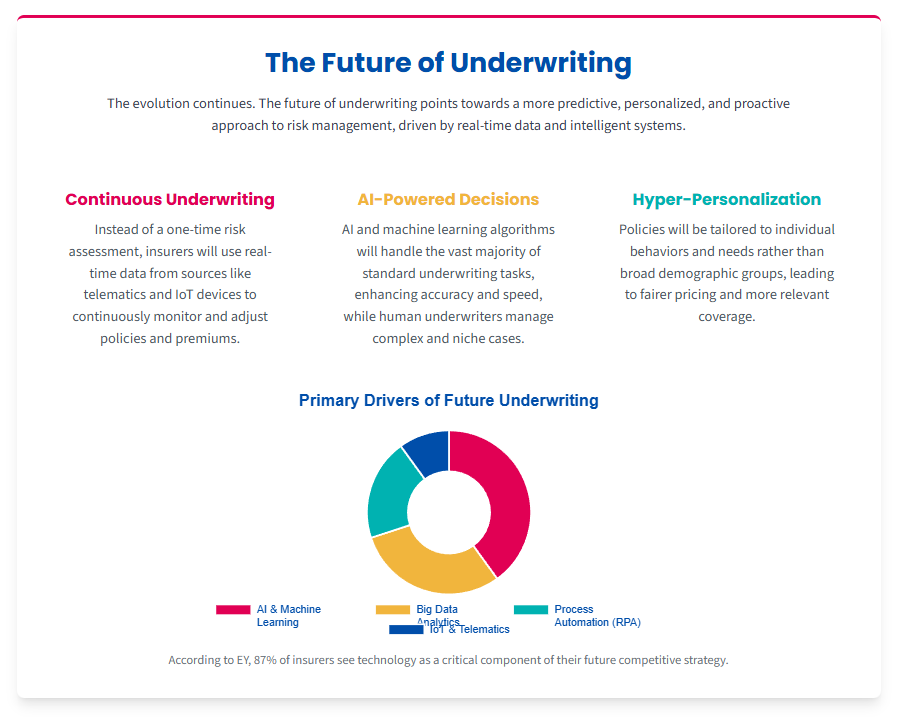
Underwriting then, now and in the future
Underwriting is the vital, historically grounded discipline of financial risk evaluation that underpins the entire insurance industry. Originating from the physical act of financial backers writing their names “under” risk descriptions at Lloyd’s, the function has evolved into a highly technical profession focused on capital preservation and precise risk assessment.
The modern underwriter role is crucial for stability, ensuring that premium rates are adequate to cover the four major components of cost: mean loss, volatility, uncertainty, and operations. The systematic underwriting process (from application review and data gathering to final policy approval) is now intrinsically linked to technology.
Strategic capacity expansion through delegated underwriting authority necessitates sophisticated governance and stringent compliance standards, making modern policy administration systems essential for efficient data management and oversight.
The future of underwriting is defined by the accelerated adoption of AI and machine learning in underwriting. While these algorithms promise to improve underwriting efficiency by up to 40% and enhance underwriting accuracy by up to 30%, the successful integration hinges on building underwriter trust, addressing ethical bias, and ensuring transparent data-driven underwriting decisions. The ultimate goal is a highly augmented human professional, freed from administrative burden, focusing expertise on navigating complex, emerging global risks.