The insurance industry, often perceived as a sector rooted in tradition, is currently experiencing an unprecedented transformation. This profound shift is largely driven by the rapid integration of artificial intelligence, fundamentally reshaping every aspect of its operations. From initial risk assessment to ongoing customer engagement, AI is redefining the very essence of insurance.
The Dawn of AI in Insurance
The insurance sector has a long and distinguished history of embracing technological advancements. Since the 1960s, the industry has consistently adopted new tools, evolving from manual processes to sophisticated digital systems involving punch cards, mainframes, tablets, and mobile phones. This continuous integration of technology has, in fact, formed the essential backbone of modern insurance operations, demonstrating an inherent capacity for innovation over many decades. This historical adaptability sets a crucial precedent for the industry’s current, widespread adoption of AI.
Artificial intelligence and machine learning represent the latest and most impactful frontier in this technological evolution, marking a significant paradigm shift. These advanced technologies are not merely incremental improvements; they are “revolutionizing the insurance industry, transforming it from the ground up”. This indicates a qualitative leap beyond simple efficiency gains, as AI is fundamentally reimagining the entire insurance process.
It moves beyond merely automating repetitive tasks, empowering insurers to predict risks with greater accuracy, personalize customer experiences, and operate with unmatched efficiency. This distinction is crucial, as AI enables entirely new capabilities and value propositions that were previously unattainable, positioning it as a strategic enabler of innovation rather than just a cost-cutting tool.
The Current State of AI Adoption: A Snapshot
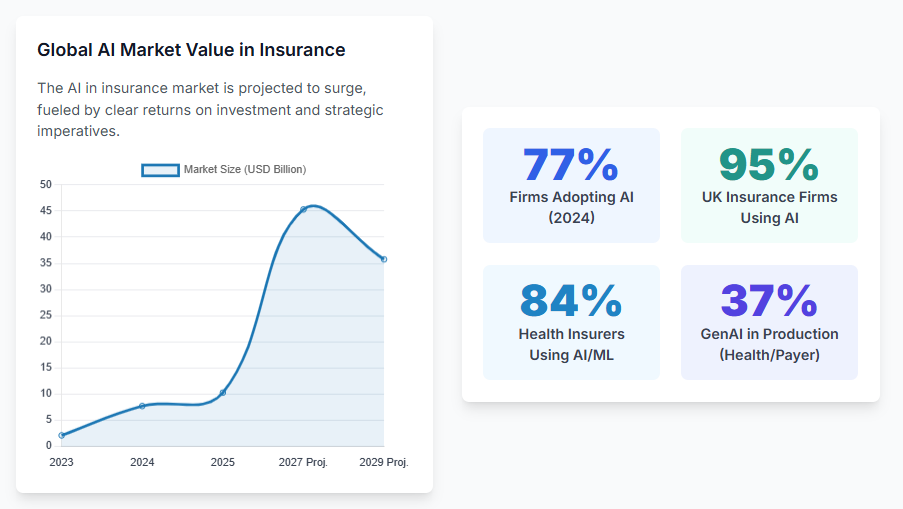
AI adoption within the insurance sector is now widespread, though the maturity of its implementation varies across different AI types and applications. A comprehensive survey conducted in 2024 revealed that 77% of senior executives in the insurance industry are in some stage of adopting AI, marking a significant 16-percentage-point increase from the previous year. This broad acceptance extends across various insurance lines, with 84% of health insurers, 88% of auto insurers, and 70% of home insurers currently utilizing or planning to explore AI and machine learning models in their operations. In the United Kingdom, the adoption rate is notably high, with 95% of insurance firms already employing AI.
However, the adoption of generative AI, a sophisticated subset of artificial intelligence, is still in its nascent stages for many carriers and agencies, with 30-41% actively exploring the technology. Conversely, health insurance and payer experts demonstrate a higher rate of generative AI in full production, reaching 37%. Notably, the South African insurance industry is emerging as a global leader in generative AI adoption, often serving as a benchmark for developed countries in terms of penetration and innovation. This widespread, yet varied, adoption underscores that while the industry broadly accepts AI, the integration of its most transformative forms is an ongoing process, presenting a strategic challenge in scaling new technologies alongside existing initiatives.
The insurance AI market is experiencing explosive growth and attracting substantial investment. The global insurance AI market saw investments reach $2.1 billion in 2023 and is projected to surge significantly, potentially surpassing $45.3 billion by 2027 or $35.76 billion by 2029. This trajectory is supported by impressive compound annual growth rates of 33.3% from 2024 to 2025 and 36.6% from 2025 to 2029. This substantial financial commitment is driven by the tangible benefits AI promises.
For instance, McKinsey estimates that generative AI could lead to productivity gains of 10-20%, premium growth of 1.5-3.0%, and an improvement in technical results by 1.5-3.0 percentage points. In the African context, generative AI is anticipated to unlock between $2.1 billion and $3.2 billion in economic value for insurers. These projections highlight that despite the early-stage nature of some generative AI applications, the compelling potential for return on investment is a primary catalyst for accelerated adoption and continued financial backing.
Consumer trust and acceptance of AI in insurance present a nuanced picture. While over 80% of respondents generally trust their insurers to handle data responsibly with AI tools, a notable segment of 22% expresses skepticism. This skepticism is reflected in the overall lower consumer trust in insurers (39%) compared to banks (50%) and health companies (46%) regarding data handling. However, consumer acceptance of AI increases significantly when tangible benefits are clearly demonstrated. For example, 46% of respondents support AI adoption if it leads to faster and more accurate claims processing.
Generational differences also play a role, with younger consumers (87% of Gen Z and Millennials) showing higher trust and preference for AI-enabled services compared to older generations (75% of Baby Boomers). Despite high satisfaction rates with AI-powered chatbots (74.5%) and the belief that AI shortens customer service wait times (73.8%), only 10% of consumers are comfortable relying solely on AI-powered chatbots. This underscores the continued importance of human interaction, especially for complex or emotionally sensitive situations. Underlying concerns persist regarding data privacy, fairness, and the potential impact of AI predictions on premiums.
This complex sentiment means that simply deploying AI is insufficient; insurers must actively communicate its value, ensure transparency in its application, and integrate it in a manner that augments human service rather than replacing it entirely, which is critical for fostering widespread customer acceptance and loyalty.
Table: AI Adoption & Market Growth in Insurance (2023-2029)
| Metric | 2023 | 2024 | 2025 | 2027/2029 |
|---|---|---|---|---|
| Global AI Market Value (USD Billions) | 2.1 | 7.71 | 10.27 | 45.3 (2027) / 35.76 (2029) |
| CAGR (YoY) | – | 33.3% (2024-2025) | 36.6% (2025-2029) | – |
| Firms Adopting AI (Overall) | 61% | 77% | – | – |
| Health Insurers Using AI/ML | – | 84% | – | – |
| UK Insurance Firms Using AI | – | 95% | – | – |
| GenAI in Production (Health/Payer) | – | 37% | – | – |
AI in Action: Transforming Core Insurance Functions
Artificial intelligence is fundamentally reshaping the core operations of the insurance industry. It drives significant efficiency gains, enhances decision-making, and improves customer interactions across the entire value chain. This pervasive influence is evident from the initial stages of policy issuance and underwriting to the complexities of claims management and post-claim services.
Underwriting and Risk Assessment
AI is revolutionizing the underwriting process by enabling rapid and comprehensive analysis of vast and diverse datasets. These datasets include traditional information like credit scores and historical claims data, alongside alternative sources such as social media activity, property records, and even aerial photography. This extensive data analysis allows for more precise risk assessment and the generation of highly accurate risk scores.
Furthermore, generative AI significantly enhances this process by efficiently extracting key insights from unstructured documents, summarizing complex information, and even drafting reports, thereby substantially reducing manual effort. The culmination of these capabilities is the generation of personalized policies and the development of dynamic pricing models that can adjust in real-time based on evolving risk factors, leading to more competitive and tailored offerings.
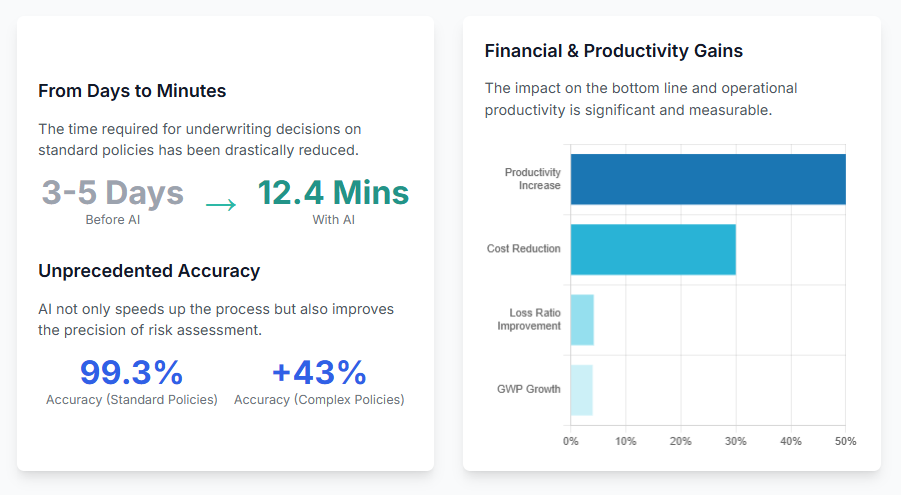
This enhanced analytical capability translates into remarkable quantitative benefits. For standard policies, AI has dramatically reduced the average underwriting decision time from 3-5 days to approximately 12.4 minutes, while maintaining an impressive 99.3% accuracy rate in risk assessment. For more complex policies, AI has contributed to a 31% reduction in processing time and a 43% improvement in risk assessment accuracy. This means that AI acts as a “second set of eyes” for underwriters, helping to identify details that might otherwise be missed.
Beyond speed and accuracy, AI drives significant financial improvements. Insurers leveraging AI in underwriting have reported Combined Ratio improvements of 3-6 percentage points, Loss Ratio improvements in the 2.1-4.2 percentage point range, and anti-selection of portfolio improvements of 10-15%. This translates to additional Gross Written Premium growth of 3-4%. The technology also reduces the administrative burden on underwriters from 30-40% of their time to less than 10%, freeing them to focus on strategic risk assessment and client relationship management.
McKinsey’s research indicates that AI can lead to 70% faster processing times and a 30% reduction in costs, with some reports suggesting up to a 50% increase in underwriter productivity. This is achieved by processing over 1,200 unique data points per application in real-time, significantly more than the 40-50 data points typically considered in traditional underwriting.
Table: AI’s Impact on Underwriting Efficiency & Accuracy
Metric | Before AI | With AI | Improvement |
|---|---|---|---|
| Avg. Decision Time (Standard Policies) | 3-5 days | 12.4 minutes | Up to 99% faster |
| Risk Assessment Accuracy (Standard Policies) | – | 99.3% | High accuracy maintained |
| Processing Time Reduction (Complex Policies) | – | 31% | – |
| Risk Assessment Accuracy (Complex Policies) | – | 43% | – |
| Operational Cost Reduction | – | Up to 30% | – |
| Underwriter Productivity Increase | – | Up to 50% | – |
| Loss Ratio Improvement | – | 2.1-4.2 percentage points | – |
Claims Processing and Fraud Detection
AI is revolutionizing claims processing by automating various stages, from initial reporting to final settlement. The AI market for claims processing alone is projected to grow from $514.3 million in 2024 to $2.76 billion by 2034, with an 18.3% CAGR. This growth is driven by significant efficiency gains: AI can reduce claims processing times from weeks to minutes, with some solutions achieving up to 90% reduction and 57% automation for large-scale operations, such as a US-based travel insurer handling 400,000 claims annually.
This drastically cuts down on manual errors and administrative delays, which traditionally cost the industry billions annually. Overall operational costs in the insurance sector are projected to decrease by 30-40% over the next decade due to AI-driven automation and analytics.
In fraud detection, AI is proving to be a game-changer. It can increase the identification of potentially fraudulent applications during the underwriting stage by 50% and prevent up to 90% of fraudulent claims overall. AI automation can also reduce fraud investigation time by up to 80%. Deloitte predicts that by implementing AI-driven technologies across the claims life cycle and integrating real-time analysis from multiple modalities, Property and Casualty insurers could save between US160 billion by 2032.
While soft fraud (inflating legitimate claims) has a detection rate of 20-40%, and hard fraud (creating false claims) is detected 40-80% of the time, AI’s ability to integrate multimodal data (text, images, audio, video) and detect subtle patterns and anomalies is significantly improving these rates. This proactive approach not only reduces financial losses but also streamlines processes for legitimate claims.
Table: AI-Driven Claims & Fraud Detection: Key Performance Metrics
Metric | Traditional | With AI | Improvement |
|---|---|---|---|
| Claims Processing Time | Weeks | Minutes | Up to 90% reduction |
| Operational Cost Reduction | – | 30-40% (over 10 years) | – |
| Fraud Detection (Underwriting Stage) | – | 50% increase in identification | – |
| Fraudulent Claims Prevention | – | Up to 90% | – |
| Potential Industry Savings (by 2032) | – | $80B-$160B | – |
Customer Experience and Engagement
AI is profoundly enhancing customer experience and engagement by enabling personalized services and faster response times. AI-powered chatbots and virtual assistants are now providing 24/7 support, handling routine inquiries, claims status updates, and premium adjustments. By 2025, it is estimated that 95% of customer interactions in the insurance industry could be facilitated by AI. User satisfaction with insurance chatbots is notably high, with 74.5% of users reporting satisfaction or very high satisfaction with their interactions.
Furthermore, 73.8% of respondents believe AI can shorten the time required to reach a customer service representative. Companies implementing AI chatbots have reported a 20% increase in customer satisfaction and a 30% reduction in response times.
AI’s ability to analyze customer behaviors, preferences, and historical data allows for highly personalized advice and policy recommendations. This level of personalization contributes to a 20-25% improvement in customer retention and satisfaction metrics. AI can even detect customer sentiment during interactions and recommend the next best action for human agents, ensuring more empathetic and effective service.
While AI significantly improves speed and personalization, it is crucial to note that customers are not yet ready to forgo human connection entirely; only 10% are comfortable relying solely on AI-powered chatbots, despite 59% expecting 24/7 live customer support. This underscores the continued importance of human interaction, especially for complex or emotionally sensitive situations.
The transformative power of AI extends beyond mere efficiency, enabling a fundamental shift in the insurance business model. By 2030, the industry is projected to transition from a reactive “detect and repair” model to a proactive “predict and prevent” approach. This means insurers will increasingly leverage AI to mitigate risks before they turn into claims, using real-time data from IoT devices and telematics to offer proactive guidance and personalized preventative measures. This shift positions insurers as trusted partners in prevention rather than just claim processors, fostering deeper customer relationships and contributing to long-term profitability.
Navigating the Complexities: Challenges and Regulatory Landscape
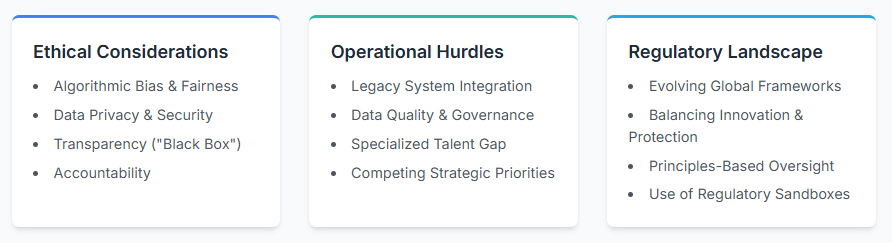
Despite the immense opportunities, the widespread adoption of AI in insurance is accompanied by significant ethical considerations, operational hurdles, and an evolving regulatory landscape that demands careful navigation.
Ethical Considerations
The ethical implications of AI in insurance are paramount, largely centered around issues of bias, data privacy, and transparency. A primary and widely acknowledged concern is the potential for AI systems to perpetuate and even amplify existing societal biases if they are trained on biased historical data. This can lead to unfair or discriminatory outcomes in critical areas such as risk assessment and pricing. Such biases raise the potential for “financial exclusion,” where certain individuals or groups might be unfairly priced out of the market or denied coverage.
Regulators are actively addressing concerns about “proxy discrimination,” where AI models might inadvertently use proxies for protected characteristics. The ultimate risk is that AI could render some individuals “uninsurable” due to algorithmic unfairness.
Data privacy and security are also top concerns, with 65% of participants citing privacy as a major issue. The immense volumes of sensitive personal data processed by AI systems create significant data privacy and security concerns. Risks include AI inference inadvertently exposing sensitive personal information, data being repurposed without explicit user awareness or consent (thereby violating fundamental purpose limitation principles), and the potential for unintended data memorization and leakage, particularly with the use of generative AI models. Ensuring compliance with stringent data protection regulations, such as GDPR, is paramount to maintaining client trust and avoiding legal repercussions.
The “black box” problem, referring to the lack of transparency and explain-ability in how some AI algorithms arrive at their decisions, poses a significant challenge to trust and accountability. This inherent lack of transparency complicates regulatory compliance, erodes consumer trust, and makes it challenging to identify, diagnose, and rectify errors or biases within the system. Clients increasingly expect to be informed about the use of AI in decisions affecting them and to receive clear explanations for those outcomes.
The complexity and opacity of AI systems can obscure the lines of accountability when errors occur or when consumer harm results from an AI-driven decision. Establishing clear frameworks for accountability for AI systems, defining who is responsible at each stage of the AI lifecycle, is therefore essential to ensure responsible deployment and to provide avenues for redress.
Finally, there are concerns about over-reliance on automation leading to a loss of the human touch, potentially reducing customer satisfaction and loyalty. Industry leaders emphasize that AI should augment, not replace, human roles, allowing people to focus on tasks requiring empathy and nuanced judgment. Addressing potential job displacement also remains a consideration.
Operational Hurdles
Beyond ethical considerations, insurers face several practical operational hurdles in scaling AI. Legacy systems represent a significant challenge, as AI models demand high-speed data processing and real-time analytics that on-premise, outdated infrastructures often cannot support. A transition to cloud-based environments is often necessary to unlock AI’s full potential.
Data quality is another critical issue. The adage “garbage in, garbage out” perfectly encapsulates the problem: imperfect, inconsistent, or missing data can seriously impact AI model performance. Robust data modernization is a foundational element for AI success.
The talent gap is consistently cited as a major concern, with fears of falling behind without the necessary expertise. There is a pressing need for upskilling underwriters, data scientists, and other professionals to effectively collaborate with and manage AI systems. Furthermore, AI initiatives often compete with “other strategic objectives” for resources and attention, hindering their full adoption and scaling. Leadership and governance readiness has also been noted as lagging behind the rapid pace of AI development, and resistance to using generative AI due to unfamiliarity can impede progress within organizations.
Evolving Regulatory Frameworks
Regulatory bodies worldwide are actively grappling with how to govern AI in financial services, including insurance, seeking to balance innovation with consumer protection.
United States (NAIC): The National Association of Insurance Commissioners (NAIC) has been proactive, adopting AI Principles in 2020 and a Model Bulletin on the Use of AI Systems by Insurers in December 2023. These guidelines promote accountability, transparency, security, and privacy. The impact is evident: a May 2025 survey found that nearly 92% of surveyed U.S. health insurers align their governance principles with the NAIC’s framework. The Model Bulletin has been widely adopted by nearly 30 states.
The NAIC’s Big Data and Artificial Intelligence (H) Working Group continues its work, having released a Request for Information (RFI) to explore a potential model law for corporate governance, transparency, and consumer protection related to AI. The NAIC has also expressed strong opposition to a proposed federal moratorium on state AI regulation, advocating for continued state-based oversight and federal-state collaboration. Specific state-level legislation, such as Colorado’s, mandates anti-discrimination testing for AI models.
United Kingdom (FCA, PRA, ABI, Lloyd’s): UK regulators, including the Financial Conduct Authority (FCA) and the Prudential Regulation Authority (PRA) (part of the Bank of England), are adopting a “tech-positive” approach. The FCA’s five-year strategy (2025-2030) emphasizes relying on existing frameworks like the Consumer Duty and Senior Managers and Certification Regime (SMCR), rather than introducing new AI-specific regulations.
To foster safe innovation, the FCA is launching a Live AI Testing Environment (September 2025) and a Supercharged Sandbox (October 2025) for firms to experiment with AI in a controlled setting. The Association of British Insurers (ABI) is actively promoting responsible AI innovation, guided by the UK government’s five principles: Accountability, Transparency, Fairness, Safety and Contestability & Redress. Lloyd’s of London, while recognizing AI’s transformative potential, highlights ongoing challenges related to talent, governance, and data quality within the market.
South Africa (FSCA, SAIA): In South Africa, the Financial Sector Conduct Authority (FSCA) is developing its regulatory approach to AI. Its 2025-2028 Regulatory Strategy emphasizes agile regulation, keeping pace with AI developments, and leveraging supervisory technology, including an Integrated Regulatory Solution, for enhanced data analysis and risk-based supervision. The FSCA plans to publish a market study on AI adoption in 2025, with a focus on consumer protection and ethical use. The South African Insurance Association (SAIA) acknowledges that advancements in technology, including AI, are revolutionizing business but also pose significant risks, particularly related to cyber threats, client data, and business systems.
Across these jurisdictions, the consistent emphasis on principles-based, technology-agnostic approaches to AI regulation is clear. Regulators aim to apply existing laws to AI, focusing on outcomes rather than prescriptive rules. However, the varied implementation strategies-from model laws to sandboxes-highlight the complexity of regulating a rapidly evolving technology. The existence of regulatory sandboxes indicates a proactive, experimental approach to regulation, fostering innovation while maintaining oversight.
The Future Vision: Human-Led, Tech-Powered Insurance
The future of insurance is increasingly envisioned as a human-led, tech-powered ecosystem, where AI serves as a powerful augmentation tool rather than a replacement for human expertise. Industry leaders consistently articulate that AI will not replace humans, but rather, “those who use AI will replace those who don’t”. This perspective frames AI as a force that augments human capabilities, empowering professionals to perform deeper analysis and focus on higher-value tasks.
The automation of routine processes by AI agents frees human agents to engage in complex, empathetic interactions, ultimately leading to better customer outcomes. This collaborative model is central to the concept of a “human-led, tech-powered” future for the industry.
A significant shift is underway from a reactive “detect and repair” model to a proactive “predict and prevent” approach, projected to be fully realized by 2030. AI is the key enabler of this transformation, allowing insurers to leverage vast datasets and real-time information to mitigate risks before they escalate into claims. This proactive stance redefines the insurer-customer relationship, positioning insurers as trusted partners in prevention rather than just claim processors, fostering deeper customer relationships and contributing to long-term profitability.
For insurers to unlock the full potential of AI, strategic investment and collaboration are paramount. The true transformative impact will come from integrating disparate AI use cases into holistic, seamless, end-to-end solutions, rather than pursuing siloed projects. This includes balancing the value derived from traditional AI (estimated at 60-80% of overall AI value) with the emerging potential of generative AI (20-40%), ensuring that generative AI complements existing AI capabilities.
The emphasis is on becoming a “smart adopter” rather than simply the fastest. This requires a deliberate strategy, focusing on building robust foundational capabilities, establishing clear governance frameworks, and proactively addressing the talent gap through upskilling and strategic hiring. A rushed or poorly governed AI implementation risks creating more problems than benefits, highlighting the importance of a well-thought-out AI strategy that balances innovation with rigorous risk management.
Embracing the AI Era Responsibly
The insurance industry stands at a pivotal juncture, poised for unprecedented transformation driven by artificial intelligence. From revolutionizing underwriting and streamlining claims processing to enhancing fraud detection and personalizing customer experiences, AI offers a remarkable opportunity to create substantial value across the entire insurance value chain. The financial upside is clear, with projections indicating exponential market growth and significant productivity gains.
However, realizing this potential hinges on a balanced approach that embraces innovation while diligently managing the inherent complexities. The pervasive concerns around data bias, privacy, transparency, and accountability underscore that ethical AI is not merely a regulatory compliance burden but a fundamental business imperative. Building trust through transparent and responsible AI deployment is paramount for customer acceptance and long-term market leadership. Regulators across the US, UK, and South Africa are converging on principles-based, technology-agnostic frameworks, emphasizing fairness, accountability, and data protection, often through collaborative initiatives like regulatory sandboxes.
The path forward demands strategic foresight. Insurers must prioritize overcoming operational hurdles such as legacy systems, data quality issues, and the talent gap, recognizing their interconnectedness. The future of insurance is indeed “human-led, tech-powered,” where AI augments human capabilities, allowing professionals to focus on complex, empathetic interactions while automated systems handle routine tasks. To thrive in this evolving landscape, insurers must adopt AI strategically, with robust governance and human expertise at the core, thereby driving sustainable value and securing a competitive future in the AI era.
Frequently Asked Questions (FAQs)
Q1: What is Artificial Intelligence (AI) in insurance? A1: AI in insurance refers to the application of artificial intelligence techniques and algorithms, including machine learning, natural language processing, and computer vision, to various aspects of the insurance industry. Its uses span risk assessment, underwriting, claims management, customer service, and fraud detection, aiming to streamline operations and improve decision-making.
Q2: How is AI transforming the underwriting process? A2: AI is revolutionizing underwriting by enabling rapid analysis of vast datasets, including traditional and alternative sources like social media and aerial photography. This leads to more precise risk assessment, personalized policies, and dynamic pricing. It has reduced average decision times for standard policies from days to minutes, with high accuracy.
Q3: What are the key benefits of AI in claims processing? A3: AI significantly streamlines claims processing by automating tasks from initial reporting to settlement. It cuts down processing durations from weeks to minutes, achieves high automation rates, and cuts down on manual errors. This leads to substantial operational cost reductions and improved customer satisfaction due to quicker resolutions.
Q4: How does AI help in fraud detection? A4: AI is a powerful tool in combating insurance fraud by leveraging sophisticated machine learning algorithms to identify subtle, unusual patterns and anomalies within vast datasets that human review might miss. It can cross-check claim data, pinpoint inconsistencies, and flag suspicious activities in real-time, preventing fraudulent payouts and saving billions of dollars for insurers.
Q5: What are the main ethical concerns regarding AI in insurance? A5: Key ethical concerns include the potential for AI systems to perpetuate biases if trained on flawed data, leading to discriminatory outcomes in pricing or coverage. Data privacy and security are also major issues due to the sensitive nature of personal data processed. Additionally, the “black box” nature of some AI models raises concerns about transparency and accountability.
Q6: How are regulators addressing AI in the insurance industry? A6: Regulatory bodies in the US (NAIC), UK (FCA, PRA), and South Africa (FSCA) are developing frameworks to balance innovation with consumer protection. Their approaches are generally principles-based and technology-agnostic, focusing on applying existing laws to AI. They emphasize accountability, transparency, fairness, and data privacy, often through initiatives like regulatory sandboxes.
Q7: Will AI replace human jobs in the insurance sector? A7: The prevailing view is that AI will augment, rather than replace, human roles in insurance. AI automates repetitive, low-value tasks, freeing human professionals to focus on more complex, strategic, and empathetic activities that require nuanced judgment. The future is envisioned as a “human-led, tech-powered” ecosystem.
Q8: What is the projected growth of the AI in insurance market? A8: The global AI in insurance market is experiencing explosive growth. Investments reached $2.1 billion in 2023 and are projected to surpass $45.3 billion by 2027 or $35.76 billion by 2029, with compound annual growth rates exceeding 33%. This growth is fueled by the tangible benefits AI offers in efficiency, accuracy, and customer contentment.
References:
- Insurance Thought Leadership, “Insurance: An Industry Embracing AI”.
- EWSolutions, “How the Insurance Industry Uses Artificial Intelligence”.
- Sutherland Global, “The Evolution of AI in Insurance”.
- NAIC, “NAIC Survey Reveals Majority of Health Insurers Embrace AI”.
- NAIC, “Artificial Intelligence”.
- Bank of England, “Artificial intelligence in UK financial services – 2024”.
- Wolters Kluwer, “2025 insurance tech trends: AI, big data and cautious adoption”.
- Mail & Guardian, “South African insurance sector leads global innovation in Generative AI”.
- ResearchGate, “THE EVOLUTION OF AI IN INSURANCE UNDERWRITING: A TECHNICAL DEEP DIVE”.
- The Business Research Company, “Artificial Intelligence (AI) For Insurance Market Overview 2025–2034: CAGR Trends, Long-Term Growth Paths, and Business Implications”.
- The Business Research Company, “Ai For Insurance Market Report 2025 – Trends And Outlook To 2034”.
- McKinsey & Company, “The potential of Gen AI in insurance: Six traits of frontrunners”.
- Swiss Re, “Consumer trust, data sharing and AI in insurance survey”.
- Genpact, “Genpact Study Shows Insurance Customers Embrace AI When Value and Benefits Are Clearly Demonstrated”.
- Insurance Business Magazine, “AI in insurance praised, but consumers still aren’t convinced – GlobalData”.
- ResearchGate, “ARTIFICIAL INTELLIGENCE IS TRANSFORMING THE INSURANCE INDUSTRY: INTRODUCING INNOVATIVE METHODS THAT REVOLUTIONIZE THE BUYING PROCESS FOR CUSTOMERS”.
- Earnix, “How to Utilize AI in Insurance Underwriting”.
- BizTech Magazine, “How Artificial Intelligence Is Transforming the Insurance Underwriting Process”.
- Teague Insurance, “How AI Will Shape the Future of Insurance: Insights for Business Owners”.
- SG Analytics, “Artificial Intelligence in Insurance Industry”.
- BizTech Magazine, “What are the specific quantitative benefits of AI in insurance underwriting?”.
- Market.us, “AI in insurance claims processing market”.
- Market.us, “AI in insurance claims processing Market Size | CAGR of 18%”.
- Shift Technology, “AI in Insurance Claims for Faster Processing and Accuracy”.
- Decerto, “Streamlining Insurance Claims Processes with AI and Machine Learning”.
- Susco Solutions, “How AI Is Eliminating Inefficiencies in Insurance Claims”.
- Biz4Group, “AI Insurance Fraud Detection: Prevent 90% of Fraudulent Claims”.
- Deloitte, “AI to Fight Insurance Fraud”.
- Maddyness UK, “Why AI is essential (and exciting!) for the insurance industry’s future”.
- Emerj, “Leveraging AI for Better Insurance Outcomes: From Risk Management to Customer Care – Mark McLaughlin, IBM”.
- Avenga, “Integrating AI for Smarter Risk Assessment”.
- Wisedocs, “AI Trends in 2025 for the Insurance, Legal, and Medical Space”.
- XenonStack, “Agentic AI in Insurance Claims: Revolutionizing Efficiency and Customer Experience”.
- Exance, “The Use of AI in the Insurance Industry: Opportunities, Pitfalls, and Ethical Considerations for Brokers”.
- ABI, “ABI launches new guide to help firms use AI responsibly”.
- NAIC, “Final-CR-Report-AI-and-Health-Insurance-11.14.24.pdf”.
- III, “Pioneering Ethical AI: The Crucial Role of Insurers”.
- Ethics and Insurance, “The Problem with Most Responsible AI Initiatives”.
- Usercentrics, “What Your Company Needs To Know About AI And Data Privacy”.
- CYBAEA.NET, “Why smart insurance executives are afraid of AI (and why they are not wrong)”.
- Kennedys Law, “The Current and Future Impacts of AI in the Insurance Sector”.
- The Actuarial Post, “Artificial Intelligence and the Lloyd’s Actuary: A Snapshot of Opportunity and Risk”.
- American Bar Association, “AI in Insurance Underwriting: Can Artificial Intelligence and Predictive Analytics Identify Risks Better Than Humans?”.
- INLE Risk Management, “Experts: AI Could Slash The Insurance Claims Process, But…”.
- Deloitte, “Scaling Gen AI in Insurance”.
- Time, “15 Quotes on the Future of AI”.
- McKinsey & Company, “How P&C insurers can successfully modernize core systems”.
- PwC, “Artificial Intelligence”.
- Holland & Knight, “The Implications and Scope of the NAIC Model Bulletin on the Use of AI by Insurers”.
- McDermott Will & Emery, “Update on NAIC’s Consideration of AI Model Law for Insurers”.
- InsureReinsure, “NAIC Responds to Proposed 10-Year Moratorium on State Regulation of AI in One Big Beautiful Bill Act”.
- Clifford Chance, “Insurance sector – AI regulation update”.
- Debevoise & Plimpton LLP, “Europe’s Regulatory Approach to AI in the Insurance Industry”.
- Pinsent Masons, “FCA AI ‘sandboxing’ strategy a positive step for financial services”.
- Regulation Tomorrow, “FCA announces launch of Supercharged Sandbox”.
- Lloyd’s Market Association, “Artificial Intelligence”.
- FSCA, “FSCA Regulatory Strategy 2025–2028”.
- FSCA, “FSCA publishes Its Regulatory Strategy for 2025 – 2028”.
- National Treasury, “Annexure E”.
- Moonstone, “FSCA discloses approach to regulating a rapidly changing financial sector”.
- SAIA, “SAIA Annual Review 2024”.
- SAIA, “SAIA Annual Review 2019”.
- PwC, “Transforming insurance claims processing: PwC AI integration”.
- Deloitte, “Generative AI in Insurance”.