

The UK insurance sector is navigating a period of profound transformation, characterised by rapid technological advancements, evolving customer expectations, and a complex interplay of economic and geopolitical factors. While the insurance market is experiencing a general softening driven by increased capacity and disciplined underwriting, underlying challenges such as sophisticated claims fraud and persistent cyber threats demand proactive and innovative responses.
This report explores the pivotal insurance trends shaping the insurance industry in 2025, from the pervasive impact of automation and open architecture to the critical imperatives of enhancing customer experience and mitigating evolving risks. Success in the future of insurance hinges on strategic investment in data-driven capabilities, fostering agility, and embracing a truly customer-centric approach, all while adhering to robust regulatory frameworks within the insurance sector.
Key Insights and Recommendations
- Technological Imperative: Digital transformation, particularly through automated workflows, open architecture, no-code tools, and microservices, is no longer optional but essential for operational efficiency, accelerated product development, and enhanced customer engagement across the insurance industry.
- Data as a Strategic Asset: Advanced data strategies and analytical capabilities are key to unlocking growth opportunities, improving risk assessment, combating fraud, and delivering hyper-personalised experiences, defining a major insurance trend.
- Customer-Centricity Redefined: Clarity, ease, and hyper-personalisation in customer journeys are paramount for building loyalty and driving renewals in a competitive insurance market, highlighting a key insurance trend for the future of insurance.
- Resilience through Proactivity: Continuous investment in cyber security, robust data protection, and adaptable risk mitigation strategies are vital to navigate an increasingly volatile risk landscape for the entire insurance sector.
- Navigating Regulatory Evolution: Adherence to evolving regulatory requirements, such as those from the Financial Conduct Authority (FCA), must be integrated into strategic planning, not merely treated as a compliance burden for the insurance industry.
The UK insurance sector, a cornerstone of the nation's economy, stands at a pivotal juncture. As we look towards 2025, the insurance industry is grappling with a multifaceted array of forces that are fundamentally reshaping its operations, competitive dynamics, and engagement with customers. From global macroeconomic shifts to the accelerating pace of technological innovation, insurers face both significant challenges and unparalleled opportunities for growth and transformation, all part of the overarching insurance trends defining the future of insurance.
The Current State of the Insurance Market
The beginning of 2025 has seen a notable shift in global and UK insurance market conditions. Aon's Q1 2025 Global Insurance Market Overview highlights a welcome source of stability amidst geopolitical turbulence, with a softening trend accelerating for well-performing risks. This has resulted in ample capacity, strong competition, and generally flat-to-modestly-down pricing in wide portions of the insurance market, with exceptions for highly volatile products, industries, and geographies.
This softening is particularly evident in the UK, where Aon's UK Insurance Market 2024 report indicated potential average pricing reductions between 11% and 20% throughout 2024, a trend expected to continue into 2025. Property rates globally decreased by 6% in Q1 2025, with the UK seeing a 6% decline, according to Marsh's Global Insurance Market Index. This follows seven years of quarterly increases, marking the third consecutive quarter of global rate decline. These are vital insurance trends to monitor.
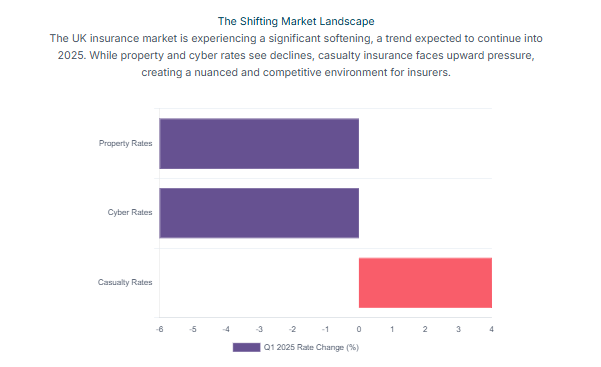
This period of insurance market softening, while advantageous for buyers, presents a nuanced picture for the insurance industry. The current favourable conditions are primarily attributable to insurers' retained earnings rather than a significant influx of new capital into the market. This underlying dynamic suggests that while pricing is currently competitive, the insurance market remains susceptible to sudden shifts. For instance, the upcoming 2025 Atlantic hurricane season or other major natural catastrophe losses could swiftly impact insurer growth appetite and potentially reverse the softening trend.
This situation compels insurers to leverage the current environment for strategic growth and customer acquisition, while simultaneously maintaining disciplined underwriting and robust capital management to prepare for potential market hardening. Clients, in turn, are encouraged to explore long-term agreements and alternative risk transfer solutions to future-proof their insurance programmes against traditional market cycles. These dynamic insurance industry trends demand constant vigilance.
Forces Reshaping the Insurance Industry
Several powerful forces are compelling the UK insurance industry to innovate and adapt, fundamentally shaping the future of insurance:
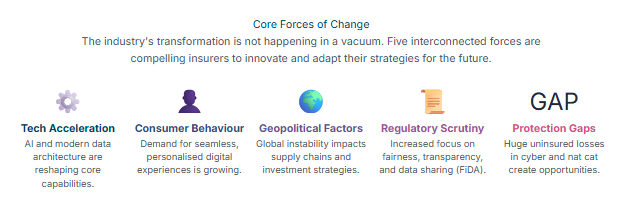
- Accelerated Technology Change: The advent of generative artificial intelligence (GenAI) and agentic AI is rapidly transforming capabilities in risk assessment, pricing, and customer interaction. Leading insurers are actively investing in emerging trends in insurance technology to achieve strategic business objectives, specifically modernising data architecture to integrate real-time data for automated underwriting and personalised offerings. This technological acceleration is not merely about efficiency; it is fundamentally altering how insurers operate and interact with their customers, a key insurance trend.
- Evolving Consumer Behaviour: Customers increasingly expect personalised experiences and seamless digital interactions, drawing comparisons to other online shopping experiences. This shift in consumer expectations demands a move from traditional advisor-led models to more integrated, end-to-end protection and service offerings, reflecting a broader demand for convenience and customisation in the insurance sector. This is a significant insurance trend impacting service delivery.
- Geopolitical and Macroeconomic Turbulence: Global instability, including wars, armed conflicts, rising trade tensions, and slowing economic growth, presents new complexities for the insurance sector. These factors directly impact supply chains, investment portfolios, and overall market stability. A striking 98% of CEOs plan to alter strategic investment plans due to geopolitical challenges, highlighting the pervasive influence of these external forces on strategic decision-making within the insurance industry. This global insurance trend requires strategic foresight.
- Increased Regulatory Scrutiny: Regulatory changes across regions significantly influence the competitive environment and innovation priorities within the insurance industry. For example, the EU Financial Data Access (FiDA) legislation, slated for 2025, is poised to pave the way for consent-based data sharing across various financial services, creating new opportunities for firms to expand their offerings and foster greater interoperability.In the UK, the Financial Conduct Authority (FCA) is actively reinforcing customer fairness and transparency regulations, particularly concerning Consumer Duty, which places a heightened emphasis on consumer outcomes. These regulatory shifts compel insurers to embed compliance deeply within their operational and strategic frameworks, influencing the future of insurance.
- Protection Gaps: Significant gaps in protection against critical risks persist globally. For instance, 99% of losses from cyberattacks and 60% from natural disasters remain uninsured, revealing substantial unmet needs in the insurance market. Furthermore, the global retirement savings gap is projected to grow dramatically, from US$106 trillion in 2022 to an estimated US$483 trillion by 2050.These considerable protection gaps represent compelling value creation opportunities for insurers, driving demand for innovative and tailored solutions, highlighting a crucial insurance trend for growth in the insurance sector.
Table 1: UK Insurance Market Conditions (Q1 2025 Snapshot)
| Metric | Global Trend (Q1 2025) | UK Specific Trend (2024-2025 Outlook) | Driving Factors |
|---|---|---|---|
| Overall Rates | -3% decline (Marsh composite rate, 3rd consecutive quarter) | 11-20% average pricing reductions in 2024, expected to continue into 2025 | Strong insurer financial performance, increased capacity, aggressive growth targets |
| Property Rates | -6% decline globally | -6% decline in UK; 10-15% rate reductions in 2024, expected to continue into 2025 | Robust competition, plentiful capacity, positive treaty renewals |
| Casualty Rates | +4% increase globally, led by US (+8%) | Softening expected for less complex risks, but U.S. exposure remains cautious due to litigation | Severity of claims, large jury verdicts ("nuclear verdicts"), social inflation |
| Cyber Rates | -6% decline globally | Softening trend expected to continue | Increased capacity, improved client preparedness against ransomware |
| Competition | Increased insurer competition | Heightened competition, new entrants, existing insurers expanding positions | Insurers pursuing aggressive growth targets |
| Capacity | Ample capacity | Noticeable market capacity increase | Positive insurer financial performance |
Technological Transformation: Driving Efficiency and Innovation in the Insurance Sector
The insurance industry's embrace of technology is accelerating, moving beyond incremental improvements to fundamental re-engineering of operations and customer interactions. This technological imperative is reshaping every facet of the insurance value chain, from product development to claims processing, marking a definitive insurance trend for the future of insurance.
Automated and Configurable Workflows
The adoption of automated and configurable workflows is revolutionising operational efficiency across the insurance sector. Modern insurance software with workflow capabilities enables insurers to automate approvals, significantly reduce repetitive tasks, and gain real-time visibility into the movement of documents, forms, and policies. This shift from manual, untrackable processes to intelligent, audit-ready flows is crucial for overcoming delays and inefficiencies, a key insurance industry trend.
Automating insurance claims workflows, for instance, can reduce processing time by up to 50% and lower operational costs by 20-30% through reduced human effort and delays, according to Feathery. Underwriting, often a bottleneck due to repetitive data checks and siloed approvals, becomes faster, more repeatable, and audit-ready with workflow automation, leading to consistent assessments and quicker turnaround times.
Beyond claims and underwriting, automation extends to quote generation, agent and broker onboarding, and regulatory disclosures, ensuring compliance by design with full traceability of actions. A study highlights that standardising and automating insurance workflows can increase customer satisfaction by an impressive 90%, primarily by reducing uncertainty and resolution times. This demonstrates that workflow automation is not merely about internal efficiency, but also a powerful driver of enhanced customer trust and experience within the insurance sector.
- Underlying Trend: The move towards automated workflows reflects a broader insurance industry trend of digitalising core processes to overcome the limitations of legacy systems and manual operations. This is driven by the need for speed, cost reduction, and improved customer satisfaction in insurance.
- Interconnectedness: Automated workflows are deeply interconnected with improved data sharing and system coordination. Without automation, disparate systems lead to manual data transfer and communication breakdowns. Workflow automation integrates data and systems at the business process level, breaking down segmentation and improving coordination across the enterprise.This integrated approach ensures that information flows seamlessly, relieving staff from mundane data updates and allowing them to focus on more complex tasks, further defining future insurance trends.
Connectivity, Interoperability, and Open Architecture
The insurance sector is increasingly moving towards an open ecosystem model, driven by the principles of connectivity, interoperability, and open architecture. This transformation is essential for digitisation and innovation, moving away from traditional closed and stratified legacy systems, marking a significant insurance trend.
Open Insurance, facilitated by standardised and interoperable APIs (Application Programming Interfaces), enables insurance companies and other industry players to share personal and non-personal data securely. This data can include Know Your Customer (KYC) information, premiums paid, coverage details, claims reporting, and even data from IoT sensors.
For customers, the benefits are tangible: greater choice of innovative products, simpler product comparison across providers, and increased transparency and ease when switching insurers. While this fosters collaboration and new product creation, it also raises important considerations regarding data access reciprocity, particularly with large technology companies, and potential risks to consumers. This embrace of open architecture is a crucial insurance industry trend.
Beyond data exchange, UI (User Interface) interoperability is addressing a critical gap in enterprise technology. Historically, significant investment has gone into back-end system integration, but front-end applications often remain disconnected, forcing users to manually transfer data between systems – a process colloquially known as "swivel-chair integration".
UI interoperability enables front-end applications to communicate directly, eliminating repetitive manual tasks, reducing process lag time, and enabling seamless cross-application workflows. This approach supports the use of best-of-breed applications without the costly and time-consuming need to consolidate core functions into monolithic platforms, thereby increasing agility and efficiency in the insurance sector.
- Broader Implication: The shift towards open architecture and interoperability signifies a fundamental change in how insurance products are designed, distributed, and serviced. It enables embedded insurance solutions, where insurance becomes a seamless part of other purchase ecosystems, as noted by KPMG. This interconnectedness, driven by enhanced connectivity, is not just a technical upgrade; it is a strategic move towards a more collaborative and customer-centric insurance industry, impacting all insurance trends.
No-Code Product Building Tools
No-code product building tools are democratising innovation within the insurance industry, empowering business users to create and adapt core systems with unprecedented speed and ease. These platforms significantly reduce development timelines, allowing insurers to respond swiftly to market demands, regulatory changes, and evolving customer expectations, reflecting a pivotal insurance trend.
The advantages are multifaceted for the insurance sector:
- Accelerated Time to Market: Intuitive visual interfaces and pre-built templates enable rapid application development, reducing implementation from months to weeks or even days, addressing a critical need in the insurance market.
- Enhanced Business Agility: Non-technical staff, often referred to as "citizen developers," can design and implement workflows and adjust processes themselves, reducing reliance on IT departments and fostering greater adaptability for the insurance industry.
- Cost Efficiency: Fewer technical resources are required for building and updating applications, leading to reduced development and maintenance costs, a positive insurance trend.
- Improved Customer Experience: The ability to quickly tailor workflows and interfaces enables personalised customer journeys and faster service delivery across omnichannel touchpoints, enhancing the insurance customer experience.
- Democratised Innovation: Cross-functional teams can contribute ideas and solutions without programming expertise, facilitating rapid prototyping and experimentation with new ideas without heavy investment, propelling the future of insurance.
This approach allows insurers to offer relevant digital solutions that solve business problems while undergoing phased digital transformation, rather than costly and risky complete overhauls of legacy systems. The empowerment of citizen developers also promotes talent diversity, freeing up highly skilled technical resources to focus on more complex challenges such as security, fraud detection, and data analytics.
The adoption of no-code product building is no longer a luxury but a necessity for competitive advantage, although its successful implementation requires cultural changes and adequate training for citizen developers, influencing many insurance trends. These tools are particularly impactful for policy administration software.
Microservices
Microservices architecture is fundamentally transforming how insurance applications are developed and deployed, offering significant advantages in scalability, flexibility, and speed to market. This architectural style breaks down large, monolithic applications into smaller, independently deployable, and manageable services, each specialised for a specific purpose within the insurance industry. This is a major insurance trend driving modern development.
Key benefits of adopting microservices include:
- Scalability and Flexibility: Insurance applications often experience fluctuating demands, such as peak claims processing after a natural disaster. Microservices allow individual services to scale up or down independently based on demand, optimising performance and resource usage without affecting other functions, crucial for the insurance sector.
- Faster Time to Market: The independent development of each service enables quicker deployment of new features and updates, crucial in the competitive insurance landscape. This enables quicker response to emerging trends in insurance.
- Easier Maintenance and Upgrades: Individual services can be updated or replaced without disrupting the entire system, reducing downtime and minimising errors. This also simplifies compliance with changing regulations in the insurance industry.
- Improved Security and Compliance: Specific security measures can be applied to each microservice based on its function, ensuring adherence to necessary compliance and security standards for sensitive customer data within the insurance sector.
- Enhanced Fault Tolerance: If one service fails, others continue to function, ensuring higher availability and minimal disruption, which is vital for continuous operations in insurance.
- Cost Efficiency: Insurers only pay for the resources that specific services require, leading to better cost management, a positive insurance trend.
In claims processing, microservices enable the division of complex tasks like document submission, fraud detection, and payment processing into smaller, efficient units, leading to faster resolution and improved customer satisfaction for the insurance industry.
For policy management, processes such as underwriting, renewals, and amendments can be broken into distinct services, allowing for rapid adaptation to market changes or the introduction of new policy types by updating only a single service. The adoption of microservices is becoming essential for insurers to keep pace with the speed of digital transformation without compromising the integrity of their core systems, a critical insurance trend for the future of insurance.
Addressing Key Challenges: Insurance Claims Fraud and Risk Mitigation
While technological advancements offer immense opportunities, the insurance sector continues to grapple with persistent and evolving challenges, particularly in insurance claims fraud and broader risk mitigation. These are constant insurance trends that demand attention.
Insurance Claims Fraud
Insurance claims fraud remains a significant and growing concern for the UK insurance industry, with fraudsters continually adapting their tactics. In 2024, Aviva reported a 14% increase in detected claims fraud, stopping over 12,700 fraudulent claims valued at £127 million. This equates to approximately 35 bogus claims per day, totalling around £349,000.
This rise follows a substantial 39% increase in detected claims fraud in 2023. Furthermore, Aviva identified fraud in more than 98,000 insurance applications, nearly double the amount detected in the previous year. Gov.uk also reported detecting 84,400 fraudulent claims worth £1.1 billion in 2023, a 16% increase in detected claims compared to the previous year. The fight against insurance claims fraud is a continuous insurance trend.
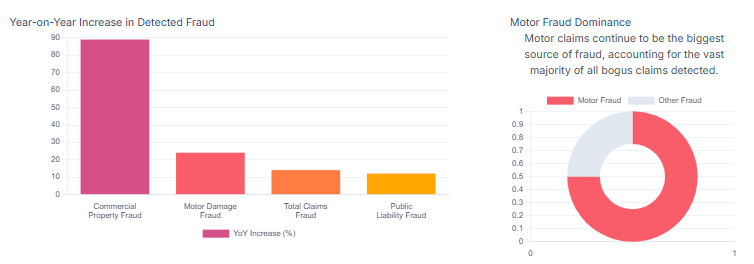
The nature of motor claims fraud is evolving, with a shift away from deliberate personal injury fraud, such as "crash for cash" schemes, towards an increase in exaggerated claims for injury. Dishonest claims for motor damage rose by 24% in 2024, driven by fraudsters inflating repair and credit hire costs. Since 2021, motor damage and credit hire fraud has surged by a staggering 275%.
A concerning trend involves "spoof ads" used by unscrupulous claims and accident management companies to mislead motorists, leading to inflated costs and disputes that insurers are often unaware of. Public liability fraud also increased by 12%, potentially influenced by whiplash reforms, as organised fraudsters pursue fake or exaggerated injury claims. Opportunistic household fraud, often linked to the cost of living crisis, accounts for one in ten fraudulent claims, with mobile phones, TVs, and jewellery being the most frequently targeted items.
Commercial property fraud rose by 89% in 2024, driven by third-party claims professionals exaggerating costs within the insurance sector.
- Underlying Trend: The persistent rise and evolving nature of insurance claims fraud underscore the critical need for continuous investment in advanced detection capabilities. Fraudsters are becoming more sophisticated, moving from overt schemes to more subtle exaggeration and exploiting new digital vectors, impacting the entire insurance industry.
- Causal Relationship: Increased investment in advanced analytics, machine learning models, and continuous staff training by insurers like Aviva has led to higher detection rates. However, this heightened detection capacity also reveals the scale of the problem and the adaptive nature of fraudsters, who respond by shifting their tactics. The economic climate, particularly the cost of living crisis, appears to be a contributing factor to opportunistic fraud, a significant insurance trend.
- Broader Implication: Combatting insurance claims fraud requires a multi-pronged approach, including technological solutions, skilled human investigators, collaboration with law enforcement, and public awareness campaigns to protect consumers from deceptive practices, all integral to the future of insurance.
Table 2: UK Insurance Fraud Statistics (2023-2024)
| Category | 2023 Detected Claims (Gov.uk) | 2024 Detected Claims (Aviva) | Change in Detected Claims (YoY) | Key Trends & Types of Fraud |
|---|---|---|---|---|
| Total Fraudulent Claims | 84,400 claims, £1.1 billion | 12,700+ claims, £127 million | Aviva: +14% (following +39% in 2023) | Evolving tactics, increased sophistication |
| Fraudulent Applications | Not specified | 98,000+ | Nearly doubled from previous year | Ghost broking, fronting, increased detection capabilities |
| Motor Claims Fraud | Significant issue | 3 out of 4 bogus claims detected by Aviva | Motor damage: +24% in 2024; +275% since 2021 | Shift from "crash for cash" to exaggerated injury/damage, "spoof ads" |
| Public Liability Fraud | Not specified | +12% | +12% | Staged slips, trips, falls, potentially linked to whiplash reforms |
| Household Fraud | Not specified | 1 in 10 fraudulent claims | Growth mostly opportunistic | Exaggerated/fabricated claims for mobile phones, TVs, jewellery, laptops, watches |
| Commercial Property Fraud | Not specified | +89% on 2023 | +89% on 2023 | Exaggeration by third-party claims professionals, especially for escape of water |
Risk Mitigation in the Insurance Sector
Effective risk mitigation is paramount for UK insurers in an increasingly complex and interconnected world. Proactive strategies are essential, encompassing robust cyber security measures, stringent data protection, and a pervasive culture of compliance throughout the organisation, addressing a core insurance trend.
Key areas for risk mitigation in the insurance industry include:
- Cyber Security and Data Protection: Insurers handle vast quantities of sensitive client data. Strong encryption, access controls, and real-time monitoring are crucial to prevent data breaches and maintain trust. The expanding attack surface due to reliance on third-party infrastructure necessitates thorough vetting of vendors and implementing firewalls and system breakers to ringfence internal networks in case of a third-party breach. This is a critical insurance trend for digital security.
- Regulatory Compliance: The regulatory landscape is constantly evolving, with guidelines from the Prudential Regulation Authority (PRA) and the Financial Conduct Authority (FCA) requiring continuous monitoring and rapid adaptation. Non-compliance can lead to significant fines and reputational damage. Robust governance structures with defined roles and responsibilities are vital for accountability in the insurance sector.
- Staff Training: Human error remains a significant risk factor. Regular training sessions are essential to keep employees updated on best practices for avoiding phishing and social engineering tactics, thereby preventing costly breaches and penalties, a key aspect of risk mitigation for the insurance industry.
- Scalable Systems and Risk Assessments: As businesses grow and adopt new technologies, their systems become more complex, potentially creating compliance gaps. Implementing scalable solutions and conducting regular risk assessments during upgrades are crucial to maintain compliance across all platforms. This supports agile responses to insurance trends.
- Policies and Procedures: Clear, well-documented policies form the backbone of compliance, providing a consistent framework for operations. These policies must be regularly reviewed and updated to reflect current regulations and insurance industry best practices.
The increasing adoption of AI also presents both opportunities and new risks for compliance. While AI tools can assist staff in summarising complex regulatory guidelines and analysing large datasets, they also introduce cyber security risks if not adequately protected. Ethical concerns around biased algorithms and legal risks from mishandling data or violating privacy standards must be carefully managed with robust governance.
Insurers are increasingly leveraging advanced risk analytics and technology, such as Aon's UK Insurance Market 2024 report, to gain deeper insights into risk profiles and facilitate more tailored insurance solutions, fostering a data-driven approach to underwriting. This proactive risk mitigation approach is defining future insurance trends.
- Broader Implication: Effective risk mitigation in 2025 and beyond demands a holistic approach that integrates technology, human capital, and a proactive compliance culture. It is not merely about reacting to threats but building resilience into the very fabric of the insurance organisation, an ongoing insurance trend.
Customer-Centricity: Enhancing Insurance Customer Experience and Hyper-Personalisation
In an increasingly competitive insurance market, customer experience (CX) has emerged as a primary differentiator for UK insurers. The focus is shifting from transactional interactions to building lasting relationships through seamless, personalised journeys, a defining insurance trend.
Insurance Customer Experience
Leading UK insurers are setting themselves apart by prioritising clarity and ease-of-experience across key customer journeys. This focus directly impacts customer loyalty and retention in an insurance market that can otherwise appear undifferentiated. Enhancing the insurance customer experience is paramount among insurance trends.
Data from NPS Prism reveals compelling statistics on the impact of a superior customer experience in insurance:
- New Policy Purchase: Customers of leading insurers are 10% more likely to describe purchasing a new policy as easy compared to the rest of the insurance market, highlighting the importance of streamlined and simplified purchase processes.
- Policy Changes: Leading insurers ensure customers have a clear understanding of how changes affect premiums, with customers nearly 20% more likely to report this clarity. Clear communication and readily available policy information are central to satisfaction during modifications, supporting a positive insurance customer experience.
- Account Management: An error-free experience when managing accounts is a competitive advantage, with customers of leading insurers 10% more likely to report this, particularly on online portals, contributing to the overall insurance customer experience.
- Claims Process: This is a critical battleground for customer loyalty. Customers of leading insurers are 20% more likely to find the claim submission process clear and 30% more satisfied with the settlement amount, resulting in a 30% higher likelihood of renewal. This underscores the importance of the insurance customer experience in driving retention.
The journey to CX excellence requires insurers to embed customer experience within their broader business strategy, design seamless multi-channel journeys, and leverage data and AI for optimisation. This includes reducing friction in key journeys like claims and renewals, enhancing first-contact resolution, and improving engagement through digital accessibility and personalisation. A single customer view for frontline employees is crucial for providing faster, more informed service, reducing frustration, and improving retention within the insurance sector. This focus on insurance customer experience is a continuous insurance industry trend.
- Underlying Trend: The emphasis on clarity and ease reflects a deeper understanding that customer satisfaction in insurance is built on frictionless interactions, not just product features. This is a direct response to evolving customer expectations shaped by digital experiences in other sectors, impacting the future of insurance.
- Causal Relationship: Investing in streamlined processes and clear communication directly leads to higher customer satisfaction, which in turn drives increased loyalty and renewal rates within the insurance industry. Conversely, legacy systems and siloed data hinder real-time integration, limiting personalisation and seamless service delivery, leading to customer dissatisfaction and churn.
Hyper-Personalisation in Insurance
Hyper-personalisation represents the advanced frontier of customer-centricity, moving beyond traditional segmentation to deliver highly individualised experiences in the insurance sector. This strategy leverages artificial intelligence (AI), machine learning (ML), and real-time data analytics to create tailored products, communications, and offers for each customer, a significant insurance trend.
The foundation of hyper-personalisation lies in Big Data, encompassing not only traditional data points like age and claims history but also granular data such as online behaviour, lifestyle choices, and real-time information from connected devices like telematics in auto insurance or wearables in health insurance. AI and ML act as the engines, transforming this raw data into actionable insights to predict risk factors, likelihood of claims, and anticipate customer needs for the insurance industry.
Benefits of hyper-personalisation include:
- Enhanced Customer Experience: Every interaction becomes relevant, timely, and meaningful, fostering deeper connections, increased engagement, and loyalty within the insurance sector.
- Improved Risk Assessment and Pricing: Detailed, individualised data allows for more accurate risk assessment and dynamic pricing models that reflect an individual's actual risk profile in real-time, benefiting both insurers and policyholders in the insurance industry.
- Proactive Risk Management: Insurers can offer personalised risk management advice and preventive measures based on an individual's lifestyle and behaviour patterns, an emerging trend in insurance.
- Streamlined Processes: Hyper-personalisation can automate form population in claims processing and provide tailored support throughout the customer journey in insurance.
Despite the compelling benefits, challenges exist. Insurers face the complexities of data management and integration from diverse sources, ensuring compliance with data protection regulations, and balancing personalisation with privacy concerns to maintain trust. Scalability to a large and diverse customer base without losing the personal touch, and the cost and resource allocation for integrating advanced AI/ML technologies into existing systems, are also significant hurdles for the insurance sector.
The adoption of AI for hyper-personalisation is still evolving, with a 2024 survey indicating that only 50% of respondents in non-life insurance and 24% in life insurance use AI, primarily for simpler tasks. Overcoming cultural and organisational resistance is also key to successful CX transformation, impacting insurance trends.
- Broader Implication: Hyper-personalisation signifies a paradigm shift from a product-centric to a truly customer-centric model, where insurance becomes an integral, adaptive part of an individual's life. Success will depend on robust data governance and the ability to build trust around data usage, a core insurance trend for the future of insurance.
The Future Insurance Trends: Strategic Imperatives for 2025
As the UK insurance sector navigates the complexities of 2025, several strategic imperatives emerge as critical for sustained growth and resilience. These imperatives are deeply intertwined with the insurance trends discussed, demanding a holistic and forward-thinking approach for the entire insurance industry.
Embracing a Data-Driven Culture in Insurance
The sheer volume of expanding data is opening new possibilities in risk assessment, pricing, and partnerships within the insurance industry. Success in the digital age demands a unified and comprehensive data strategy, one that is driven by senior leadership rather than solely the IT department, because better data underpins every aspect of the business and is crucial to innovation. Insurers with successful data and analytics strategies have seen a 100-25% increase in operating profits, highlighting the direct financial benefits. Leveraging data effectively is key to seizing growth opportunities and building on recent momentum, a foundational insurance trend.
Investing in Agility and Adaptability for Insurance Organisations
The rapid pace of technology change, particularly with GenAI and agentic AI, coupled with geopolitical and macroeconomic turbulence, necessitates enterprise retooling with richer data, modernised technology, and refreshed talent. Insurers must foster a culture of innovation and adaptability to unlock productivity gains and support sustainable transformation, influencing future insurance trends.
The ability to quickly iterate on products, respond to market shifts, and adapt business models will be fundamental to keeping pace with evolving consumer needs and intense competition within the insurance sector. This includes reviewing and transforming organisational cultures and processes to improve product development and portfolio management.
Building Resilient Ecosystems and Partnerships in Insurance
The future of insurance increasingly lies in collaborative ecosystems and embedded solutions. Organisations are developing new partnerships across wealth, health, and non-traditional sectors to meet integrated end-to-end customer needs. This involves using a wider array of channels and marketplaces to provide flexible, fast, and convenient services, especially for new entrants and less affluent consumers.
Strategic partnerships, particularly with technology providers, are becoming essential for enhancing efficiency and agility, with 79% of executives consolidating technology vendors to achieve this. The British Insurance Brokers' Association (BIBA) and the Association of British Insurers (ABI) are already collaborating to boost the global reinsurance industry, establishing frameworks for cooperation and joint research on industry themes and regulatory adjustments, an important insurance trend.
Focusing on Protection Gaps and Underserved Markets in Insurance
The substantial protection gaps in cyber and climate risks, alongside the massive shortfall in retirement savings, represent compelling value creation opportunities for the insurance industry. Addressing these underserved markets, which contribute the lion's share of the worldwide protection gap, offers the biggest potential for insurers to sustain solid bottom-line performance. This requires bold strategic thinking and creative action to deliver affordable and desired solutions. Usage-based products, modular add-on features, and tailored pricing can demonstrate commitment to unique customer needs, promoting loyalty and engagement, a key insurance trend for growth.
The UK insurance sector stands on the cusp of a new era, defined by technological innovation, shifting market dynamics, and heightened customer expectations. The current market softening, while providing a period of stability and opportunity for buyers, is a transient phase influenced by insurers' retained earnings, rather than new capital. This necessitates a strategic approach that balances aggressive growth targets with disciplined underwriting and preparedness for potential market hardening driven by external shocks. This complex interplay of insurance trends requires careful navigation.
The pervasive influence of technology, from automated workflows and microservices to no-code product building and open architecture, is not merely improving efficiency; it is fundamentally reshaping business models and enabling unprecedented agility for the insurance industry. These advancements are crucial for accelerating product development, streamlining operations, and enhancing the insurance customer experience.
Concurrently, the insurance sector must remain vigilant against the evolving threat of insurance claims fraud, which continues to rise in sophistication and value, demanding continuous investment in advanced analytics and collaborative counter-fraud measures. This ongoing battle is a critical insurance trend.
Ultimately, success in the future UK insurance market hinges on a profound commitment to customer-centricity. This means delivering clear, easy, and hyper-personalised experiences across every touchpoint, leveraging data and AI to anticipate needs, and building trust through transparent data governance. By embracing a data-driven culture, investing in technological agility, fostering resilient ecosystems, and strategically addressing protection gaps, UK insurers can not only navigate the challenges of 2025 but also unlock significant growth opportunities and solidify their position as essential pillars of the economy.
The path forward requires bold leadership, continuous innovation, and a steadfast focus on meeting the evolving needs of a dynamic world, shaping the very fabric of insurance trends for years to come.
We'd rather show you than tell you.
We'll start by getting to know your business. Then we'll show you exactly how Genasys handles it.
Insurance People
Zero Fluff
Tailored to You