
Definition and Historical Context of MGAs
A Managing General Agent (MGA) is a type of insurance intermediary entrusted with significant underwriting authority by insurers. Unlike a standard broker, an MGA acts on behalf of an insurer by managing underwriting, pricing, and often policy issuance and claims handling within agreed terms. The Managing General Agents’ Association (MGAA) defines an MGA as “an agency whose primary function and focus is the provision of underwriting services and whose primary fiduciary duty is to its insurer principal”.
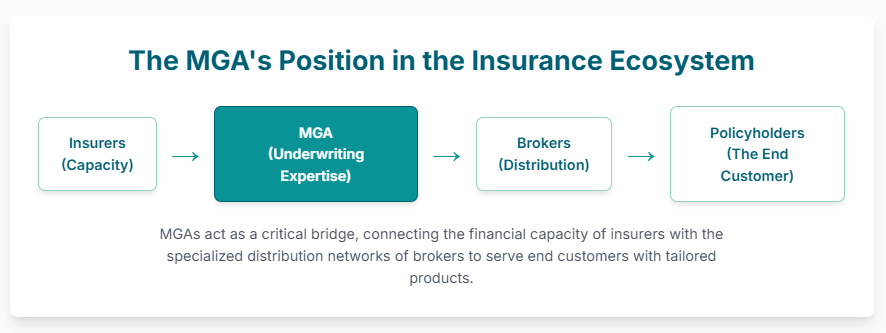
In practice, this means MGAs stand in for the insurer in many capacities, except that they do not typically carry the insurance risk on its own balance sheet. Instead, they use the capital and capacity of its insurer partners to underwrite policies, operating under a delegated authority agreement. For example, at Lloyd’s of London such delegated authorities are extended to coverholders (the Lloyd’s term analogous to MGAs), allowing them to enter into contracts of insurance on behalf of Lloyd’s syndicates.
Historical context: Managing General Agents have existed for decades in various markets. The model first gained prominence in the United States in the mid-20th century, particularly to help insurers expand into regional or niche markets without opening local offices. Over time, the concept spread and evolved internationally.
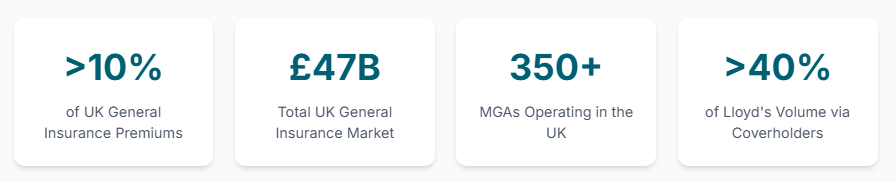
In the UK, underwriting agencies (as they were often called) became an integral part of specialty insurance lines and the Lloyd’s market. Lloyd’s has long utilized coverholder arrangements; roughly 30% of Lloyd’s insurance income was being written via delegated authority by the mid-2010s, and that figure has grown to over 40% of Lloyd’s volume by 2023, underscoring how significant they (coverholders) have become in distribution.
Recognising the growing role of MGAs, industry participants in Britain founded the Managing General Agents’ Association (MGAA) in 2011. Since its inception, the MGAA has served as a dedicated trade body to represent their interests, promote best practices, and liaise with regulators.
From a humble start, the sector has expanded rapidly, today the UK is regarded as one of the two most developed markets (alongside the US). In fact, more than 350 MGAs now operate in the UK, collectively underwriting over 10% of the country’s £47 billion general insurance market.
This growth reflects how MGAs have moved from being a “new kid on the block” to a mainstream channel in the insurance industry. Major insurers increasingly view these underwriting specialists as strategic partners for accessing specialist business. Overall, the model has deep roots in markets like the UK, US, and South Africa, and its evolution continues to shape insurance distribution today.
Specialist underwriting agencies: roles and responsibilities
Specialist underwriting agencies perform a range of functions traditionally handled by insurance companies, using the authority delegated to them. Typical roles and responsibilities include the following.
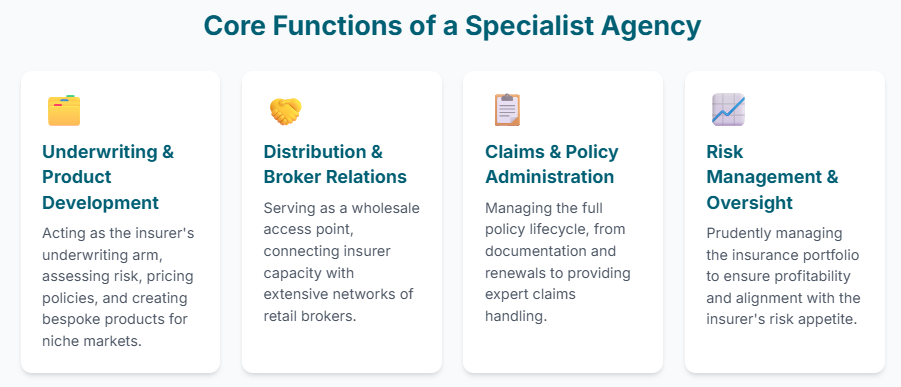
- Underwriting and product development: A delegated underwriting agency underwrites policies on behalf of one or more insurers. Using the insurer’s guidelines and capital, underwriters assess risks, set coverage terms, and price policies. Within agreed limits many agencies are empowered to bind cover without prior insurer approval for each policy.
They often specialise in particular lines such as cyber liability, marine cargo, or professional indemnity, or in defined customer segments, bringing deep expertise in those niches. As a result they can design and tailor products to emerging or complex risks that standard insurers might struggle to accommodate. These specialists have been adept at crafting solutions for novel risks where actuarial data may be limited.
By focusing on specialised underwriting they extend the insurer’s reach into niche markets with bespoke products, effectively offering product manufacturing services with policy wordings, rating models, and coverage features suited to the target market. This underwriting authority is what distinguishes them from ordinary brokers or agents. Many agencies are granted binding authority to quote and issue policies within agreed parameters, setting them apart in the distribution chain. - Distribution and broker relationships: Specialist underwriting agencies frequently act as intermediaries between retail brokers and insurers. In this role they serve as a wholesale underwriter or programme administrator. They typically distribute specialised products through networks of insurance brokers, and sometimes directly to customers, though many avoid retail distribution to prevent channel conflict.
A delegated underwriting firm becomes a one-stop access point for brokers to reach specific capacity. This is valuable when standard insurers will not cover a particular risk or class. These specialists give brokers access to niche markets and tailored policies, helping brokers meet unique client needs. In the UK brokers have increasingly turned to these agencies for challenging markets or high-hazard risks where traditional appetite is limited.
Agencies often appoint brokers under their own Terms of Business Agreements, expanding distribution for their insurer partners. In essence they connect wholesale capacity with retail distribution. Operating with lean teams and modern platforms they can streamline distribution, enabling faster quote-to-bind cycles and more agile responses to broker enquiries. - Claims handling and policy administration: Many specialist agencies have authority to manage claims on the policies they underwrite, or at least to oversee claims handling. In some cases the insurer delegates claims settlement authority to the agency, or to a third-party administrator under the agency’s oversight, for defined claim sizes or types. This allows the agency to offer a full service from underwriting through to claims.
Agencies that handle claims tend to have niche expertise, which can translate into more responsive and knowledgeable management. Even when an agency does not directly pay claims, it often acts as the liaison between the broker or policyholder and the insurer’s claims department, guiding the process and advocating for prompt resolution. Additionally these firms perform policy administration tasks such as issuing documentation, handling mid-term adjustments and renewals, and managing premium collection, often holding premiums in a fiduciary capacity before remitting to insurers.
By taking on these administrative burdens they allow insurers to operate hands-off for day-to-day policy management. In effect the arrangement can deliver end-to-end lifecycle management — underwriting, binding, issuance, and facilitation of claims – mirroring many insurer functions except bearing the ultimate risk. - Risk management and portfolio oversight: Acting on behalf of insurers, agencies are responsible for prudent portfolio management. They ensure the book they underwrite sits within risk appetite and pricing expectations, performing risk analysis, monitoring loss ratios, and adjusting guidelines to maintain profitability.
Actuaries and data analysts refine pricing and selection in the specialist domain. Some agencies also provide loss prevention advice or services to policyholders, particularly in commercial lines. In collaboration with capacity providers they may have input into reinsurance arrangements for the portfolio to manage volatility.
In the Lloyd’s market, coverholders are expected to uphold robust risk management under delegated authority oversight. Performance is tracked through detailed management information shared with the insurer. Profit-sharing is common, with profit commission rewarding favourable loss ratios, aligning the agency’s incentives with the insurer’s.
In summary, a specialist underwriting agency operates like a virtual insurer department. It underwrites and administers policies, distributes them through brokers, may handle claims, and manages the portfolio, all on behalf of an insurer that provides the capital and regulatory licences.
The agency acts for the insurer, not the insured. Its remit is set out in a binding authority contract that defines classes of business, limits, territories, and delegated responsibilities. By taking on these roles, specialist firms enable insurers to extend their reach efficiently while providing brokers and customers with specialised products and services.
Advantages Specialist Underwriting Agencies Offer to Insurers and Brokers
The delegated underwriting model delivers advantages to multiple stakeholders across the insurance value chain. Below are some of the key benefits these specialist agencies provide to insurers and brokers.
Cost-efficient market expansion for insurers: Partnering with a specialist underwriting agency is a cost-effective way for insurers to enter new markets or niches without the expense of building an in-house underwriting team and infrastructure.
These agencies are typically smaller, more agile operations with lower overheads than a large insurer establishing a new division or regional office. They often use modern technology platforms, avoiding the legacy costs that weigh on incumbents. As a result, an insurer can access additional premium income with far less fixed cost. Specialist agencies provide instant infrastructure, skilled underwriters, systems, and distribution relationships, allowing insurers to deploy capacity quickly.
This model is especially attractive when testing new products or customer segments, as the insurer’s role is reduced to providing capital and oversight while the agency handles underwriting and servicing. In the UK these agencies are seen as a cost-effective way for insurers to access distribution and transact SME business efficiently. Particularly in specialised or lower-premium markets where direct operation may not be economical, partnering with a specialist agency extends reach with minimal upfront investment.Access to specialised expertise and niche markets: Specialisation is a hallmark of these agencies. Most focus on particular lines or demographics, such as high-value home, cyber liability, motor fleet, or industry-specific insurance like marine or equine.
Their teams develop deep expertise and industry relationships in those niches. Insurers value this because it gives them access to business that might otherwise fall outside their expertise or radar. Sector specialism can also improve claims handling and client relationships. For brokers and customers, this specialisation translates into better products and service for unique risks. A specialist agency can innovate coverage or adjust underwriting criteria more quickly than a large generalist. Brokers increasingly rely on them to place non-standard or hard-to-place risks.
These agencies also fill capacity gaps, offering solutions for emerging risks such as drones or crypto-assets and addressing areas the traditional market finds challenging. Their knowledge and underwriting flair allow them to design bespoke solutions even where actuarial data is sparse, delivering value to insurers through profitable new business and to brokers through tailored client coverage. In the UK and US many agencies are known for driving product innovation in underserved segments.Expanded distribution networks and broker relationships: Insurers benefit from the extensive distribution reach of specialist underwriting agencies. Many maintain large broker networks or ties to broker clusters across regions or countries. Through such agencies, an insurer’s capacity can be accessed by hundreds of brokers and thousands of policyholders without the insurer needing to manage individual broker relationships.
Some large insurers use these agencies as a channel to serve smaller regional brokers they do not deal with directly. For brokers, working with these agencies often means direct access to underwriting decision-makers, faster quotes, and tailored coverage – agility that builds trust and strengthens relationships. These agencies can also bring insurers into distribution channels they might otherwise miss, such as niche affinity groups or specialist intermediaries.
Around 40% of Lloyd’s business now comes via coverholders, demonstrating their importance to distribution both in the UK and globally. Brokers also benefit because these agencies increase capacity supply, especially in hard markets. Industry bodies like the British Insurance Brokers’ Association have highlighted the value of additional delegated capacity, especially in challenging conditions.Underwriting profitability and innovation for insurers: Specialist agencies deliver strong underwriting performance because their success depends on profitability – often linked to performance-based commissions. This drives focus on risk selection and pricing fundamentals, and in niche areas they may achieve better loss ratios than broad-market insurers. Insurers also gain access to proprietary data, pricing models, and innovative techniques developed by these agencies, effectively leveraging their intellectual property.
Many are early adopters of new technology in underwriting and distribution, such as algorithmic rating for faster quotes or platforms integrated with broker software. These innovations provide competitive advantage and growth opportunities in new segments. A wave of tech-driven underwriting agencies has emerged in recent years, combining technology with underwriting in areas such as usage-based insurance or API-driven distribution.
These bring fresh ideas and enhanced digital experiences that benefit insurers backing them with capacity. Overall, insurers view specialist agencies as centres of excellence, supplying underwriting acumen and innovation while the insurer provides capital and claims-paying strength.Enhanced service and flexibility for brokers and clients: Delegated underwriting agencies often operate with a service-oriented mindset to win and retain broker business. Many offer brokers greater flexibility in tailoring coverage or negotiating terms than a large insurer might, thanks to their authority and close understanding of risk. They can be more creative or accommodating on challenging accounts within their delegated limits.
This flexibility is particularly valuable for brokers placing unusual risks. Agencies also prioritise quick turnaround on quotes, policy documentation, and claims decisions – responsiveness that brokers and policyholders appreciate. The broker-agency relationship is typically collaborative, with trust and performance central to the partnership. Successful agencies offer consistency in underwriting appetite and claims service, giving brokers confidence in recommending their products.
Clients benefit from niche expertise, bespoke risk management advice, and the reassurance that claims will be paid by a regulated insurer standing behind the agency. This blend of specialist service and reliable capacity drives high customer satisfaction in the segments these agencies serve.
Delegated underwriting firms create a win-win proposition: Insurers gain profitable growth, expert underwriting, and extended distribution at lower cost, while brokers gain access to specialised products, additional capacity, and often superior service for difficult or niche risks.
These advantages explain why the delegated underwriting model has grown rapidly. As one commentator put it, insurers view writing business through these vehicles as a core strategy based on “historical success in accessing and developing profitable portfolios” via these vehicles. Brokers likewise increasingly see these firms as indispensable partners in delivering tailored solutions to clients.
(It should be noted that delegated underwriting firms earn their income through commissions from insurers (often termed “overrider” commissions on gross premium), fees for administrative services, and sometimes profit-sharing bonuses. Thus, their incentives are aligned with producing good business and keeping both insurers and brokers satisfied.)
The Managing General Agents’ Association (MGAA)
Founded in 2011, the Managing General Agents’ Association (MGAA) is the UK’s official trade body representing delegated underwriting firms. The MGAA was established to give the growing community of such agencies a collective voice and to promote high standards of professionalism in the sector.
As a not-for-profit organisation, its core mission is to support delegated underwriting firms and advance their interests within the insurance industry. Since inception, the MGAA’s membership has expanded to include the majority of UK-based agencies (as well as some in the Republic of Ireland and Gibraltar). As of early 2025, the MGAA counts 233 full member agencies, writing over £13.2 billion in gross written premium. This represents a significant portion of the UK insurance market, underscoring the importance of these delegated authority firms and the influence of the MGAA.
Purpose and activities: The MGAA’s purpose is multifaceted: it provides advocacy, education, networking, and technical support for its members. A key role is advocacy and representation, the MGAA acts as the voice of delegated underwriting firms in discussions with regulators (like the Financial Conduct Authority), government bodies, and other industry associations. By presenting a united front, these agencies can ensure their unique business model is understood and considered in policy or regulatory changes.
For example, the MGAA frequently liaises with the FCA on proportional regulation and has campaigned on issues such as fair treatment under the Insurance Distribution Directive rules. The Association also interfaces with other industry groups; notably, in 2025 the MGAA signed a Memorandum of Understanding with the Association of British Insurers (ABI) to collaborate on key industry issues and “amplify the voice of these agencies on critical…issues including regulatory challenges and market opportunities”. This partnership with the ABI highlights the MGAA’s growing influence in mainstream insurance dialogues.
Another core function is member support and benefits. The MGAA provides its members with resources to help run their businesses effectively and compliantly. This includes regulatory and compliance support (such as updates on FCA regulations, guidance on meeting new rules like the Consumer Duty, and even regulatory calendars to ensure key deadlines are met).
The Association often partners with expert consultancies (for instance, Sicsic Advisory) to offer regulatory guidance and training for members. It also runs market briefings, seminars, and an annual conference where members can learn about emerging trends (e.g. InsurTech, data analytics, ESG issues) and share best practices.
Education and professional development are promoted through initiatives like the Chartered Insurance Institute (CII) delegated underwriting competency framework, which the MGAA helped develop to accredit professionals in this field. By elevating professional standards, the MGAA aims to enhance the credibility and authority of these firms in the wider market.
Networking and community-building are also important. MGAA events facilitate relationship-building between its members, capacity providers (insurers and reinsurers), and broker partners. This is exemplified by the MGAA’s creation of a “Broker Exchange” or Broker Gateway, a platform to improve connectivity between brokers seeking specialist solutions and agencies who can provide them. Such tools strengthen the ecosystem by making it easier for brokers to find markets for their risks, and for agencies to promote their offerings.
The MGAA also welcomes supplier members (companies providing services to delegated underwriting firms, like software vendors, law firms, auditors), which further enriches the community and knowledge sharing.
Regulatory impact: The MGAA has had a positive impact on the regulatory landscape for these agencies. It engages with the FCA to ensure that rules are appropriately calibrated for the delegated authority model. For example, the MGAA has worked to address concerns around the appointed representatives regime and to clarify the fiduciary responsibilities of delegated underwriting firms (who must hold premiums in trust for insurers, etc.). By issuing guidelines and through dialog with regulators, the MGAA helps members navigate compliance requirements.
Both delegated underwriting firms and brokers are subject to similar FCA standards for treating customers fairly, governance, and controls. The MGAA emphasizes these obligations and encourages a compliance culture among members, which in turn boosts confidence in the sector’s integrity. In recent times, as the FCA rolled out the Consumer Duty (raising the bar for customer outcomes in retail financial services), the MGAA has been actively helping delegated underwriting firms interpret and implement these rules in their operations.
The Association also acts as a liaison with the Lloyd’s market on coverholder matters and with the government on any legislative issues affecting insurance intermediaries. An illustration of its growing stature is that other industry bodies like BIBA (British Insurance Brokers’ Association) publicly acknowledge working closely with the MGAA and the benefits these delegated authority firms bring to the market. This kind of collaboration has helped integrate these firms more fully into the insurance mainstream, moving past any notion that they are unregulated or on the fringes.
In fact, delegated underwriting firms are fully regulated firms (authorised by the FCA as insurance intermediaries) and the MGAA reinforces that its members adhere to high professional standards. In summary, through advocacy, support, and self-regulation initiatives, the MGAA plays a pivotal role in shaping a favorable environment for delegated underwriting firms to thrive within the UK’s robust regulatory framework.
UK Delegated Underwriting Market Overview: Size, Growth, Trends, and Regulation
The UK delegated underwriting market has grown into a significant and dynamic segment of the insurance industry. In terms of size, industry estimates indicate that these firms now underwrite over 10% of UK general insurance premiums. With the UK general insurance market valued around £47 billion annually, this implies these firms handle roughly £5 billion or more of premium per year – a substantial share. The MGAA’s members alone (just a subset of the total delegated underwriting universe) write £13.2 billion GWP across various lines.
There are 300+ delegated underwriting firms operating in the UK, ranging from small specialist agencies writing a few million in premium to large businesses writing hundreds of millions. Some well-known UK delegated underwriting firms include Pen Underwriting (one of the largest, with diverse specialty programs), DUAL (an international group with a big UK presence), and numerous others focusing on areas like motor fleets, property binding authorities, casualty schemes, and emerging risks.
Market growth: The delegated underwriting sector in the UK has been on a strong growth trajectory. Over the past five years, premiums placed through these firms globally have grown at over 20% per annum, outpacing the broader insurance broking market growth (~11% annually). The UK mirrors this global trend, with these firms steadily increasing their share of business in both personal and commercial lines. Even during challenging periods (such as the COVID-19 pandemic), these firms proved resilient and continued to attract new capacity and investors.
A contributing factor is the influx of private equity and venture capital investment into delegated underwriting startups and acquisitions, seeing them as high-growth opportunities. In recent years, many insurers have also launched their own “delegated underwriting incubators” or provided seed capacity to new firms, fueling expansion. The model’s flexibility and lower capital requirements make it easier to launch such a firm than a full-stack insurer, so we have seen a proliferation of entrepreneurial teams setting up delegated underwriting businesses to exploit market niches.
Trends in specialisation and innovation: Specialisation continues to deepen in the delegated underwriting market. These firms are increasingly focusing on micro-niches, for example, insurance programs tailored for specific professions, or novel products like parametric insurance for climate risks. This granular specialism is driven by the demand for bespoke solutions and the delegated underwriting firm’s ability to pivot quickly to cover new exposures. Technology and innovation are also major trends.
A wave of tech-driven delegated underwriting firms (sometimes dubbed “InsurTech agencies”) has emerged, using digital platforms, data analytics, and AI in insurance to enhance underwriting and distribution.
These delegated underwriting firms often target underserved customer segments online (for instance, on-demand insurance for gig economy workers, or usage-based motor insurance using telematics). The UK has seen several InsurTech delegated underwriting firms launch with venture backing, bringing fresh competition to traditional players.
Moreover, established delegated underwriting businesses are investing in technology to improve efficiency, for example, using APIs to integrate with broker software for seamless quote/bind, or deploying data science to refine risk selection.
According to Deloitte, there is a widening gap in technology capabilities in the delegated authority space: newer digital-first delegated underwriting firms are racing ahead with advanced analytics and platforms, while some older operations risk falling behind. This is driving incumbent delegated underwriting firms to upgrade systems and embrace innovation.
Another trend is collaboration platforms: the MGAA’s Broker Gateway and similar initiatives are leveraging digital directories and matchmaking tools to connect brokers with the right delegated underwriting markets quickly. This reflects an industry push to break down information barriers and make the delegated underwriting market more accessible and transparent to brokers.
Market segments and capacity: Delegated underwriting firms in the UK operate across virtually all insurance segments. A large portion are in commercial lines, serving SMEs and specialty commercial risks (liability, property, marine, trade credit, etc.). Others focus on personal lines niches, classic cars, high-net-worth household, pet insurance schemes, etc.
These firms have also been instrumental in the London Market, especially for international risks written under Lloyd’s. In fact, Lloyd’s coverholders (who are a form of delegated underwriting firm) now source an estimated 40%+ of Lloyd’s premiums, highlighting that delegated authority is a core part of London’s global underwriting reach.
The delegated underwriting model has been exported from the UK to other regions as well, often via the London Market: for example, coverholders/delegated underwriting firms are used to write local risks in Asia, Latin America, and Africa on behalf of Lloyd’s syndicates. (South Africa’s insurance market, for instance, uses the term Underwriting Management Agencies (UMAs) for similar delegated authority entities, and has seen global firms partner with local delegated underwriting firms to bring specialised products to the region.)
A crucial aspect of the delegated underwriting market is capacity. the insurers or reinsurers providing the financial backing. In recent years, capacity has come not just from traditional insurers but also from alternative sources such as dedicated capacity vehicles, “fronting” insurers backed by reinsurance, and even Insurance-Linked Securities (ILS) in some cases.
The appetite for providing capacity to delegated underwriting firms remains strong overall, though it fluctuates with market cycles.
During hard market conditions (high rates, tight capacity), insurers may retrench capacity to core business, which can challenge some delegated underwriting firms to find backing. Indeed, MGAA’s leadership has cited “capacity constraints” as an ongoing obstacle for some delegated underwriting firm members, especially in a challenging rating environment. Nonetheless, the general trend has been supportive. many insurers see partnering with specialist delegated underwriting firms as a way to deploy capacity profitably in segments they might not serve directly.
The entrance of new capacity providers (like ambitious start-up insurers or transatlantic insurers entering the UK via delegated underwriting deals) has further spurred growth. We have also seen existing brokers or managing agents launching their own delegated underwriting firms (sometimes called “broker-delegated underwriting firms”) to tap into this distribution method.
Regulatory landscape: In the UK, delegated underwriting firms are subject to regulation by the Financial Conduct Authority (FCA) just like other insurance intermediaries. There is no separate “delegated underwriting license” as such, a delegated underwriting firm must have regulatory permission for insurance distribution (and often for underwriting activities which fall under the Managing Agent of Lloyd’s or insurance intermediary categories).
They must meet threshold conditions on capital (though far lower than insurers), governance, compliance systems, and carry professional indemnity insurance as required by the FCA.
A delegated underwriting firm’s fiduciary duty is to the insurer principal; however, they also have obligations to treat customers fairly and avoid mis-selling, just as brokers do. In practice, delegated underwriting agreements often stipulate strict compliance with both insurer’s standards and regulatory rules. The FCA has increasingly focused on delegated authority oversight in recent years, ensuring that insurers properly vet and monitor the delegated underwriting firms they work with.
From the regulator’s view, while the insurer is ultimately responsible for the risk and policyholder outcomes, the delegated nature of these firms means there must be robust oversight to prevent consumer harm.
The FCA’s expectation is that brokers and customers clearly understand the capacity chain, who the actual insurer is behind the policy provided by a delegated underwriting firm. In fact, the FCA has cautioned brokers to not misrepresent a delegated underwriting firm as the insurer, emphasizing that customers need to know which authorised insurer underwrites their policy. Ensuring transparency (e.g. including the insurer’s name on documentation) is a must.
In terms of industry guidance, BIBA’s 2025 guide for brokers using delegated underwriting firms underscores compliance considerations like having proper Terms of Business Agreements, clarifying roles, and planning for potential termination of binder agreements. The MGAA also contributes to shaping good practices, it has published codes of conduct and worked with the FCA on matters such as fair value in delegated products and the new Consumer Duty rules.
Broadly, UK regulation treats delegated underwriting firms as an important part of the insurance distribution chain, subject to similar rules as insurance brokers (e.g. around client money handling, complaints, and marketing). There is also oversight from Lloyd’s for those delegated underwriting firms that are Lloyd’s coverholders – they must go through Lloyd’s approval processes and audits to maintain coverholder status.
Overall, the regulatory landscape in the UK is supportive but increasingly scrutinising delegated underwriting firms to ensure they uphold high standards.
Industry sentiment suggests that delegated underwriting firms that can adapt swiftly to new regulatory changes (for example, implementing strong governance and customer outcome monitoring per Consumer Duty) gain a competitive advantage.
The ability to demonstrate robust compliance and alignment with insurers’ conduct expectations is now a prerequisite for success in the UK market.
In summary, the UK delegated underwriting market is significant and growing, driven by specialisation, innovation, and the ongoing need for insurers to find efficient distribution channels. It operates under a mature regulatory framework that safeguards policyholder interests while allowing these firms the flexibility to thrive. With these firms accounting for a double-digit share of premiums and continuing to attract investment, they are firmly entrenched as a key pillar of the UK insurance ecosystem, alongside insurers and brokers.
Future Outlook for Delegated Underwriting Firms in the UK
The future for delegated underwriting firms in the UK looks robust, with continued opportunities for growth, albeit coupled with challenges that will require adaptation. Here are some key points on the outlook and evolving trends:
Continued Growth and Importance: All indicators suggest that delegated underwriting firms will continue to grow their share of the insurance market in the coming years. Insurers remain keen on the delegated underwriting model as a means to achieve sustainable growth by tapping into new markets and product areas.
Brokers, too, are expected to lean even more on these firms for specialised solutions as client needs become more complex and bespoke. As we head further into the 2020s, delegated underwriting firms are set to become even more indispensable partners in the distribution chain.
The demand for specialised expertise is rising across both commercial and personal lines, and delegated underwriting firms with niche underwriting capabilities are well positioned to meet that demand. In areas like cyber insurance, climate-related risks, and new mobility or gig economy risks, delegated underwriting firms are likely to spearhead product development.
The consensus in industry reports is that the delegated underwriting model shows “little sign of slowing down its pace of growth”, if anything, it is gaining momentum as more business is transacted through delegated authority arrangements each year.
Emergence of Tech-Driven and Digital Delegated Underwriting Firms: Technology will be a decisive factor in the delegated underwriting landscape of the future. We expect to see more digital-first delegated underwriting firm launches, agile startups leveraging data and technology to differentiate themselves. These could be platform-based delegated underwriting firms, for instance, offering embedded insurance via APIs, or AI-driven underwriting for ultra-fast quote and bind.
Established delegated underwriting firms are also investing heavily in digital transformation, adopting advanced analytics, AI for risk modeling, and customer-facing apps to enhance service.
Such technology adoption can significantly improve efficiency, allowing delegated underwriting firms to handle larger volumes without proportional increases in headcount. Deloitte’s analysis points out that some recent market entrants (often “digital natives”) are racing ahead in building data and tech capabilities, creating a gap between them and more traditional players.
This is pushing the entire delegated underwriting sector to modernise. In the near future, use of automation in policy administration software and claims (for example, automated claim triage or straight-through processing for simple claims) will likely become standard among leading delegated underwriting firms. Embracing insurtech partnerships and tools will be crucial.
Those delegated underwriting firms that successfully integrate cutting-edge technology will be able to offer better, faster service and more insightful underwriting, which should translate into competitive advantage.
Evolving Capacity Dynamics and Partnerships: The outlook for capacity is generally positive, insurers and reinsurers are forecast to maintain a strong interest in partnering with delegated underwriting firms that can deliver profitable books of business. However, delegated underwriting firms will need to navigate the cycles: if the underwriting cycle tightens (due to, say, large losses or economic downturns), capacity providers might consolidate their delegated underwriting firm relationships to only the best performers.
This puts a premium on delegated underwriting firms demonstrating profitable performance and strong governance to retain and attract capacity. One trend to watch is the rise of fronting insurers in the UK, akin to the US model, which provide licensed paper and outsource 100% of the underwriting to delegated underwriting firms (with reinsurance behind it).
This model could expand, giving delegated underwriting firm entrepreneurs more options for capacity arrangements. Additionally, more brokers might create their own delegated underwriting firms (or “delegated underwriting firm incubator” platforms) to capture underwriting margin internally, a form of vertical integration in distribution.
The relationships between brokers, delegated underwriting firms, and insurers may thus become more interwoven. We also anticipate further M&A and consolidation activity in the delegated underwriting space. As noted in market analyses, delegated underwriting firm valuations have been high and deal activity hit record levels in recent years. Private equity investors continue to see delegated underwriting firms as attractive investments due to their high margins and low capital needs.
This could lead to some smaller delegated underwriting firms merging to achieve scale, or larger intermediaries acquiring successful delegated underwriting firms. While consolidation can reduce the number of independent delegated underwriting firms, it also often results in well-capitalised delegated underwriting groups that can invest more in innovation and expansion (for example, UK’s Nexus group or US’s Ryan Specialty Group which have grown by acquisition).
Internationally, we might see UK delegated underwriting firms expanding abroad (some already have footprints in the EU or US markets), as well as foreign delegated underwriting franchises entering the UK.
Regulatory and Compliance Focus: The regulatory environment will undoubtedly shape delegated underwriting firm operations going forward. The FCA’s intense focus on customer outcomes (through the new Consumer Duty and other measures) means delegated underwriting firms must embed a strong culture of compliance and evidence that their products offer fair value.
Given that delegated underwriting firms often design niche products, they will need to ensure these are transparent, not overly complex, and genuinely meeting customer needs, otherwise regulators could intervene.
We expect greater scrutiny on delegated underwriting agreements, sales practices, and how much control delegated underwriting firms have versus the capacity provider. Any high-profile failures or misconduct in the delegated underwriting space could prompt stricter rules, so the industry is motivated to self-police and maintain high standards.
On the positive side, delegated underwriting firms’ agility in compliance can be an advantage. The MGAA’s CEO has highlighted that delegated underwriting firms tend to adapt swiftly to regulatory changes, which brokers find reassuring in choosing partners.
Future regulation may also cover new areas like operational resilience (requiring delegated underwriting firms to have solid IT continuity plans) and ESG considerations (both in underwriting and in running their own operations). The delegated underwriting firms that stay ahead of these compliance trends will strengthen their reputation and relationships with insurers and brokers.
Challenges to Address: Despite the overall optimistic outlook, delegated underwriting firms will face a set of challenges that they must manage to ensure long-term success. Competition is intensifying, not only are more delegated underwriting firms forming (including spin-offs from insurers or brokers), but insurers themselves can be competitive if they decide to underwrite certain niches in-house after seeing delegated underwriting firm success.
The market could become congested in some lines, putting pressure on delegated underwriting firms to truly differentiate themselves (either through superior expertise, service, or technology). Talent acquisition and retention is another concern.
There is a finite pool of experienced underwriters and technical staff, and delegated underwriting firms compete with insurers and brokers for this talent. Delegated underwriting firms often need people who are entrepreneurial and highly skilled in underwriting, attracting such talent when larger insurers might offer more stable careers will be an ongoing battle.
However, many underwriters are drawn to delegated underwriting firms for the autonomy and potential rewards (like profit commissions or equity), so delegated underwriting firms will continue to leverage that in recruitment.
Market cycles could test delegated underwriting firm resilience: if we enter a very soft market with falling premiums, delegated underwriting firms’ commission incomes drop; if the market hardens too much, capacity may be pulled or become pricier. Delegated underwriting firms will need prudent financial management (including building contingency funds) to weather volatility.
Additionally, infrastructure and data demands are rising, delegated underwriting firms must invest in robust data security, underwriting systems, and MI reporting to satisfy both insurers and regulators. Bridging the technology gap identified earlier is critical; those who do not invest may find themselves losing business to more efficient peers.
In terms of future opportunities, one significant area is international collaboration. We might see UK delegated underwriting firms partnering with overseas insurers looking for UK distribution, or vice versa. Lloyd’s is likely to maintain its “market of choice” strategy for delegated authority, potentially simplifying processes to onboard new coverholders, this could open doors for more delegated underwriting firms to join Lloyd’s schemes or for Lloyd’s syndicates to sponsor startup delegated underwriting firms in the UK.
Long-term outlook: The consensus is that delegated underwriting firms are now an entrenched part of the insurance value chain, not a temporary phenomenon. They fill a structural need by aligning capital with expertise and distribution. As long as they continue to deliver value, through underwriting acumen, efficiency, and service, they will remain key players. In the UK, it is anticipated that delegated underwriting firms will further solidify their role in lines like specialty commercial insurance, where they might handle an even larger share of the market.
Some even speculate on delegated underwriting firms moving closer to assuming risk in the future (for example, via captive arrangements or “risk carrier as a service” models), effectively blurring lines with insurers. A few delegated underwriting firms have already taken steps like obtaining their own insurance licenses or setting up cells to participate in risk, a trend that could grow in the long term.
In conclusion, the future of delegated underwriting firms in the UK appears bright: they are expected to grow in influence, powered by specialisation and innovation. However, success will favor those delegated underwriting firms that remain agile, tech-savvy, and compliant.
The delegated underwriting firm-insurer-broker partnership model will likely deepen, supported by trade bodies like the MGAA and collaborative industry initiatives. Delegated underwriting firms are poised to continue evolving, driving insurance innovation, and bridging gaps in the market, a testament to their enduring relevance in the UK and beyond.
Representative UK Specialist Underwriting Agencies
The UK delegated underwriting market is home to a diverse array of specialist firms, ranging from large, established entities to innovative newcomers. While specific rankings can fluctuate based on various metrics, the following table highlights some of the significant and well-known specialist underwriting agencies operating in the UK, showcasing the breadth of expertise within this dynamic sector. These companies demonstrate the variety of specialisms and operational models that contribute to the strength of the delegated authority market.
| Company Name | Key Specialisms/Focus Areas | Notes |
|---|---|---|
| Pen Underwriting | Diversified specialty programs, commercial | One of the largest and most diversified players. |
| DUAL | International presence, various lines | Global delegated authority group with strong UK operations. |
| Nexus Underwriting | Specialty lines (Financial, Marine, Cyber) | Known for M&A growth and a diverse portfolio. |
| CFC Underwriting | Cyber, Technology, Specialist Liability | A pioneering InsurTech firm, leading cyber underwriter. |
| KGM Underwriting | Motor (classic, specialist, commercial) | Large specialist in various motor insurance segments. |
| Ascent Underwriting | Cyber, FinPro, Space | Focuses on complex and emerging risks. |
| Plum Underwriting | High-net-worth, non-standard property | Niche specialist in property insurance. |
| GRP (Global Risk Partners) | Broad specialty, regional broking group | Operates with a significant delegated authority book. |
| Covéa Insurance (Delegated Authority) | Property, Motor, Specialty schemes | A major insurer with a substantial delegated authority book. |
| Tokio Marine HCC (International) | Specialty lines, D&O, Marine, Energy | Strong presence in the London Market’s delegated authority. |
The Managing General Agent model has firmly cemented its position in the UK, moving from a peripheral option to a core strategic channel for insurers. Accounting for a double-digit share of the nation’s general insurance premiums, MGAs provide a crucial mechanism for market access, specialised risk assessment, and product innovation.
Value and Resilience
The essence of the MGA’s enduring appeal is twofold:
Efficiency and Expertise for Insurers: MGAs offer insurers a cost-efficient route to deploy capacity, accessing specialised expertise (in areas like cyber or niche property) and wider distribution networks without the heavy overheads of building their own divisions. Their focus on underwriting profitability, often linked to performance commissions, helps deliver high-quality business.
Access and Agility for Brokers: For brokers, MGAs are essential partners, providing agile access to capacity for non-standard, specialist, or hard-to-place risks. The blend of deep niche knowledge, bespoke product creation, and enhanced service responsiveness sets them apart in the distribution chain.
So what’s next for MGAs?
Looking ahead, the MGA sector is poised for continued growth, driven by twin forces: specialisation and digital innovation. New, tech-driven MGAs are leveraging data analytics and artificial intelligence to refine underwriting and distribution, forcing established players to also digitally transform. While challenges such as capacity cycle management, intensifying competition, and the constant need for top talent persist, the overriding trend is one of expansion.
The regulatory environment, spearheaded by the Financial Conduct Authority and supported by the advocacy of the Managing General Agents’ Association (MGAA), will continue to demand high standards, especially concerning consumer outcomes (the Consumer Duty). This focus on governance and transparency will ultimately benefit the sector’s credibility and strengthen the trust placed in these delegated authority partnerships.
In sum, MGAs are not merely an alternative distribution method; they are active architects of new insurance solutions. Their adaptability, entrepreneurial spirit, and unique position at the intersection of capital, risk, and technology ensure they will remain a vital and dynamic component of the UK’s financial services landscape for the foreseeable future.