Part four of Back To School series is here, in which we seek valuable insights from our senior leadership team on the things they’ve learned, both in the current roles and along the way.
Next up, is Christelle Frost, Genasys’s Chief People Officer. Hot of the back of her “Meet The Leadership” piece, she offers her thoughts on how customer centricity and brand strategy can help insurance businesses grab the upper hand.
Company Culture – Why is company culture important, and what steps do you recommend for fostering a strong culture?
Company culture is such a broad term and difficult to define because there are so many different definitions. Broadly speaking it’s about the shared values, norms, beliefs, behaviors, and attitudes that form the collective identity of the company. A company’s culture can contain many elements, including written and unwritten documents and practices, such as the company’s vision, mission, values, policies, practices, and acts of recognition and reward.
Simply put, it’s the “how we do things around here” and since this sets the tone for how the business goes through its daily functions, a company’s culture is critical to ensuring success and sustainability. A strong company culture can provide companies with a competitive advantage by enhancing employee engagement and productivity, improving customer satisfaction, attracting and retaining talented individuals, and enabling higher profitability.
Fostering a strong company culture requires a few key drivers:
- Company Vision, Mission and Values: These form the foundation of a company’s culture, so it’s important to be clear and transparent on what needs to be achieved, how this will be done, and what the principles are that will guide this process.
- Leadership and Communication: Lead by example. Leaders need to display and live the company’s values, encouraging team members to model their behaviour on this. If Leadership “talks the talk” without “walking the talk” then it’s just “yakety yak”.
- Take your team on the journey: Clearly communicate and regularly reinforce the company’s values. Make it part of the hiring and onboarding process, include this in the policies and practices, communicate and celebrate successes that align with the company culture, and integrate this into your recognition and rewards processes by celebrating team members who live the culture.
Talent Acquisition: What have you learned about attracting and retaining top talent in a competitive industry like insurance technology, and what strategies have been most effective?
While talent acquisition is certainly a challenging prospect in a niche and highly competitive industry such as InsurTech, it’s certainly not a unique challenge. Most industries face similar challenges in attracting, developing, and retaining top talent.
As mentioned earlier, a strong company culture can provide companies with a competitive advantage, making a significant impact on talent acquisition processes. A positive company culture supports the process of attracting talented individuals and by the same measure, where individuals align with the company culture, where they are highly engaged, and where they see long-term growth for themselves within the company, there is a lower risk that such individuals will consider leaving the company. So the starting point is always culture.
Some further strategies that support this process include:
- Position yourself as the great company that you are
Showcase and demonstrate why the company is a great place to work. Put a dedicated Career and Culture section on your webpage and showcase the company on social media or career pages such as LinkedIn, Glassdoor, and Indeed. Longer-term strategies may include having the company listed on a “best places to work” platform.
- Have a great onboarding process
Onboarding sets the tone for everything that’s to come in the employee’s journey at the company and can be a positive experience that strengthens the person’s belief that they chose the right company. Provide a structured, well-planned onboarding process that sets the person up for success and where they feel supported in their new role. Communication is important – schedule regular check-in sessions to monitor progress and determine areas where the person might need stronger support. Clearly communicate the company’s culture and the expectations from the employee.
- Have a great offboarding process
While this might seem contradictory to attracting and retaining talent, getting the exit process right supports the exiting employee’s relationship with the company. They can move on to new challenges with a positive view of the company and be satisfied with the conclusion of their time at the company. They will continue to speak positively about the company, serving as brand ambassadors who may return themselves or refer others to the company. Word of mouth is a strong tool to leverage in the talent acquisition process.
- Reward and Recognition
Put a structure in place where employees can be recognised for what they bring to work and rewarded for great achievements. Diversify these and keep things interesting by providing different forms of recognition. - Invest in the development of people
Create an environment where continuous learning is supported and encouraged. Identify the growth and development ambitions of team members and identify the opportunities to develop talent within the company. Implement intentional, structured solutions to support development, upskilling, and succession planning.
Employee Development: What key insights have you gained about employee development, and what steps should a company take to ensure continuous learning within the company?
Employee Development is a critical part of talent acquisition, employee retention, and enabling a high-performance culture. Considering the dynamic and highly competitive nature of the InsurTech industry, the ability of a company to continuously learn, develop, innovate, and adapt, will become a critical part of its success and sustainability.
This highlights the need for a company to foster a culture of continuous improvement learning. There’s a lot of truth in the famous conversation/quote between the CFO and CEO.
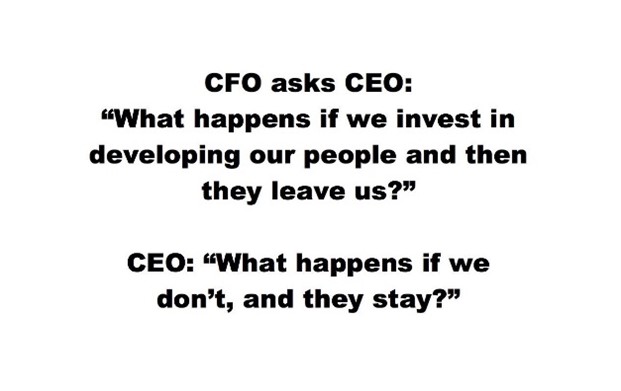
Enabling a culture of continuous learning requires intentional actions from Human Resources and Leadership teams.
- Provide learning opportunities. Dedicate time for learning and provide employees with access to learning platforms (online tools, internal training, knowledge sharing opportunities, formal training, coaching and mentoring programs)
- Identify learning requirements, skills gaps and create training plans to address these.
- Communicate with employees and provide effective feedback on the skills and learning required.
- Integrate learning into reward, recognition and performance programs.
- Make it clear that learning is a priority. Encourage and support employees in their learning journeys.
Diversity and Inclusion: What have you learned about creating a diverse and inclusive workplace, and how do these efforts contribute to the success of companies?
A diverse and inclusive workplace is one where everyone, regardless of who they are and what they do, feels included, valued, and respected. What should be added to this is the concept of belonging – where everyone feels that there is an experience of connection, security, and community. At its core, having a true sense of belonging at work is one of the deepest measures of engagement.
These are important concepts because these components need to work in harmony with each other to ensure success. Creating a diverse working environment, but failing to be inclusive, can lead to a toxic culture, while an inclusive culture without diversity can limit creative thinking and lead to stagnation.
Research from institutions such as Harvard Business Review, Gallup, and McKinsey & Company have found companies that prioritize diversity and inclusion within the workplace tend to show stronger business results than their less diverse peers.
Diverse and inclusive working environments can lead to:
- Increased employee engagement, trust, and collaboration.
- Increase employee retention
- Increased innovation and creativity
- Diverse perspectives and improved decision-making
- Access to larger talent pools and the ability to leverage top talent
Remote Work: With the rise of remote work, what lessons have you learned about managing a distributed workforce, and how do you maintain engagement and productivity in this environment?
The starting point is to accept that there is no “one-size-fits-all” ideal best practice solution when it comes to how and where we work. In the global market, there are numerous examples of companies opting for fully remote or fully onsite or various blends of hybrid models. It is up to each company to find a model that works for them and to be flexible in adopting this model as the market changes. How these models work and what they aim to achieve will differ drastically.
However, there are some guiding principles that we’ve learned from our lessons in remote working:
- An increased focus on Training and Development: Surviving and ideally thriving when working remotely or in a hybrid model requires different skill sets. Employees need to remain up to date with changing technologies, tools, and automation processes.
- Increased communication and transparency: This is critical to ensure that employees remain engaged, informed, and aligned with the shared vision and values of the company. Leadership needs to regularly and intentionally engage with team members to share information, drive alignment, source input from employees, remain aware of concerns, and address concerns.
- Performance Management: Hybrid or remote working models and flexible working arrangements contribute to the necessity of rethinking how we do performance management. If employees are no longer managed and their performance measured based on hours worked and the traditional bums-in-seats approach, but rather on work completed, then performance evaluations need to align. This considers the need to move towards more output, metric-based measurements, with clearly defined targets, where performance can be viewed continuously and performance reviews shift from formal, annual events to more fluid ongoing discussions.
Thank you for joining us for this insightful conversation and be sure to tay tuned for more expert perspectives in our Back to School series, where we continue to explore the strategies shaping the future of our industry.