
Definition, Core Capabilities and Benefits
Policy administration software, often called a Policy Administration System (PAS) or shortened to “Policy Admin, is a core insurance system that underpins an insurer’s day-to-day operations. It serves as the central platform for managing insurance policies from inception through to cancellation, ensuring that everything from issuing new policies to handling renewals and mid-term changes is executed efficiently and in compliance with regulations.
Modern policy admin software is particularly crucial in the UK insurance market, where firms must meet strict standards set by regulators like the Financial Conduct Authority (FCA) and market bodies such as Lloyd’s of London. Equally, insurers and Managing General Agents (MGAs) in markets like South Africa and the US rely on these systems to streamline their processes and maintain regulatory compliance, highlighting the global importance of robust policy administration solutions.
What is Policy Administration Software?
Policy administration software refers to specialised insurance platforms designed to manage the entire lifecycle of an insurance policy. This means handling everything from the initial quote and underwriting assessment, through policy issuance and servicing, to adjustments (endorsements), renewals, and even integration with claims handling. In essence, a PAS acts as the central hub for all policy-related activities within an insurance company.
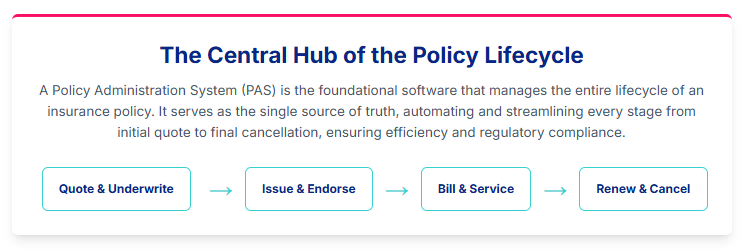
It automates and streamlines core tasks that were historically performed via paper files or legacy mainframe systems, thereby reducing manual effort and errors. Importantly, a modern policy admin system is used not only by insurance carriers (insurers underwriting the risk) but also by MGAs and other intermediaries who administer policies on behalf of insurers. By providing a single source of truth for policy data and documents, the PAS enables different departments – from underwriting and customer service to finance and claims – to access up-to-date information and work in a coordinated manner.
Key capabilities of policy administration software include:
Quoting and Underwriting: Supporting the rating of risks and generation of insurance quotes, and facilitating the underwriting process by assessing risk factors and determining appropriate premiums. This often involves applying underwriting rules and product guidelines to decide whether to accept a risk and at what price.
Policy Issuance and Endorsements: Once a policy is bound (i.e. the customer agrees to purchase), the system issues formal policy documents and contracts. It then maintains the policy throughout its term, allowing adjustments or endorsements (mid-term changes such as adding a coverage or updating details) to be processed accurately and reflected in updated documentation.
Renewals and Cancellations: A PAS tracks when policies are due to expire and can automate the renewal process generating renewal quotes or documents to continue coverage into the next term. If a policy is not to be continued, the system handles cancellations or lapses, ensuring proper notification and record-keeping for policy termination.
Billing and Payment Management: Modern policy admin platforms integrate with billing functions, calculating premiums, handling payment schedules, and issuing invoices. They often support various payment methods and installment plans, posting payments and updating policy status accordingly. This ensures that premium collection is tightly linked with coverage in force.
Claims Integration: While claims are typically managed in a separate claims management system, a policy administration system interfaces with it, providing the necessary policy coverage details to validate claims and update policy records if a claim affects the coverage (for example, aggregating claims against policy limits). Some PAS solutions include basic claims tracking or at least enable a seamless flow of data to and from dedicated claims platforms.
Compliance and Reporting: Given the heavily regulated nature of insurance, policy admin software is built to ensure that every transaction and document is compliant with current laws, regulations, and industry standards. The system enforces underwriting authority limits, rating guidelines, and regulatory rules (such as auto-generating required information on policy documents). It also produces reports for regulators and management, aiding transparency and oversight. For instance, insurers can generate regulatory returns or audit trails directly from the system.
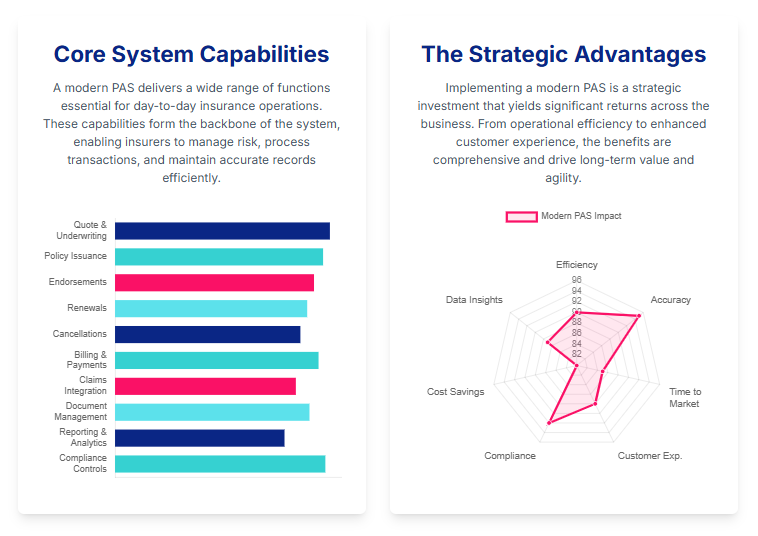
These capabilities illustrate why policy administration software is considered the backbone of an insurer’s IT infrastructure it handles all the critical transactions that turn underwriting and sales efforts into enforceable insurance contracts. In the UK, a policy admin platform must be able to accommodate market practices like mid-term adjustments (MTAs, equivalent to endorsements) and to interface with broker systems, whereas in the US it might need to handle multistate compliance variations.
The core functions, however, remain largely the same across regions: a single system to input, store, process and retrieve all information related to insurance policies.
Key Functions of a Modern Policy Admin System (PAS) | Comparison
To better understand the scope of a PAS, the table below provides a structured breakdown of key functionalities in modern policy administration software and what each entails:
| Functionality | Description |
|---|---|
| Quote & Underwriting | Supports initial quoting by capturing risk information and applying rating engines to calculate premiums. Enables underwriters to evaluate risk and set terms. |
| Policy Issuance | Generates formal policy documents once coverage is bound and records all details of the insurance contract. Issues schedules, certificates, and policy wording to the insured |
| Endorsements (Changes) | Processes mid-term policy changes (e.g. adding a driver to a motor policy or increasing sum insured on a property) and automatically recalculates premium or terms as needed. |
| Renewals | Automates renewal underwriting by notifying expiring policies, generating renewal quotes or offers, and renewing coverage for the next policy term upon acceptance. |
| Cancellations | Handles policy cancellations or terminations (mid-term or at expiry) including calculations of any return premium and ensuring proper record closure. |
| Billing & Payments | Integrates with billing systems to schedule premiums, handle collections, allocate payments, and manage arrears or lapses for non-payment. Often supports direct debit, credit card, and other payment methods. |
| Claims Integration | Provides claims systems with policy coverage data to validate coverage at time of claim. May allow claims status lookups from within the PAS and update policy records upon claim settlement. |
| Document Management | Automatically generates and stores all policy documents (quotes, policies, endorsement letters, renewal notices, etc.) and correspondence. Ensures version control and easy retrieval of policy records. |
| Reporting & Analytics | Produces standard reports (e.g. premium volumes, policy counts, regulatory reports) and offers business intelligence on the portfolio. Modern systems often include dashboards for underwriting performance and risk analytics. |
| Compliance Controls | Embeds rules to enforce regulatory compliance (e.g. UK policyholder notifications, treating customers fairly guidelines) and internal business rules. Facilitates audits and ensures each policy transaction meets required standards. |
Table: Key functionalities of a modern Policy Administration System and their descriptions.
This comprehensive feature set highlights why selecting a robust PAS is a strategic decision for insurance organisations. Beyond these core functions, many policy admin platforms also offer role-based user interfaces (for underwriters, brokers, operations staff), workflow tools for task routing, and APIs for integration with digital channels or insurtech add-ons. In summary, policy administration software centralises all policy lifecycle activities, enabling insurers to operate efficiently at scale while maintaining accuracy and control.
Benefits of Policy Administration Software
Upgrading or implementing a modern policy administration system can deliver significant benefits to insurance companies, their staff, and their customers. Below are key advantages and value drivers associated with contemporary PAS platforms:
Improved Operational Efficiency: Automation of routine tasks (such as data entry, document generation, and calculations) dramatically reduces manual workload and processing times. Insurers report that by streamlining policy workflows, they can issue policies and endorsements much faster and with fewer errors, allowing staff to handle more policies with the same resources. In practice, this means quicker turnaround on quotes and changes, which in turn lets the business write more business and focus human effort on higher-value activities (like product design or complex underwriting).
Greater Accuracy and Reduced Errors: By minimizing human intervention in calculations and record-keeping, PAS software helps eliminate common errors. Important data (coverage amounts, premiums, customer details) is entered once and reused throughout the system. This consistency ensures that policy documents and statements are accurate. According to industry analysis, fewer manual touchpoints lead to significantly lower error rates in policy issuance and servicing. A reliable system also enforces underwriting rules uniformly, so nothing is overlooked, thereby increasing the quality and correctness of policy data across the board.
Faster Time-to-Market & Flexibility: A modern policy admin platform offers insurers the agility to introduce new products or modify coverage quickly. For example, companies can configure new insurance products, rates, or endorsements in the system without lengthy IT projects, responding rapidly to emerging market opportunities or regulatory changes. This product and pricing flexibility translates to improved speed to market.
In a PwC analysis, carriers with modern core systems achieve faster product launches and can adapt to pricing pressures more readily than those stuck on legacy platforms. Ultimately, being able to swiftly adjust offerings (such as adding a cyber insurance add-on or updating policy wording post-Brexit) gives insurers a competitive edge.
Enhanced Customer Experience: Policyholders and distribution partners (like brokers) benefit directly from efficient policy administration. When policies are issued correctly and swiftly, and endorsements or claims are handled without delay, customer satisfaction increases. A PAS supports timely communications issuing documents on schedule and providing customer service reps with up-to-date information to answer queries instantly.
Features like accurate billing and quicker policy changes lead to a smoother customer journey, which boosts retention In short, policy admin software underpins better service: fewer mistakes in policies, faster response times, and the ability to offer modern conveniences (like digital policy documents or self-service portals tied into the core system).
Regulatory Compliance and Risk Management: Insurance is a regulated business, and non-compliance can result in fines or reputational damage. A key benefit of good policy administration software is that it helps ensure compliance is baked into operations. The system can enforce approval workflows for underwriting exceptions, include mandatory disclosures in documentation, and keep an audit trail of all changes.
It also simplifies regulatory reporting – for example, generating the data needed for FCA returns or Lloyd’s oversight reports. By ensuring policies align with the latest rules (such as the FCA’s pricing and product governance regulations), a PAS reduces the risk of inadvertent non-compliance. This is particularly vital in markets like the UK and South Africa, where regulators expect firms to have adequate systems and controls to manage their business responsibly
Cost Savings and Productivity Gains: Replacing fragmented legacy systems with an integrated PAS can yield substantial cost savings over time. Automation cuts down on labor-intensive tasks and the costs associated with errors or rework. Insurers can often reduce IT maintenance costs by retiring multiple old systems once a unified platform is in place. Moreover, streamlined processes translate to handling more business without proportional headcount growth.
Industry examples note that automating policy administration not only reduces operating expenses but also frees up teams to focus on revenue-generating activities, thereby improving profit margins. In the long run, lower operational costs and improved efficiency contribute to better combined ratios for insurers.
Data Insights and Integration: Modern policy admin solutions often come with robust data analytics and reporting tools. They consolidate all policy data, which can be analysed to identify trends (for instance, loss ratios by segment or uptake of new product features) and to inform strategic decisions. Ready access to clean policy data also facilitates integration with advanced analytics, pricing models, or even AI tools. For example, insurers can use PAS data to fuel pricing optimization models or to feed customer relationship management (CRM) systems for targeted marketing.
These insights help in refining underwriting guidelines and tailoring products to market needs. Additionally, the ease of integration means the PAS can be part of a broader digital ecosystem connecting with claims, reinsurance systems, or comparison websites providing a more holistic and responsive insurance operation.
In summary, a state-of-the-art policy administration system is more than just a back-office tool; it is a strategic asset that drives efficiency, agility, and reliability in insurance operations. Firms that invest in modern PAS technology position themselves to deliver better service and innovate rapidly, all while keeping operational risks and costs in check.
Evolution of Policy Administration Systems
The concept of policy administration in insurance is not new. Insurers have been managing policy records for as long as insurance has existed. However, the technology underpinning policy admin has evolved dramatically over the past few decades:
Legacy Era (Mainframes and COBOL): Traditionally, insurance companies (especially large UK insurers and US carriers) built their own policy management systems on mainframe computers or early IT platforms. Many of these legacy PAS solutions were developed in the 1980s and 1990s using COBOL or similar languages. They were often monolithic, inflexible systems, heavily customised to each insurer’s products and processes.
While reliable in their time, these older systems are difficult to maintain and costly to update with new features. In fact, Deloitte has noted that many insurers remain “stuck” with aging policy admin systems, which have become a Gordian knot, a complex tangle that is hard to unravel. Crucially, such legacy PAS often represent the single greatest barrier to insurers looking to design innovative products or provide modern customer service, because any change to the product or process in a legacy system can be laborious and risky.
Workarounds and Bolt-on Solutions: Through the late 1990s and 2000s, instead of fully replacing core systems, many insurers tried to cope by bolting on supplementary systems or using manual workarounds. For example, if the core policy system couldn’t easily support a new line of business or a broker portal, the insurer might build an external database or spreadsheet-based process and then reconcile it back into the main system.
As PwC observes, insurers “largely worked around” their legacy policy admin, claims, and billing systems with manual processes and one-off tech fixes. This approach could keep the business running in the short term, but it led to fragmented data, inefficiencies, and high operational risk. By the 2010s, the pressure to modernise became greater due to mounting maintenance costs and the digital expectations of customers.
Modern Core System Transformation: The industry reached a tipping point where the convergence of aging platforms, shifting market demands, and more demanding clients made replacing policy admin systems a priority. In the UK, for instance, insurers found that legacy systems built around products (silos for motor, home, etc.) were hindering efforts to be more customer-centric and offer multi-product packages. Thus, many carriers embarked on core system transformation projects in the 2010s and early 2020s, often choosing either to buy modern commercial PAS software or to build new systems using contemporary architectures.
Modern policy administration platforms are typically cloud-based, modular, and configurable, a stark contrast to the inflexible old mainframes. The evolution has been described as moving from “cumbersome, monolithic systems” to flexible, adaptive solutions, fundamentally changing the insurance industry from the inside out. Key modernisation trends included adopting cloud computing for scalability and cost-effectiveness, and more recently, leveraging microservices architecture, breaking down policy admin functions into smaller, independently deployable components.
This microservices approach, increasingly common in new PAS offerings, allows insurers to update parts of the system (say, the rating engine or document module) without impacting the entire platform, greatly improving agility.
Current and Future State: By 2025, the modern policy admin system is often part of a broader core insurance suite that includes claims and billing, and possibly customer relationship management. Leading insurers in the UK and globally are focusing on digital integration, making sure their PAS can easily connect via APIs to insurtech services, comparison sites, and partner systems.
For example, insurers at Lloyd’s of London are aligning their systems with market-wide digital initiatives like Lloyd’s Blueprint Two, which aims to digitalise the insurance market’s processes end-to-end. The Blueprint Two programme underscores the market’s push for data standards and straight-through processing of risks and policies, which modern PAS must be able to support. In parallel, advances like data analytics, artificial intelligence, and straight-through processing are being incorporated into policy admin platforms to enable things like automated underwriting decisions for simple risks or personalised policy recommendations.
The evolution is ongoing, but one thing is clear: insurers that have modernised their policy administration capabilities are better positioned to innovate and compete. Those that have not yet done so face increasing urgency as PwC warns, carriers that do not adapt and replace their outdated core systems risk losing market share while also suffering higher costs.
In sum, the journey of policy administration systems reflects the broader digital transformation of insurance. Where once an in-house mainframe might have been the only option, today insurers can leverage cloud-based PAS platforms that are continually updated and compliant with the latest standards. The historical challenge has been managing the transition replacing a core system is famously complex, but the strategic payoff is substantial in terms of business agility and cost reduction.
This history also explains why many established insurers in markets like the UK have undergone multi-year transformation projects to modernise their policy admin: it’s a necessary step to remain relevant in a fast-moving, customer-driven environment.
Regulatory and Compliance Considerations
Insurance companies must operate within strict regulatory frameworks, and policy administration software plays a pivotal role in helping firms meet these obligations. Below we outline how PAS aligns with key regulatory requirements and market practices in the UK (with notes on South Africa and the US):
UK – FCA Requirements: The UK’s Financial Conduct Authority (FCA) expects insurers and intermediaries to have robust systems and controls in place for all aspects of their business. In fact, Principle 3 of the FCA’s Principles for Businesses and the SYSC (Senior Management Arrangements, Systems and Controls) rules explicitly require firms to “take reasonable care to establish and maintain such systems and controls as are appropriate to [their] business.”. A modern policy administration system helps fulfill this by providing a controlled environment where policy processes are standardised, transparent, and auditable.
For example, with a PAS an insurer can ensure that policy documents are issued promptly and contain all information mandated by the FCA’s ICOBS (Insurance Conduct of Business) rules such as policy summaries and cancellation rights. Furthermore, the FCA’s Product Oversight and Governance rules (PROD) require insurers to monitor and review insurance products to ensure they deliver fair value to customers. PAS platforms support this by capturing detailed product data and performance metrics, making it easier to generate reports on how products are being sold and used, and to ensure pricing changes or product adjustments are consistently applied to all policies in force.
UK – Lloyd’s and London Market Practices: Insurers and MGAs operating in the Lloyd’s of London market face additional oversight and data requirements. Lloyd’s has been driving market modernisation efforts (Blueprint Two) that aim to digitise risk placement, policy issuance, and downstream processes “to make [the market] better, faster, and cheaper for all participants.” Policy admin software used by Lloyd’s syndicates or coverholders needs to integrate with Lloyd’s central systems and standards. For instance, Lloyd’s has specific tools for delegated authority business (coverholder arrangements) such as the Delegated Data Manager (DA SATS) for reporting risk and policy data.
A PAS that’s aligned with these standards can automatically produce the required data uploads and support compliance with Lloyd’s reporting requirements. Additionally, UK insurers must comply with Solvency II (EU/UK solvency regulations) and IFRS 17 (insurance contract accounting standards), both of which demand granular data on policies and cash flows. A capable policy administration system helps firms compile the necessary data for actuarial models and financial reports, ensuring that regulatory capital calculations and financial disclosures are based on accurate, up-to-date policy information.
South Africa – Regulatory Alignment: The South African insurance market, while smaller than the UK’s, similarly emphasizes strong regulatory compliance and systems. The Financial Sector Conduct Authority (FSCA) oversees insurers and has its own set of rules to ensure fair customer treatment and solvency (South Africa implemented a Solvency Assessment and Management regime akin to Solvency II). For brokers, UMAs (Underwriting Management Agencies, similar to MGAs) and insurers in South Africa, having a reliable policy admin system is considered essential for compliance.
A PAS in South Africa will support adherence to local regulations such as binder regulations (which govern the delegation of policy admin authority to UMAs) by tracking all delegated transactions and enabling the insurer to audit them. It also helps ensure that required disclosures (in policy schedules or renewal notices) meet the standards of the FSCA. Just as in the UK, maintaining rigorous regulatory adherence is much easier with an automated system that flags non-compliant entries and keeps users following defined processes, rather than relying on potentially inconsistent manual methods.
United States – State Compliance and Filings: The US insurance regulatory environment is highly decentralised, with each state’s Department of Insurance setting its own rules and approving insurance products and rates. This means insurers must manage a complex matrix of compliance requirements. Policy admin software in the US context typically includes features to handle multi-state variations, for example, applying state-specific forms and endorsements automatically based on the insured’s location. One of the biggest advantages of modern PAS in the US is the ability to respond quickly to regulatory changes or filing objections.
As noted by Accenture, state regulators frequently raise objections to product and rate filings, and having a system that allows rapid product changes is crucial to keeping up with these demands. With a flexible PAS, an insurer can implement a regulator’s requested change (such as altering a rate factor or adding a disclosure) across all new and in-force policies with speed and accuracy, thereby avoiding compliance breaches. Additionally, many US PAS solutions integrate with bureau content (like ISO circulars for property/casualty insurance) to automatically update policy definitions when industry standards change, which again helps insurers stay compliant with less effort.
Data Protection and Record-Keeping: Across jurisdictions, regulators expect insurers to maintain proper records of policies and to safeguard customer data. Policy administration systems support this by securely storing all policy information and communications. In the UK/EU, where GDPR and UK Data Protection Act apply, a PAS must protect personal data and allow for data retrieval or deletion requests as needed. It also ensures that documents like policy contracts are retained for the legally required durations. Good policy admin software will have role-based access controls to prevent unauthorized data access, helping firms meet their data protection obligations as part of operational resilience and governance.
In conclusion, alignment with regulatory frameworks is a core design consideration for policy administration software. These systems are often built with compliance in mind, enabling insurance companies to embed regulatory checks into their workflows (for example, preventing a policy from being issued if it fails certain validation rules) and to demonstrate to regulators that they have control over their processes.
By using a modern PAS, insurers in the UK can more easily satisfy the FCA’s expectations on systems and controls, while Lloyd’s market participants can meet market standards and reporting duties. Likewise, insurers in other regions can localise the system to their regulatory context, whether that’s U.S. state insurance codes or South African rules. In all cases, the end result is the same: a reduced risk of compliance breaches and a stronger ability to evidence that the firm is in control of its business.
Policy admin software: now and in the future
Policy administration software is the cornerstone of insurance operations, providing the digital foundation on which insurers build products, serve customers, and meet their obligations. In the UK insurance market, as well as in comparable markets like South Africa and the US, a modern policy administration system is indispensable for any insurer or MGA aiming to remain competitive and compliant.
It combines all the essential capabilities (quoting, underwriting, policy issue, servicing, billing, and integrations) into one coherent platform, thus replacing fragmented legacy processes with an efficient, centralised solution. Crucially, a PAS enables speed and agility in a sector where timely response to market changes and regulatory updates is vital. It helps insurance professionals focus on underwriting and innovation rather than paperwork and firefighting operational issues.
As we have seen, the evolution from manual and legacy systems to today’s flexible, cloud-based platforms has unlocked tremendous benefits from cost savings and faster product launches to improved accuracy and customer satisfaction. Moreover, policy admin software ensures that an insurer’s heart, its book of policies, is managed with precision and transparency, aligning with the high standards expected by regulators like the FCA and industry bodies such as Lloyd’s.
With the market every-changing, having the right PAS in place is vital. It underpins everything from regulatory compliance to the ability to distribute insurance digitally or launch new offerings. In essence, policy administration software is the engine that drives the insurance business forward, turning underwriting intents into enforceable contracts and customer promises into delivered service.
For insurance professionals evaluating their core systems, it’s clear that investing in a robust PAS brings long-term rewards. Whether the goal is to streamline operations in a Lloyd’s syndicate, expand an MGA’s product lines, or ensure compliance across multiple jurisdictions, the right policy administration platform provides the necessary capabilities.
As the industry continues to modernise (with trends like AI, straight-through processing, and ecosystems on the horizon), having a solid policy administration foundation will allow firms to adapt and integrate new tools much more readily. In summary, policy administration software is both a safeguard of today’s business, maintaining order and compliance and an enabler of tomorrow’s innovation, giving insurers the confidence and capacity to evolve in the face of new opportunities and challenges.