
Love your fate.
The line James Bilham keeps coming back to is Latin, and he learned it after the accident rather than before. Amor fati. Love your fate. He is careful to say it does not mean "it is what it is," the shrug people reach for when they want to sound at peace and are not. He means something with more teeth than that.
We will get to the cliff. First, the news, because James is the reason for it. This September he leads the Chester leg of the Tour de InsurTech, the cycling series Genasys is running across the season. He is a qualified British Cycling coach who used to lead group rides for a living, which means the riders setting off from Chester are in better hands than most. When the conversation turns to ride safety he is immediately, unmistakably the expert in the room, talking about group sizes and spacing and what happens on a long country road when a line of cyclists gets too long for a car to pass. The man knows bikes. He just rides a different one now.
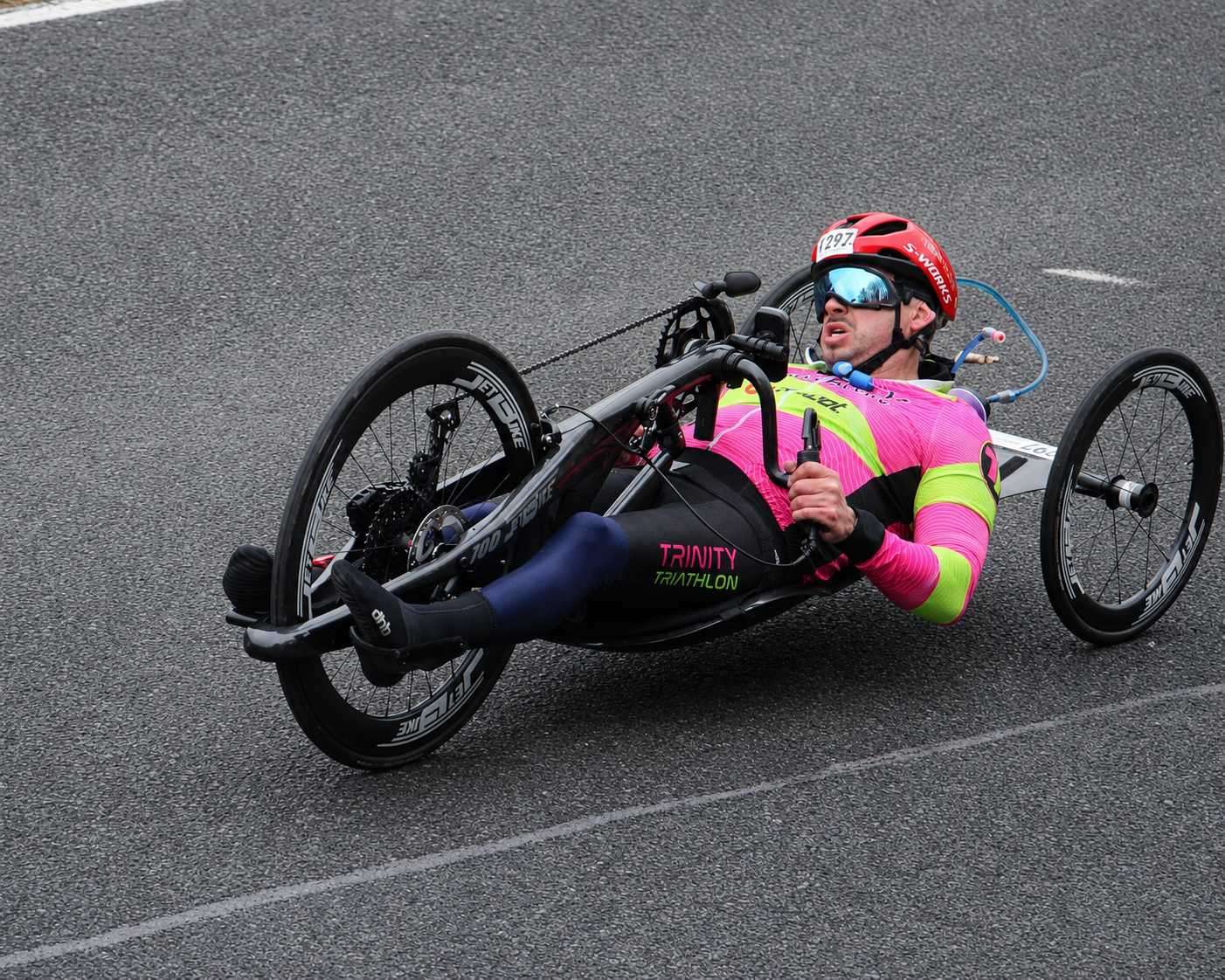
BeforeThe business, then the cliff
Before the cliff, James ran Verius Risk Solutions, a data business for insurers. It collected information about motor insurance claims and analysed it for fraud, and it was starting to find its feet. There was a car rental firm using the product on subscription and proof-of-concept work running with Experian and a couple of insurers directly.
Then, in his words, he "literally went off a cliff."
It was his brother's stag do. His brother is teetotal, so the whole thing was, James says, "a very grown-up affair" at Lake Garda. The group hired mopeds and motor trikes to see the sights. It was the middle of the day. They were coming down one of the mountainsides that ring the lake when the accident happened and the trike careered off the edge.
"I woke up looking at the Italian sunshine, flat on my back," he says, "with my brother giving me a slap to the face, going, wake up, talk to us, don't go to sleep, ambulance is on its way."
What followed was a blur of consciousness and unconsciousness: treated on the side of the mountain, airlifted to the road, treated again, airlifted to hospital. Then scans, and then a week he does not remember. He woke up to be told he had broken his back in several places, injured his lungs badly and sustained a spinal cord injury. He had very nearly died. The reason he had not, the doctors told him, was that he had been fit and healthy going in. As for what came next, nobody could say. He might never walk again. He might walk. They did not know.
Coming to terms"Okay"
Here is the part that is hard to credit until you hear how flatly he says it. James came to terms with it in hospital, in Italy, within hours.
"My wife, my mum, my dad, my brothers, saying to me, James, you've got a spinal cord injury, you might never walk again. And I just remember going, okay."
He is at pains to separate two things that sound the same and are not. He came to terms with it. He did not accept it. "Some things in life you can't undo," he says, and a spinal cord injury is one of them. But the prognosis had a gap in it, and he climbed straight into it.
"No one said I won't. They said I might. Well, if I might not walk, then I might walk."
He puts the optimism down partly to temperament and partly to having been a founder. "Anybody that starts a business has to be an optimist," he says. "You don't start a business if you're a pessimist. There are no certainties. You have to take risks, and to take risks you have to believe there's an upside." His wife, he notes cheerfully, is the opposite, a realist who spent the early days telling him to be realistic. His reply is not printable in full, but the gist was that realism had never got him anywhere he wanted to be.
The framework that gave shape to all this came from Mo Gawdat, the former Google X executive who wrote about happiness after losing his son. James listened to it on audiobook during recovery, and it reduces to three questions asked in order. Is it true? Can you change it? How do you live with it?
Applied to a hospital bed it goes like this. Is it true that I have a spinal cord injury? Yes, the scans show it. Can I change it? No. So the only live question is the third one, and James has spent four years answering it.
The journey homeThe flight home
The answering started before he had even landed. Once it was clear he would live, James was flown back from Italy on a medical jet, a private aircraft with the seats taken out and a stretcher in their place. His father had stayed on the last couple of days to help organise it, and flew home beside him. Halfway across Europe, James turned to him.
"We've done it, dad."
His father, reasonably: "What?"
"We're on a private jet, mate." Very Del Boy. This time next year, Rodney.
His father looked at him on the stretcher. "This isn't quite what I had in mind, James."
The comebackHow you live with it
The first answer was rehab, all of it, with nothing held back. "I wouldn't have been able to live with myself if I'd given up at the first sign of things being difficult," he says. He had spent his life following processes with bad days in them, in business and in training for marathons and on the bike, and he knew the rule that governs all of them: if you skip the work, you do not get to wonder why the result did not come. He was not going to look back and tell himself he would be walking if only he had committed to the physio.
The second answer was to find new sport where the old sport used to be. There are things he simply cannot do. He cannot run. "There are things in my feet where the nerve just doesn't fire," he says. "It doesn't matter how hard I think about it, my toes will not move." So he stopped trying to win an argument he could not win, and went looking for a different game.
It started in the pool. The rehab unit had a gym and a swimming pool attached, and James, who could swim a bit but not properly, got in as part of his recovery. The water gave him back something. "It felt the most similar to what it had felt like before the accident," he says.
The proper route in came at the Inter Spinal Unit Games, an annual sports day where spinal units gather and try a bit of everything. James did the swimming in the morning. He went on to two more days run by British Triathlon and got hooked. Out of that came para triathlon, the hand cycle, the racing chair and the eight to twelve hours a week he now trains on top of his physio.
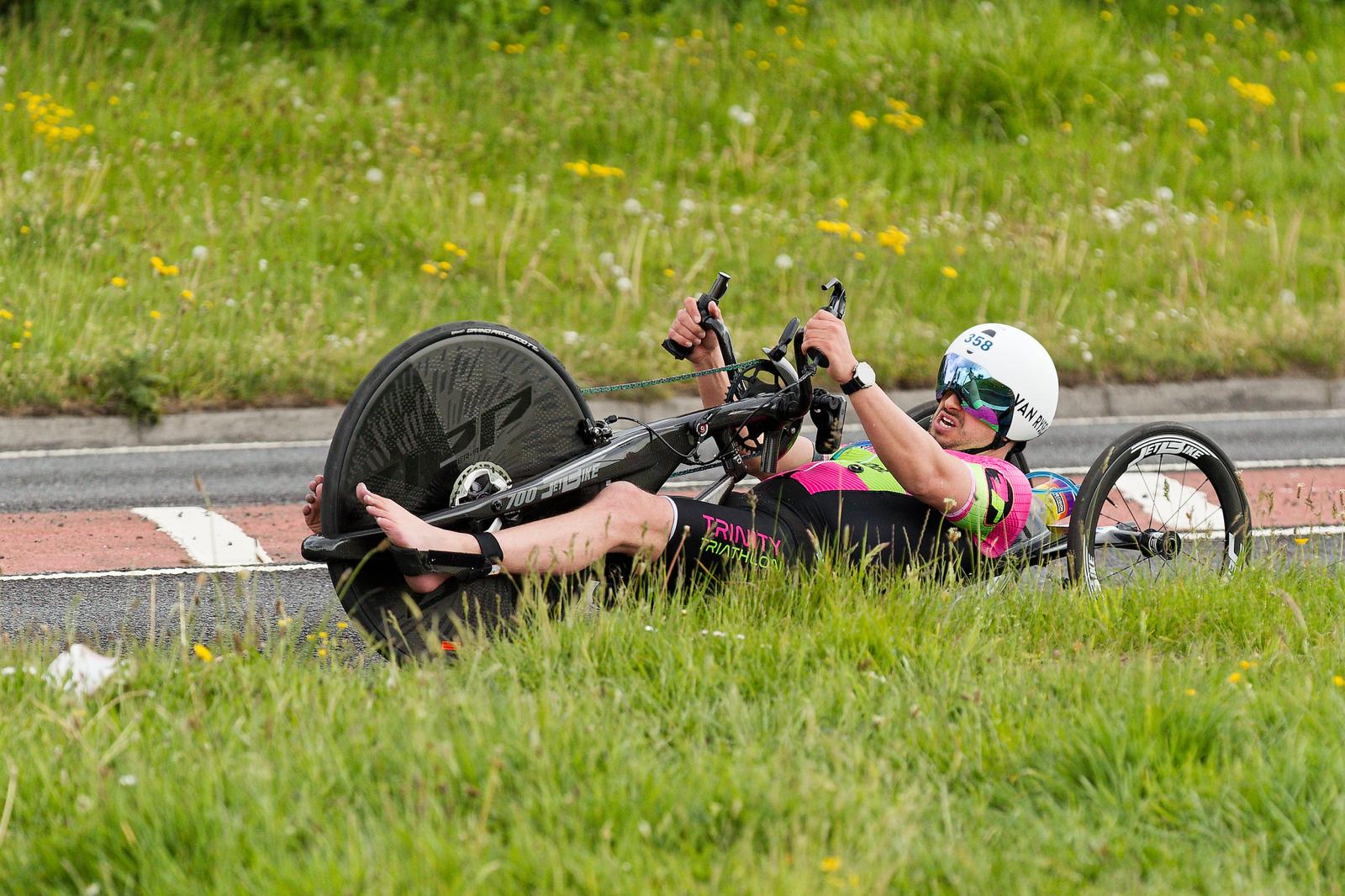
"It's not worse. It's different. And sometimes it's better."
This is where amor fati stops being a slogan and becomes a fact about his life. He trains on Monday nights in his racing chair alongside nine-time Paralympic gold medallists. None of that existed in the version of his life where the trike stayed on the road.
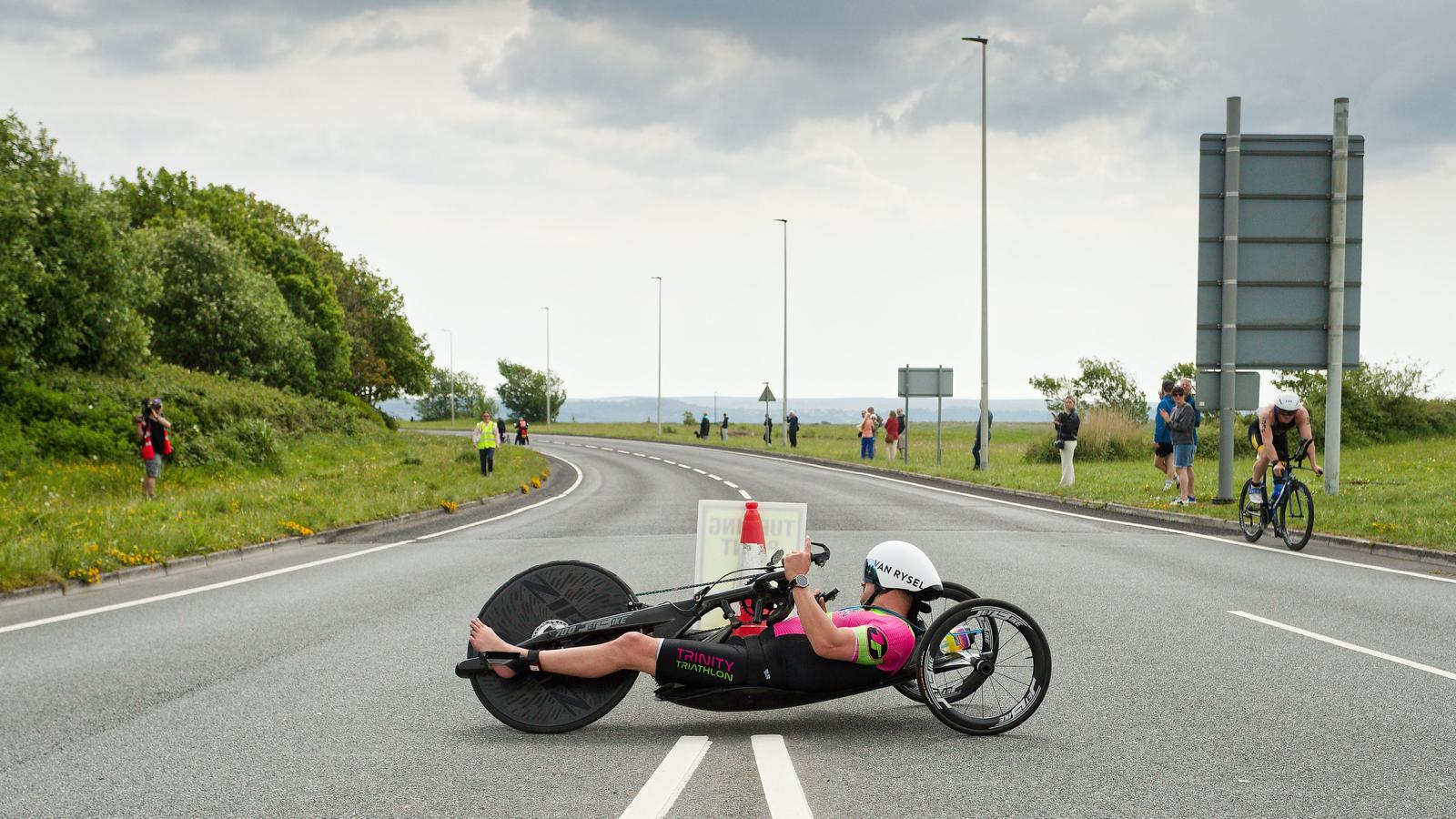
The honours followed. James is the reigning British Para Triathlon wheelchair champion, a two-time British Para Duathlon wheelchair champion and a two-time super series winner. In mid-July he pulls on Team GB colours for the European Aquathlon Championships. Asked what he expects, he gives the most James answer available. "I'm likely to be European champion, on the basis that at the moment there's no one else entered in my category." Then the line that tells you how he thinks: "Take the wins. Don't let the truth get in the way of a good story." He will represent his country. That, he says, is a win.
This SeptemberLeading out Chester
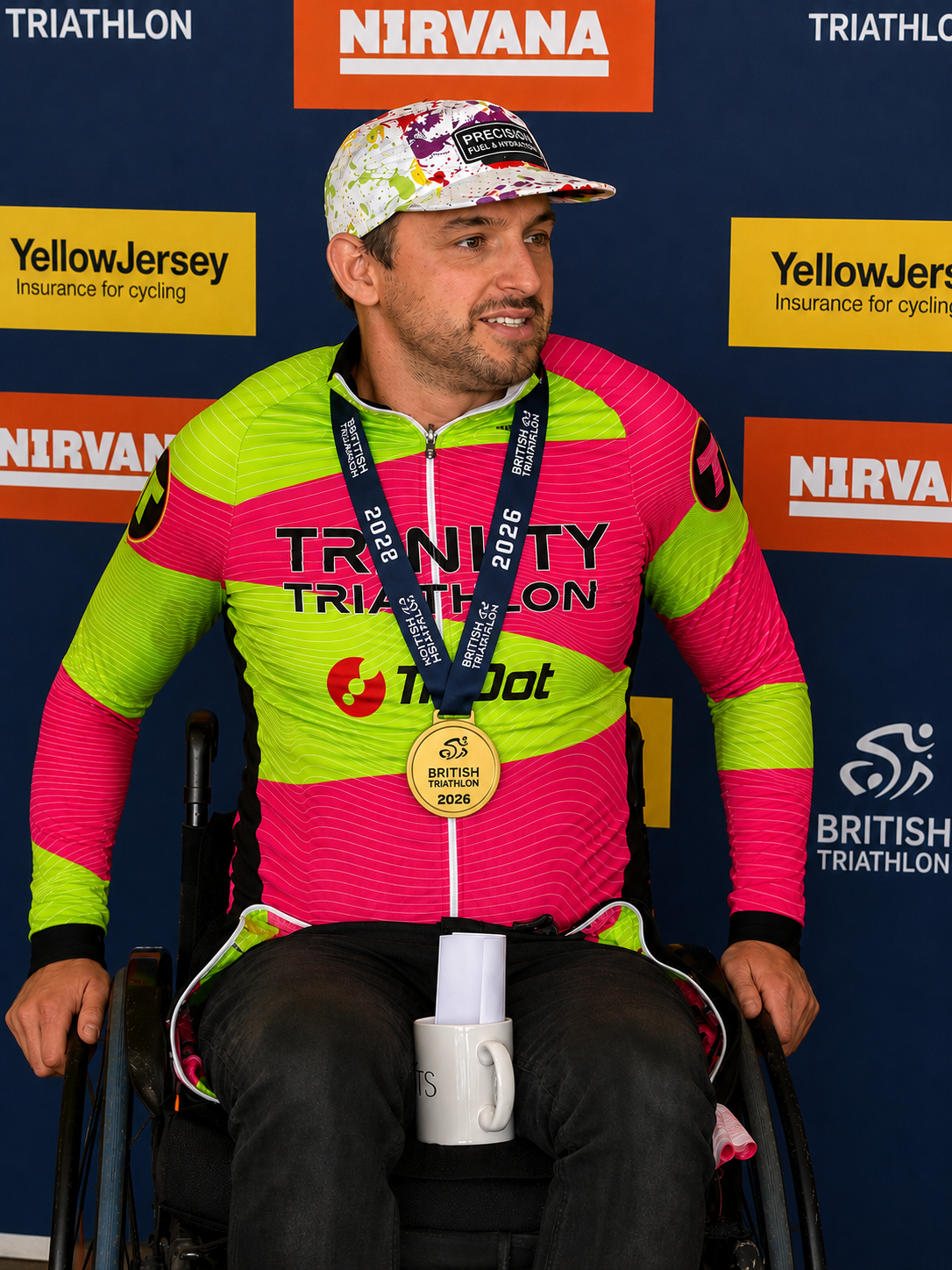
It is hard to spend an hour listening to James and come away unchanged. He talks about breaking his back the way most people talk about a delayed flight, plainly and with jokes, and at no point does he ask for sympathy. The effect is odd and specific. Whatever felt heavy at the start of the conversation feels lighter by the end of it. He hands you perspective without once using the word.
He would probably resist the word inspiring too. The facts make it hard to avoid. Four years ago he was strapped to a stretcher on a medical jet, finding the win in the situation. This month he races for Team GB. And in September he leads a group of insurance people out of Chester, a British Cycling coach who knows exactly how to bring a ride home safely and who worked out what he could still do, then did all of it.
Come and ride with him.