The 16 Billion Credential Leak: A Data Security Wake-Up Call
Last week, over 16 billion digital credentials were exposed in a public data dump. This wasn’t just old data recirculating; a significant portion of these logins, including those for major platforms like Apple, Google, Facebook, and GitHub, were fresh, stolen via sophisticated infostealers. For the insurance industry, operating in an increasingly SaaS-driven and remote-first world, this event isn’t just news, it’s a critical stress test for your data security model. Effective data security for insurance data is now paramount.
The stark reality is this: a single compromised password, perhaps from a personal streaming service or an old forum, can now become the weakest link. In the insurance sector, where remote teams rely heavily on cloud-based tools and handle vast amounts of highly sensitive customer data (PII, financial details, health information), such a compromise doesn’t just risk a personal account.
It risks client trust, regulatory compliance, and the very stability of your business. The traditional ‘strong password and hope’ approach to cybersecurity is fundamentally broken. It offers a flat, undifferentiated shield in a world demanding multi-layered defences.
Why Your Current Data Security Model Fails in a Modern Insurance Landscape
Many organisations, and indeed many individuals within them, still operate under a ‘flat security’ paradigm. They focus on individual strong passwords and perhaps a basic authenticator app. There’s little to no prioritisation, no contextual understanding of data sensitivity, and a dangerous assumption that all digital assets are equally protected.
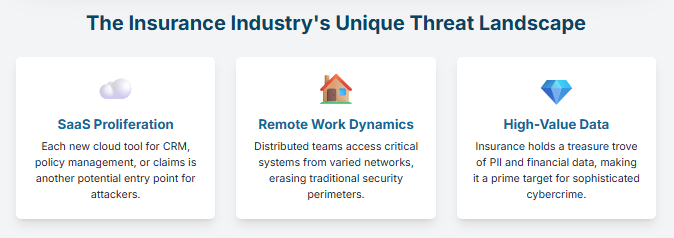
This approach is no longer sufficient for the complexities of the insurance industry, especially when managing vast volumes of client insurance data. Your teams use countless cloud applications for CRM, policy administration systems, claims processing, and communication. Each SaaS platform represents a potential entry point, highlighting the need for robust data security.
Distributed workforces access critical systems from diverse locations and networks, blurring traditional perimeter defences. This decentralisation elevates the need for proactive data security across all remote operations. Ensuring consistent protocols is crucial for safeguarding sensitive information.
Insurance companies are custodians of extremely valuable and sensitive client insurance data, making them prime targets for malicious actors seeking financial gain or identity theft. Implementing the right insurance software is crucial to holistically protect this vital information and maintain your competitive edge.
Regulatory bodies like HIPAA, GDPR, and CCPA impose stringent requirements, and breaches carry severe penalties. Comprehensive data security strategies are vital to ensure compliance and avoid costly repercussions. Robust security also supports your speed-to-market capabilities, enabling agile business growth.
You need a robust, adaptable, and layered security model, a framework that ensures your most critical assets remain secure, even if vulnerabilities emerge at the periphery. This model is key to protecting your sensitive insurance data. For instance, a strong policy admin capability provides a solid operational security layer.
The Nine Circles: A Resilient Personal Data Security Model for Insurance Professionals
Envision your entire digital footprint, both personal and professional, as nine concentric circles. As you move inward, the data becomes exponentially more sensitive, and the consequences of a breach escalate dramatically for you, your clients and your firm.
| Circle | What’s in it (Insurance Context) | If breached (Business Impact) | Recommended Protections (for Insurance Professionals) |
|---|---|---|---|
| 9 | Public bios, LinkedIn, professional posts | Impersonation risk, brand reputation impact | Unique, complex passwords; dedicated professional profiles; brand monitoring |
| 8 | Social media content, public professional groups | Employee profiling for phishing, brand reputational damage | Strict privacy settings; robust 2FA; internal social media guidelines; employee training |
| 7 | Business email, internal chat, DMs | Enterprise-wide compromise, data exfiltration entry point | Secure email gateway; encrypted communication platforms; advanced phishing training; 2FA on all business accounts |
| 6 | SaaS tools (non-critical policy data), streaming, general apps | SaaS account takeover, lateral movement risk, nuisance access | Enterprise password manager (e.g., LastPass, 1Password); unique, strong passwords; SSO where available |
| 5 | Browsing history (work-related), location, cookies | Corporate surveillance, intellectual property exposure, advanced phishing | Hardened browser (with security extensions); enterprise VPN (always on for remote work); strict browsing policies |
| 4 | Internal reports, non-client notes, drafts, personal files | Blackmail, internal data exposure, privacy breach | Full disk encryption (FDE) on all work devices; secure, encrypted cloud backups (e.g., SharePoint, Google Drive with enterprise encryption) |
| 3 | HR documents, internal ID, medical info (employee) | Identity fraud for employees, internal compliance breaches | Zero-knowledge storage solutions; robust access controls; encrypted, offline copies for essential HR docs |
| 2 | Client policy data, financial records, claims data, regulatory filings | Severe financial loss, regulatory fines (HIPAA, GDPR, CCPA), massive reputational damage | Hardware-based Multi-Factor Authentication (MFA); isolated, segmented network access; granular role-based access controls (RBAC); regular compliance audits |
| 1 | Master credentials (IT admin, security keys), root access, sensitive client keys | Catastrophic business failure, total data loss, irreversible compliance violations | Offline storage (air-gapped); locked physical access to hardware; no network exposure for master keys; comprehensive audit logs and monitoring |
How This Layered Model Protects Your Insurance Data
Adopting the Nine Circles model provides your insurance firm and its remote workforce with a powerful defence strategy:
- Stops the Cascade: If a peripheral account (like a social media profile, Circle 8) is compromised, it does not automatically grant access to critical client data (Circle 2) or master systems (Circle 1). Each layer maintains its distinct security posture, protecting your insurance data effectively.
- Guides Incident Response: In the event of a suspected breach, you gain immediate clarity on the potential blast zone. A compromised business email (Circle 7) directs your focus, allowing for targeted investigation and containment, escalating inward only if direct evidence of deeper penetration is found. This effective data security minimises impact.
- Isolates the Damage & Ensures Compliance: This model promotes data segregation. Public-facing information is allowed to ‘float,’ while sensitive client data is rigidly protected, often in environments specifically designed for compliance. It reinforces the principle: critical insurance data never touches unsecured cloud platforms or personal devices. This directly aids in meeting stringent regulatory requirements.
- Scales Across Your Organisation: This intuitive framework can be easily understood and adopted by every member of your team, from new hires to executive leadership. By establishing a shared mental model for data sensitivity, you foster a pervasive culture of data security, crucial for managing risk in distributed teams handling shared, sensitive insurance data.
Immediate Data Security Action Steps for Insurance Professionals
Given the recent breach and the evolving threat landscape, here’s where your firm and its employees should focus immediately. Proactive data security is vital to protect your valuable insurance data assets.
-
- Audit Circles 9 to 7: Mandate a review of all public profiles, social media, and business email accounts. Enforce unique, strong passwords and universal 2FA on all business-critical applications. Implement advanced phishing awareness training tailored to common insurance industry threats.
- Secure Circles 4 and 3 Data: Verify that all internal documents, employee data, and less sensitive client information are encrypted, both at rest and in transit. Ensure secure, version-controlled backups are in place, accessible only to authorised personnel. Ensure comprehensive data security for these layers.
- Air-Gap Circle 2 and 1 Assets: Implement strict protocols to keep highly sensitive client data, master administrative credentials, and proprietary algorithms offline or within highly isolated, tightly controlled environments. Absolutely no screenshots, email attachments, or insecure cloud storage for these assets. Moving critical insurance data to air-gapped storage is paramount.
- Regular Security Reviews: Integrate quarterly security posture reviews into your operational calendar. Treat these not as optional, but as essential for maintaining continuous compliance and data security integrity.
- Train Your Team: Proactively share this layered security model with all employees, especially remote workers. Emphasise their individual role in protecting client insurance data and the firm’s reputation. A single weak link can compromise the entire chain.
Final Word on Insurance Data Security
Cybersecurity in the insurance industry isn’t about fostering paranoia; it’s about strategic, deliberate protection of what matters most: your clients’ trust and your firm’s integrity. Ensuring robust data security for all your insurance data is non-negotiable.
Breaches are an unfortunate reality of the digital age. What truly matters is ensuring that when they occur, the impact is contained to the outer circles, far from your critical client data and core operations. Empower your team to map their digital lives, harden the centre, and ensure the noise hits the edge, staying far from the core.
If your firm needs assistance in formalising this ‘Nine Circles’ model for your specific operational context or in enhancing your team’s security awareness, please reach out. We specialise in developing structured, actionable security frameworks for the modern, remote-enabled insurance enterprise.
If this analysis provided clarity for your firm, please share it. If your organisation already employs a similar structured security model, we’d be keen to hear how you define your inner circles.