
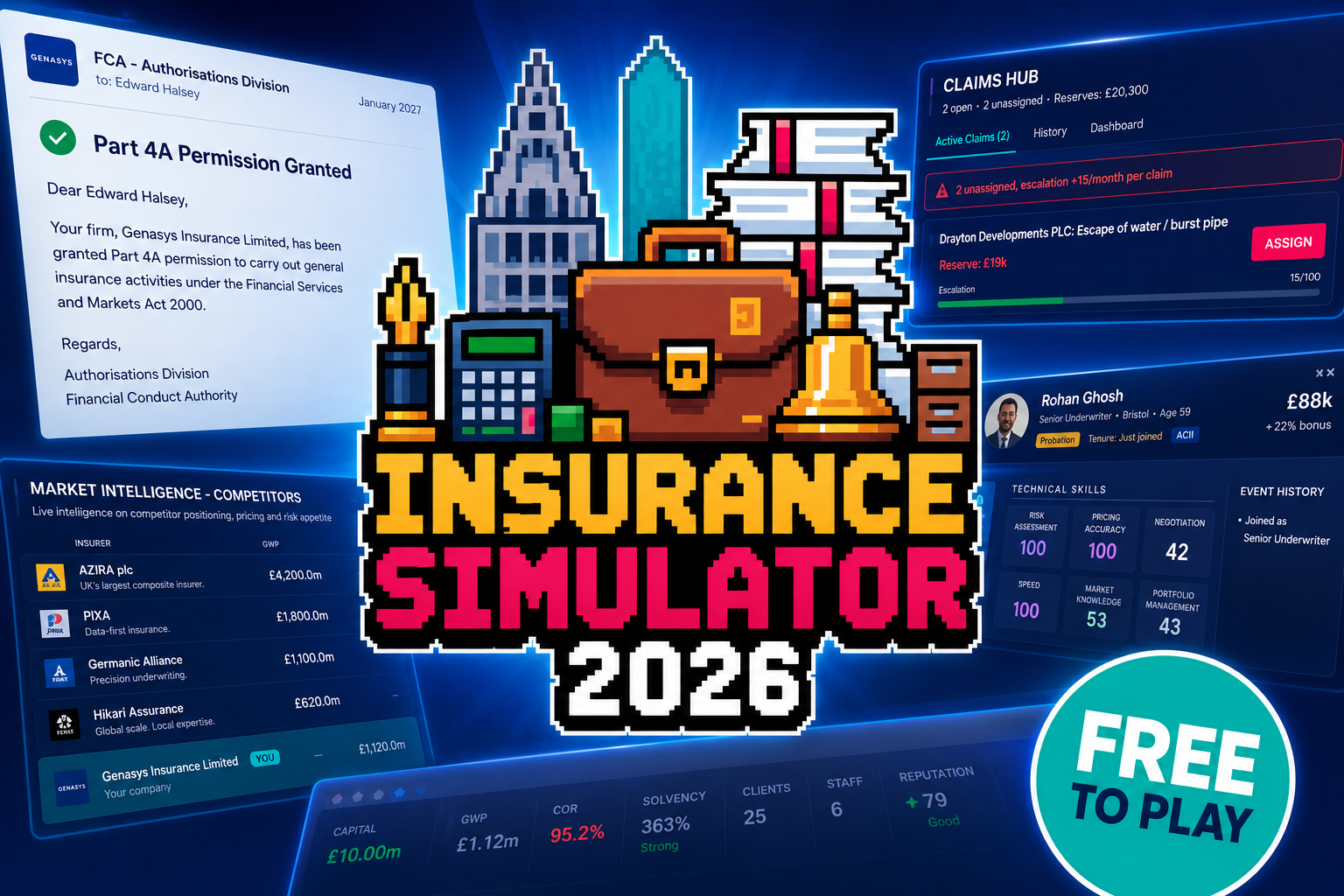
He founded a games studio that did not exist, to build Insurance Simulator 2024 - a game that did not exist. This week, the game became real.
Ian was the founder of an independent games studio called InaudibleMirage. His studio was developing a title called Insurance Simulator 2024, a management game where players built and ran their own insurance company.
We made screenshots, logos, feature lists and a launch website. Ian even supplied a quote about how excited he was to be working with Genasys who had consulted on and sponsored the game.
There was only one problem.
Ian Trelom did not exist.
Ian Trelom is an anagram of "I'm not real", a detail we were certain somebody would spot within the hour. Nobody did. Not on launch day, not when we revealed the joke, and not once in the two years since.
The whole thing was an April Fool's prank.
At least, that was the original plan.
The nagging thoughtThe joke kept describing a real game
The further we went building the joke, the harder it became to ignore something. Every feature we invented for the fake game sounded like something we would actually want to play. The more detail we added, the clearer it got: running an insurer has most of the ingredients that make a management game work.
Most people outside the industry picture insurance as paperwork, forms and regulation. Those of us inside it know it is really a long exercise in decision-making under uncertainty. Every day is a series of judgements made on incomplete information. Which broker do you trust? Which risks do you write? Which warning signs do you investigate, and which do you wave through because you are busy? The consequences rarely show up until months or years later, by which point you have made a hundred more.
And that's what makes insurance so utterly gamifiable.
So the joke turned into a question. Could you build a real simulation around the actual job? Could you capture the tension of balancing growth, profit, compliance and reputation, and make something an underwriter would recognise while a graduate could still pick it up cold?
In 2024, those questions were academic. Building the game would have meant a development team, artists, designers and a budget nobody was going to sign off for what began as a marketing gag. So we let it go.
Then the tools caught upThe joke stopped needing to be a joke
Over the two years since Ian Trelom first appeared, AI-assisted development demolished the barrier we had run into. Tools that barely worked in 2024 made things possible for one person that used to need a small studio. We started prototyping, mostly to see if we could, and realised something faintly dangerous.
The joke no longer had to stay a joke.
So we built it. Insurance Simulator 2026 is now a real game, free to play in your browser, made by our marketing team, which is one person, using the latest generation of AI coding tools alongside Midjourney, ChatGPT and Photoshop. There is still no studio. It turns out we no longer needed one.
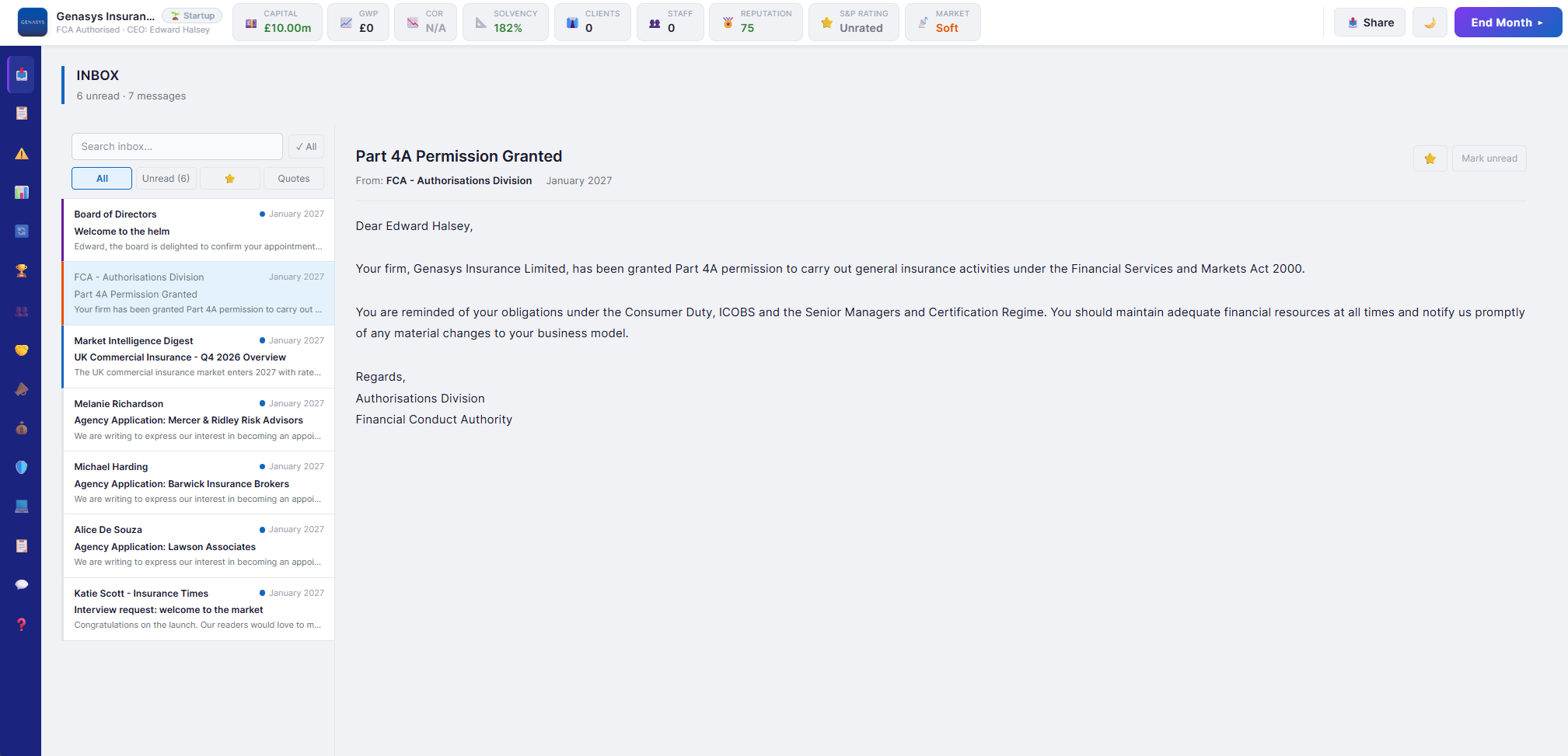
The job, as a gameEvery decision looks simple from outside
Remember those questions. Which broker do you trust, which risks do you write, which warning signs do you investigate. The game does not ask them in the abstract. It puts them in front of you and makes you answer.
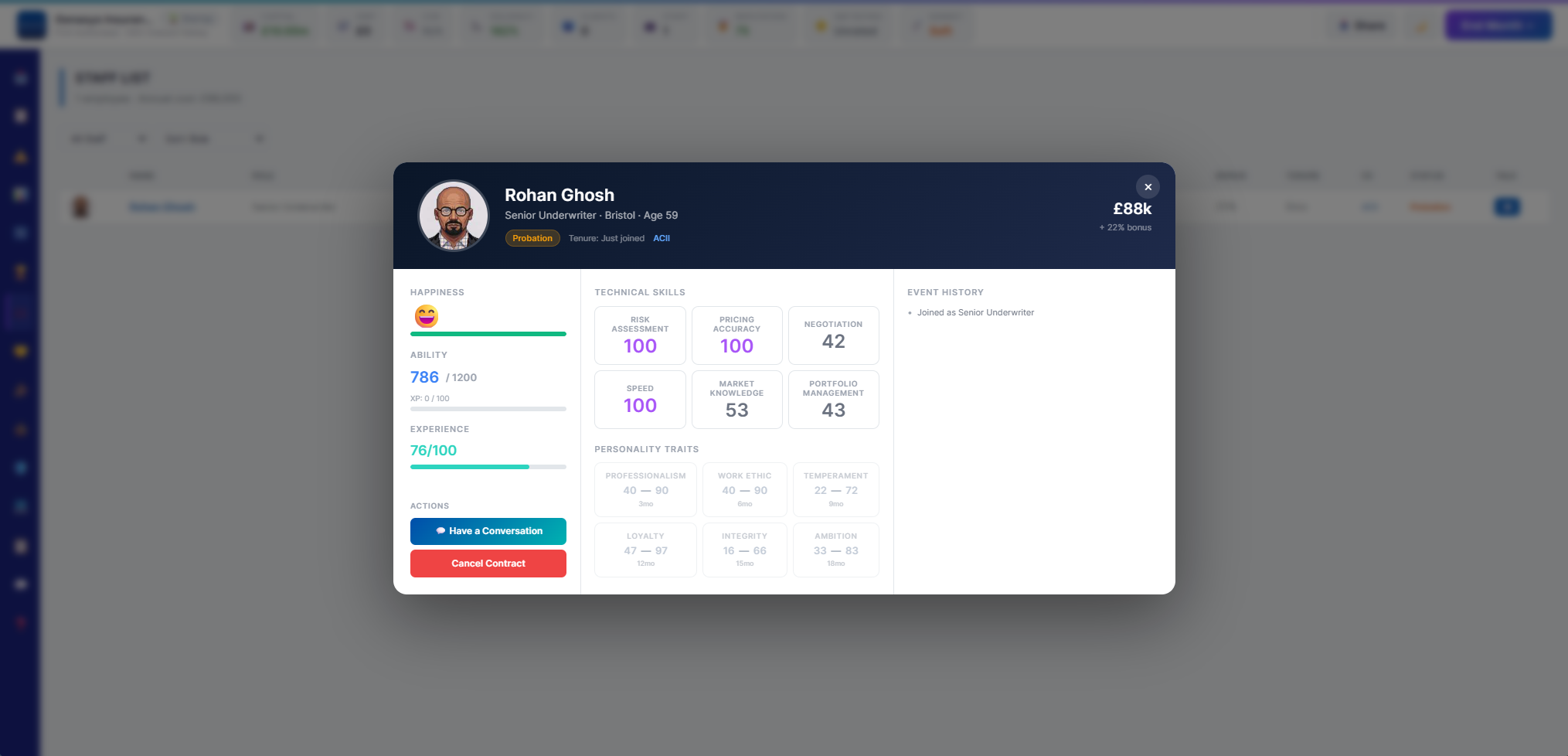
Which people do you hire?
Your first serious candidate is Rohan Ghosh. Fifty-nine, senior underwriter, ACII, and on paper superb: risk assessment 100, pricing accuracy 100. He wants £88,000 and a 22% bonus, and he is on probation, and buried in his profile is an integrity score the game will only tell you sits somewhere between 16 and 66. You learn which end when it is far too late to matter.
Which brokers do you trust?
Mercer & Ridley want an agency. Thirteen years trading, £2.4m of financial lines, run by a market fixture called Toby Stafford, FCA record showing three complaints, all resolved. The biography is warm right up to the sentence that mentions, in passing, that some underwriters have flagged inconsistency in how they present renewal information. You get three steps to decide whether that one line is a red flag or just how the sausage is made.
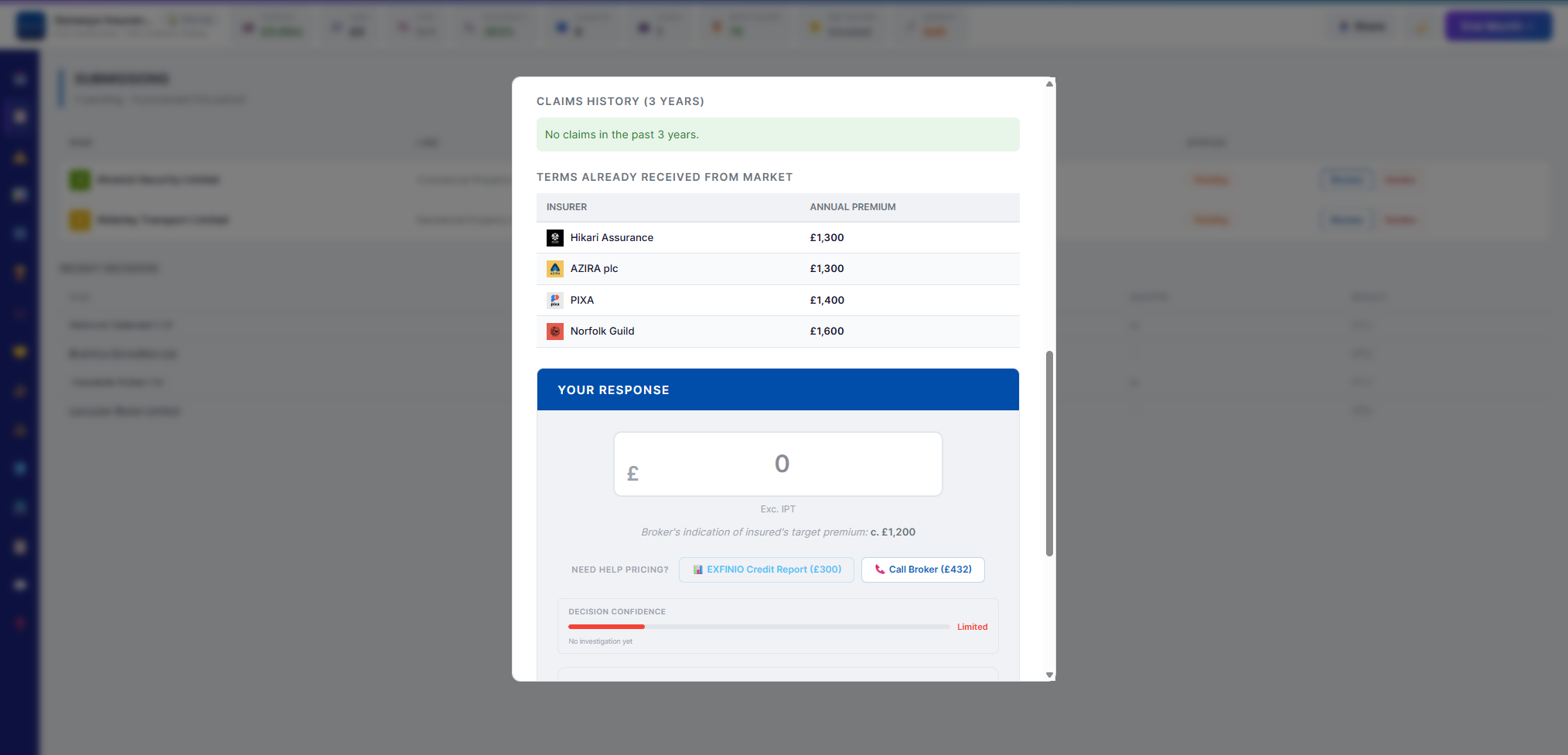
Which risks do you write, and at what price?
A clean risk arrives. No claims in three years. The market has come back between £1,300 and £1,600, and the broker lets slip the client wants to pay about twelve hundred. You can price it on instinct, spend £300 on a credit report, or £432 to call the broker and fish for more. Your decision confidence, the game notes helpfully, is "Limited". Welcome to underwriting.
And when the press call?
Insurance Times asks for a word. Katie Scott, thirteen seconds a question, four answers, each a slightly different flavour of overconfident. There is no right answer, only how you will read in print. Play it careful and you get the headline "Market's newest chief plays it close to the chest", which is the polite version of saying you gave them nothing.
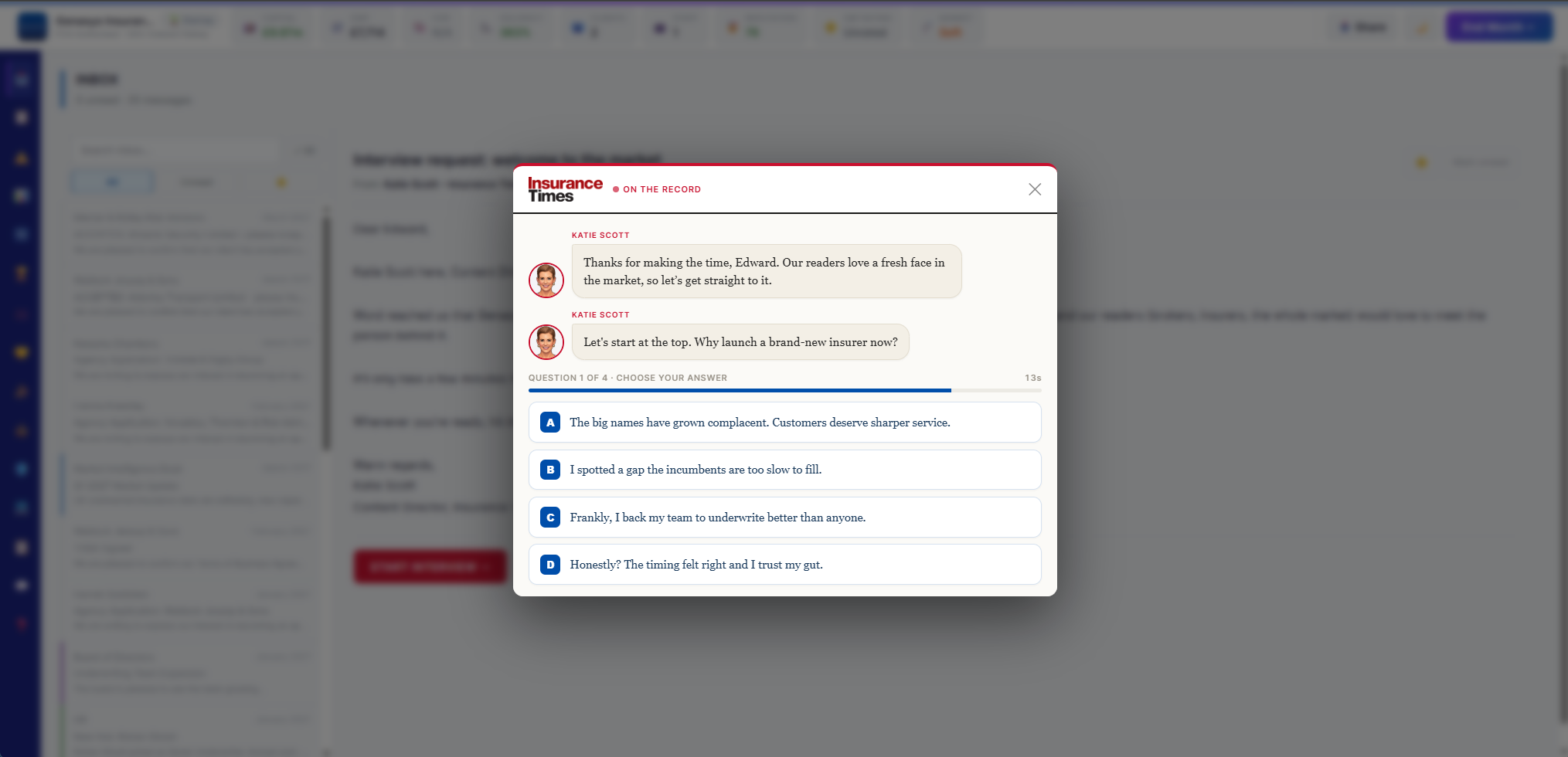
Read that write-up properly rather than clicking past it, and the sidebar is running its own headlines.
Apparently.
- Actuary's spreadsheet gains sentience, requests annual leave
- Underwriter declines own birthday, cites "adverse risk profile"
- New AI claims bot revealed to be intern named Dave
Nobody was meant to read those, the same way nobody was meant to unscramble Ian Trelom. We keep hiding things in the margins to see who is paying attention. Mostly the answer is nobody, which is somehow both disappointing and entirely the point.
LosingThree ways it ends, all of them your fault
You do not really win Insurance Simulator. You postpone losing it. There are three exits, and anyone who has worked in this market will recognise every one.
Cash runs dry
You wrote the business, you paid the claims, and one morning the reserves simply are not there.
The loss ratio runs hot
Too much bad risk, held too long. The numbers catch up with the optimism, the way they always do.
The FCA steps in
Miss your obligations for long enough and the regulator arrives to close the doors for you.
Here is what the game gets right, and the reason it stopped being a joke. Every one of those endings traces back to a decision you made somewhere else entirely, a few years earlier, feeling quite pleased with yourself. The cheap hire. The broker whose bio you skimmed. The quote you rushed. Nobody loses an insurer in a single dramatic moment. You lose it slowly, in small sensible-looking steps, which is exactly how it works in the building the rest of us go to on Mondays.
How we built itNinety per cent thinking, ten per cent code
The whole thing was made by our marketing team, which is one person, using the latest generation of AI coding tools alongside Midjourney, ChatGPT and Photoshop. The tools have moved fast enough that the coding is no longer the hard part.
The hard part, and close to ninety per cent of the work, was the thinking. Deciding how the business should behave. Working out which corners of the insurance industry to model and which to leave out. Designing the gamification so that a loss ratio or a reserve means something on screen. Then testing it, modelling it, breaking it and tuning the numbers until losing money feels like losing money. A game where nothing you do has consequences is not a game, it is a form, and getting that balance right took far longer than the code ever did.
What comes nextThe roadmap is a hoax from 2024
Delegated authority. Mergers and acquisitions. Deeper reinsurance mechanics. And the London Market, because no insurance game would be complete without it.
Go back and read the feature list of the game that never existed, and there they are: delegated authority, M&A, the lot. The roadmap for the real game is a hoax press release we wrote two years ago. We are entirely comfortable with that.
Ian Trelom never existed. Two years on, everything he was pretending to sell does. And it turns out running an insurer is every bit as hard as we suspected.
The 2024 April Fools, for the record Hide the 2024 April Fools
- Insurance Times, "Genasys sponsors insurance-based PC game to entice new talent" — the original hoax announcement, 1 April 2024. insurancetimes.co.uk/news/genasys-sponsors-insurance-based-pc-game-to-entice-new-talent
- Insurance Times, "Insurance Times and Genasys team up for April Fools' Day prank" — the reveal, 2 April 2024. insurancetimes.co.uk/news/insurance-times-and-genasys-team-up-for-april-fools-day-prank
- Genasys Technologies, "Insurance Simulator 2024" — the original landing page, still live. genasystech.com/insurance-simulator-2024
Now live · Free to play
Go and run an insurer
A free browser game where you build and run an insurer, and try not to bankrupt it. No signup, no download. It is the game we pretended to sponsor as an April Fools joke in 2024, and have now actually built.
Playing through? Share your progress on social and tag Genasys.
Frequently Asked Questions
Insurance Simulator 2026, in full: what it is, how you play and why we built it.
What is Insurance Simulator 2026, and how much does it cost?
It is a free browser game in which you build and run your own insurer. You name and brand the company, set your risk appetite and recruitment policy, then hire staff, underwrite risks, handle claims, take on brokers and manage your reputation as you grow. It costs nothing. There is no signup, no account, no download and no monetisation of any kind. You open the page at genasystech.com/insurance-simulator-2026 and you play, on any modern desktop browser.
How do you actually play, and how do you lose?
You start with a name, a logo, a CEO avatar and ten million pounds of capital doing nothing. From there every decision is a judgement made on incomplete information: which broker to trust, which risks to write and at what price, which staff to hire, which warning signs to investigate and which to wave through because you are busy. Underwriting is quoted against live market terms, claims escalate until you assign the right handler, and the press turn up wanting an interview. You lose one of three ways. Your cash reserves run dry, your loss ratio runs too hot for too long, or the FCA loses patience and shuts you down. Every one of those traces back to a decision you made much earlier, which is rather the point. Most people do not survive their first few years.
Is this really the game from the 2024 April Fools, and what were the clues?
Yes. On 1 April 2024 we announced, through Insurance Times, that we were sponsoring a game called Insurance Simulator 2024, built by an independent studio and coming to Steam. The studio was fictional. So was its founder, Ian Trelom, who is quoted in the original piece and whose name is an anagram of "I'm not real". The studio itself was a second clue hidden next to the first: InaudibleMirage, a sound you cannot hear and a sight that is not there, two things that are not real. We were certain someone would spot at least one of them within the hour. Nobody did, then or in the two years since, which as an insurance company we probably should have predicted, given how few people read the small print. This is the real version of that joke, finally built.
Why did an insurance software company build a video game, and why now?
Two reasons. The first is that the joke would not leave us alone. The more detail we invented for the fake game, the more it sounded like a real one worth playing, because running an insurer is genuinely a continuous exercise in decision-making under uncertainty, which is also a decent description of a management game. The second is the point we actually care about. The same collapse in cost and time that let one person build this game in a few months is reshaping how serious insurance software gets built, including on our own platform. The game is the enjoyable proof of a bigger shift: the gap between an idea and a working product has almost disappeared. As for "why now", in 2024 building it would have needed a studio, artists, designers and a budget nobody would sign off. By 2026 that barrier had come down far enough for a single person to build it in a few months.
How was it made, and did AI do all the work?
It was built by one person in our marketing team, using the latest generation of AI coding tools alongside Midjourney, ChatGPT and Photoshop. There is no games studio, and there never was. But no, the tools did not make it on their own, and we would not claim otherwise. The coding is no longer the hard part. Close to ninety per cent of the work was the thinking: deciding how the business should behave, choosing which corners of the insurance industry to model, designing the gamification, then testing, modelling and tuning the numbers until losing money feels like losing money. A simulation where nothing you do has consequences is not a game, it is a form. The tools handled the execution. The judgement still had to come from someone who has seen the real thing. Planned updates, by the way, include delegated authority, mergers and acquisitions, deeper reinsurance mechanics and the London Market, several of which were features of the game we invented in 2024, so the roadmap is essentially our own hoax catching up with us.
We'd rather show you than tell you.
We'll start by getting to know your business. Then we'll show you exactly how Genasys handles it.
Insurance People
Zero Fluff
Tailored to You