
The Imperative of Deploying New Insurance Products Quickly
Why Speed Matters in Insurance Today
If you’re in insurance, you’ve felt it: the ground is shifting. Customer expectations are evolving, technology is advancing at pace and market conditions are constantly in flux, demanding a new approach.1 This environment demands a fundamental shift in how insurers operate and are deploying new insurance products. Accenture’s research highlights this urgency, with 62% of executives prioritising the faster launch of new products and services as a top strategic goal.3
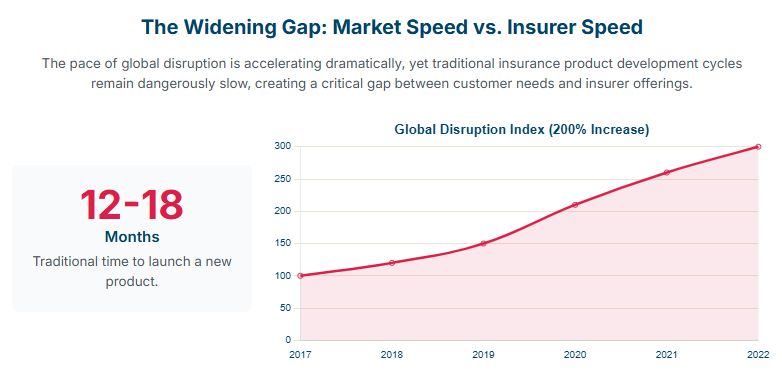
Traditionally, deploying insurance products often took 12 to 18 months for new products and 3 to 6 months for modifications and this is no longer sustainable. By the time a product is ready, market conditions may have shifted, rendering it irrelevant to current customer needs. Insurers that take longer than 3 to 6 months to launch new products risk losing competitive advantage, market share, and profitability.4 The global disruption index, a measure covering economic, social, geopolitical, climate, consumer and technology disruption, increased by 200% from 2017 to 2022.1 This dramatic acceleration of external changes means that deploying new insurance products and iterating existing products at speed has become ever more closely aligned to the success of insurance businesses. If products are outdated upon release, the entire business model faces significant threats.
While there is a clear understanding of the need for speed, a notable gap exists between strategic intent and operational capability. Although 82% of life and annuity executives believe product development is a core competency, only 12% feel they can deliver strong product development innovation.4 This significant disparity suggests that the challenge is not a lack of desire or recognition, but rather deeply embedded structural, process, or cultural impediments preventing the execution of strategic goals. Addressing this gap is central to deploying new insurance products quickly and effectively.
Overcoming Traditional Hurdles
Many insurance organisations have historically struggled with transformation initiatives, with only 25% considered highly successful.5 This low success rate indicates deeply embedded challenges that impede how quickly people are deploying new insurance products. A major hurdle is the fragmented approach to transformation, which often leads to siloed initiatives and duplicated efforts. Less than four in ten insurers execute transformation through a centralised model.5 This lack of cohesion among operational units and geographic locations frequently results in a proliferation of redundant products and increased maintenance costs.
Poor data quality and a tendency to rush technology implementation without first evaluating core processes also contribute to inefficiencies.5 Oliver Wyman identifies a lack of structure in the idea funnel, difficulty pivoting from initial plans, and lengthy implementation times as common challenges.6 These issues highlight that the primary impediments to speed are not solely technological, but deeply rooted in organisational structure, process, and culture. Simply acquiring new technology will not resolve the problem; the underlying organisational design that fosters silos and poor data management must be addressed first.
The inefficiencies stemming from these traditional hurdles, such as redundant products, increased maintenance costs, and protracted development cycles 6, create a systemic drag on profitability and responsiveness. This situation is not merely about missing opportunities; it actively erodes the cost base and competitive position. The fragmented approach exacerbates this by creating inefficiencies and duplication, making it harder to invest in the very solutions needed for speed. KPMG identifies four key differentiators for successful transformation: clearly defined cost objectives, robust dedicated budgets, alignment between cost and transformation goals, and leadership accountability.5
Table 1: Key Challenges in Insurance Product Development
| Challenge Description | Impact | Supporting Source |
| Lengthy Development Cycles | Market Irrelevance, Lost Competitive Advantage, Eroding Profitability | Deloitte |
| Fragmented Approach | Siloed Initiatives, Duplicated Efforts, Increased Costs | KPMG, 5 |
| Poor Data Quality | Hindered Decision-Making, Inefficiencies | KPMG, 5 |
| Lack of Idea Funnel Structure | Missed High-Potential Initiatives, Inefficient Prioritisation | Oliver Wyman, 6 |
| Difficulty Pivoting | Costly Changes During Implementation, Slow Adaptation | Oliver Wyman, 6 |
Embracing Agile Operating Models
Streamlining Processes for Quicker Launches
Agile operating models are proving transformative for insurers, enabling them to launch new products and update pricing models up to five times faster than traditional methods.7 This acceleration is achieved by minimising handovers and maximising accountability within cross-functional teams.7 A core advantage of agile is the close collaboration between business and IT, which significantly reduces time spent on alignment, syndication, and decision preparation.7 This integrated approach moves away from the traditional, sequential departmental handoffs that cause delays.8
The power of agile extends beyond project management; it functions as a profound organisational restructuring tool. By delayering hierarchies and simplifying governance, it removes bureaucratic bottlenecks inherent in traditional models. McKinsey reports that one European insurer, by adopting an agile operating model, reduced hierarchical layers from seven to three and cut management committees by 30%, leading to 20% operational efficiency.7 This demonstrates how agility simplifies governance and streamlines operations. Moreover, agile practices also lead to improved customer satisfaction and employee engagement.7 The benefits extend beyond financial metrics to human capital, creating a more motivated workforce better equipped to deliver customer value. This suggests that operational improvements foster better human outcomes, which in turn reinforce business success.
Fostering Collaboration and Accountability
Agile models foster collaboration through cross-functional tribes and self-managing teams, which serve as key building blocks for delivering change initiatives and running everyday operations.7 These teams unify all necessary resources to deliver on their missions, increasing end-to-end ownership.8 By distributing work within multiskilled teams, agile practices empower employees to make decisions, leading to higher productivity and efficiency.8 This contrasts sharply with traditional models that involve numerous handoffs across different departments.8
The shift to cross-functional, self-managing teams minimises handovers and maximises accountability. This direct accountability within empowered teams is a critical driver of speed, as it reduces delays associated with approvals, handoffs, and blame-shifting common in siloed environments. When a team is fully accountable for a mission, its members are incentivised to find the fastest, most efficient path to completion, rather than waiting for external dependencies or passing responsibility.
Successful agile transformation requires full buy-in from leadership, who must set a clear vision and remain engaged throughout the process.8 This executive alignment is crucial for overcoming resistance to change and ensuring the transformation is business-led.9 While agile provides the framework, its success hinges on a cultural shift towards empowerment, trust, and shared ownership, supported by strong leadership commitment. Without this cultural foundation, even well-designed agile processes can fail to deliver their full potential. This cultural readiness is a crucial prerequisite for sustainable rapid deployment.
Table 2: Impact of Agile Operating Models on Insurance Performance
| Performance Metric | Improvement/Change | Supporting Source |
| Time to Market | Up to 5x Faster | McKinsey, 7 |
| Operational Efficiency | 20% Improvement | McKinsey, 7 |
| Customer Satisfaction | 20-30 Percentage Point Improvement | McKinsey, 7 |
| Employee Engagement | 20-25 Percentage Point Improvement | McKinsey, 7 |
| Hierarchical Layers | Reduced from 7 to 3 | McKinsey, 7 |
| Management Committees | Reduced by 30% | McKinsey, 7 |
Leveraging Advanced Technology
The Transformative Power of AI and Generative AI
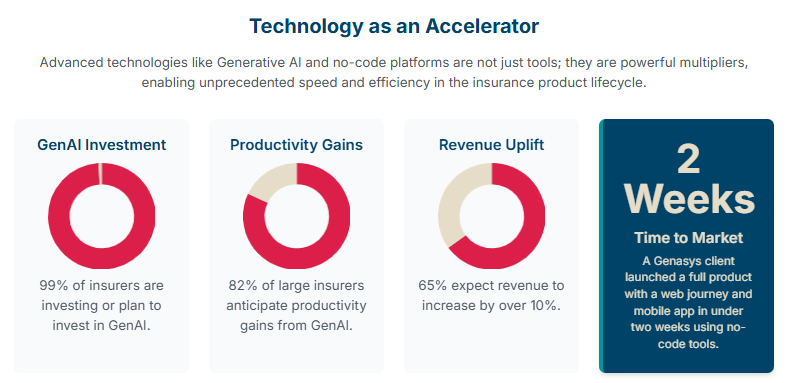
Artificial Intelligence (AI) and Generative AI (GenAI) are revolutionising how insurers use data, aiding decision-making, identifying trends, and enhancing efficiency while reducing costs.3 AI can lead to significant improvements, including 10-20% in new-agent success rates and sales conversion, 10-15% in premium growth, and a 20-40% reduction in customer onboarding costs.9 Insurers are actively investing in GenAI, with 99% either already investing or planning to do so.11 Large insurers (over US$25bn in direct premiums) anticipate substantial returns from GenAI investments: productivity gains (82%), revenue uplift (65% expect over 10%), and cost savings (52% anticipate 11-20%).11
GenAI can automate application submission and review, proactively identify risks, and generate suggested pricing.11 It can dramatically compress the claims lifecycle, automate compliance monitoring, and detect fraud.12 For instance, UK insurer Aviva deployed over 80 AI models to improve outcomes in its claims domain, cutting liability assessment time for complex cases by 23 days and reducing customer complaints by 65% in motor claims, saving over £60 million in 2024.9 These examples illustrate that AI and GenAI are not simply tools that enable faster processes; they act as multipliers across the entire value chain, driving significant improvements in sales, underwriting, claims, and customer service. This holistic impact frees up resources and generates new understandings, indirectly accelerating product deployment by optimising the surrounding ecosystem.
The Financial Conduct Authority (FCA) and the British Insurance Brokers’ Association (BIBA) acknowledge the rapid adoption of AI in the UK insurance sector, with a 2024 Bank of England report finding that 95% of insurers are using AI in some capacity.13 However, a significant understanding gap exists, as only 34% of firms using AI fully comprehend how it works.13 This highlights a critical need for robust governance, ethical frameworks, and human oversight to mitigate associated risks, such as those related to intellectual property, corporate reputation, bias, and information security.12 Simply deploying AI quickly without understanding its implications could lead to significant future problems, underscoring the importance of responsible AI deployment, especially when integrating it into core product and customer-facing processes.
No-Code and Low-Code Platforms: Accelerating Development
No-code and low-code platforms are pivotal for accelerating product development, enabling business users—not solely IT teams—to actively contribute to the innovation process.16 This democratisation of technology empowers teams to configure and customise products quickly without requiring deep technical expertise.17
Genasys Technologies, for example, provides a core insurance administration system that includes no-code product building tools.18 These tools allow customers to quickly deploy, distribute, and manage their insurance products online.18 The platform offers features such as dynamic question sets that adapt to user answers, “if this, then that” rating mechanisms for flexible pricing, and a bespoke documentation suite with tokenised data fields.17 Genasys’s no-code product builder is designed to allow users to configure and customise products quickly across any line of business with no technical expertise required, enabling businesses to respond to market demands faster than ever.17
The impact on launching new insurance products is significant. Genasys’s tools come with over 350 pre-configured product templates, enabling users to launch new products in a matter of days.17 A client, GENRIC, reported having a product in production, complete with a functional web-based onboarding journey and a mobile application for customers, within just one and a half to two weeks.17 The Genasys system supports the entire insurance policy lifecycle, from quote and bind to renewals, mid-term adjustments, and cancellations.17 It also offers multi-line and multi-risk functionality, built-in automation to streamline repetitive tasks, and API-driven integration with over 350 robust endpoints for seamless connection with third-party tools and emerging technologies.17 Real-time data and reporting capabilities further enable data-led decision-making.17 These platforms directly translate business ideas into deployable products, bypassing traditional IT bottlenecks and fostering continuous iteration. This direct enablement of business agility and market responsiveness is a key factor in achieving rapid product deployment.
Strategic Product Rollout and Regulatory Alignment
Simplifying Product Offerings
The lifespan of insurance products is becoming significantly shorter, with insurers often needing to retire products just months after launch due to irrelevance or inadequacy. Given this dynamic, carriers must simplify their product offerings and ensure they are easily understandable.16 Historically, the industry has tended to layer on numerous riders, resulting in overly complex products. Today, insurers must adopt a more open and flexible approach to feature bundling.16 Simplification does not have to be complicated; it involves standardising product features and processes wherever feasible, while introducing differentiation only where it provides a clear market advantage.16 This approach indicates that simplification is a prerequisite for speed and adaptability. Complex products hinder quick iteration and market responsiveness, making simplicity a strategic advantage in a rapidly evolving market.
Greenfield Approaches and Ecosystem Integration
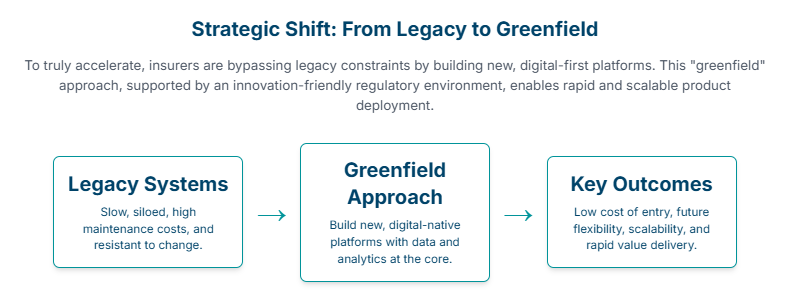
The time and investment required when deploying new insurance products has decreased dramatically.19 This presents a major opportunity for existing major firms, as the rise of InsurTechs and cost-effective, flexible digital technology tools and platforms are ushering in a new era of growth and innovation.19 Many major insurers are leveraging this by launching greenfield business units and new digital versions of their core offerings to gain first-mover advantage and establish new market leadership positions.19
A “greenfield” approach involves establishing a completely new entity or service, built on the newest digital architecture with data and analytics at its core.19 Recent InsurTech start-ups have demonstrated that new insurance propositions can be brought to market for less than $5 million.19 This approach utilises cloud-based architecture, enabling a low cost of entry, limited risk, and future flexibility and scalability for compelling value propositions.19 When executed correctly, a structurally low-cost, digital-by-design new platform can offer immediate customer value and generate momentum as it builds a customer base, collects data, and integrates new functionalities.19 This contrasts sharply with the challenges of updating or transforming legacy IT systems, which often involve multi-year budgets in the tens or hundreds of millions of pounds, making the greenfield option particularly attractive for addressing critical strategic priorities.19
This approach allows insurers to bypass legacy constraints and rapidly build future-proof capabilities, which can then influence the core business. A greenfield approach should be seriously considered when there is an urgent need to meet customer needs in new ways, address intractable cost pressures, or leverage next-generation core technology platforms and microservices.19 Furthermore, integrating strategic partnerships into the value chain can transform key processes, increasing business resilience and flexing the cost curve.10 Insurers are seeking to differentiate themselves through reimagined products and smart partnerships with industry peers and new market entrants.1
Navigating Regulatory Considerations
The regulatory environment for insurers is constantly evolving, with changes in regulations and laws significantly impacting business operations.20 However, regulators are increasingly adopting an innovation-led approach, aiming to support growth and responsible experimentation. The FCA, for instance, has announced a five-year strategy to “deepen trust, rebalance risk, and support growth” by harnessing innovation.13 As part of this, the FCA has created a Supercharged Sandbox, an improved version of its original Regulatory Sandbox, offering firms enhanced datasets, better computing abilities, and more advanced tools to encourage responsible AI experimentation.13
The British Insurance Brokers’ Association (BIBA) has also released a new guide to help brokers understand the potential role of AI in their operations, outlining where AI is being used, associated regulatory and compliance considerations, and insights from early adopters.14 This guidance aims to help brokers navigate the new era of AI safely and within regulatory requirements.14 Similarly, Lloyd’s of London has its “Product Launchpad,” a commitment to nurturing a “safe space” for underwriters to experiment with new ideas in a controlled way, balancing oversight with the imperative to innovate quickly.22 These initiatives indicate that the regulatory environment is increasingly becoming an enabler, not just a constraint. Regulators are actively fostering innovation, creating opportunities for rapid product development when engaged collaboratively. This collaborative approach can help firms ensure compliance while embracing new technologies and strategies for quicker product deployment.
Key Takeaways
The ability to deploy new insurance products quickly has transitioned from a competitive advantage to a fundamental imperative for survival in a rapidly changing market. Traditional, protracted development cycles and fragmented organisational structures are no longer viable, leading to market irrelevance and eroding profitability. The significant gap between executives’ recognition of the need for speed and their organisations’ actual capability to deliver highlights a systemic challenge rooted in operational and cultural impediments.
To address this, insurers must embrace agile operating models that streamline processes, minimise handovers, and foster collaboration through cross-functional, self-managing teams. This approach not only accelerates time to market by up to five times but also drives operational efficiency and improves both customer and employee engagement. The success of agile is deeply tied to a cultural transformation that prioritises empowerment, trust, and shared ownership, underpinned by strong leadership commitment.
Furthermore, leveraging advanced technology is critical. Artificial Intelligence and Generative AI are proving to be powerful multipliers, enhancing efficiency and driving growth across the entire insurance value chain, from sales and underwriting to claims and customer service. While AI adoption is widespread, a clear understanding of its functionalities and robust governance frameworks are essential to mitigate risks and ensure responsible deployment. No-code and low-code platforms, such as those offered by Genasys Technologies, directly empower business users to configure and launch new products rapidly, bypassing traditional IT bottlenecks and fostering continuous iteration.
Finally, strategic product rollout involves simplifying offerings to match shorter product lifespans and considering greenfield approaches to bypass legacy constraints and build future-proof capabilities. Crucially, the regulatory environment is evolving to become an enabler of innovation, with bodies like the FCA, BIBA, and Lloyd’s actively supporting responsible experimentation. By integrating agile methodologies, advanced technologies, and strategic regulatory engagement, insurers can accelerate product deployment, enhance responsiveness, and secure a sustainable competitive position.