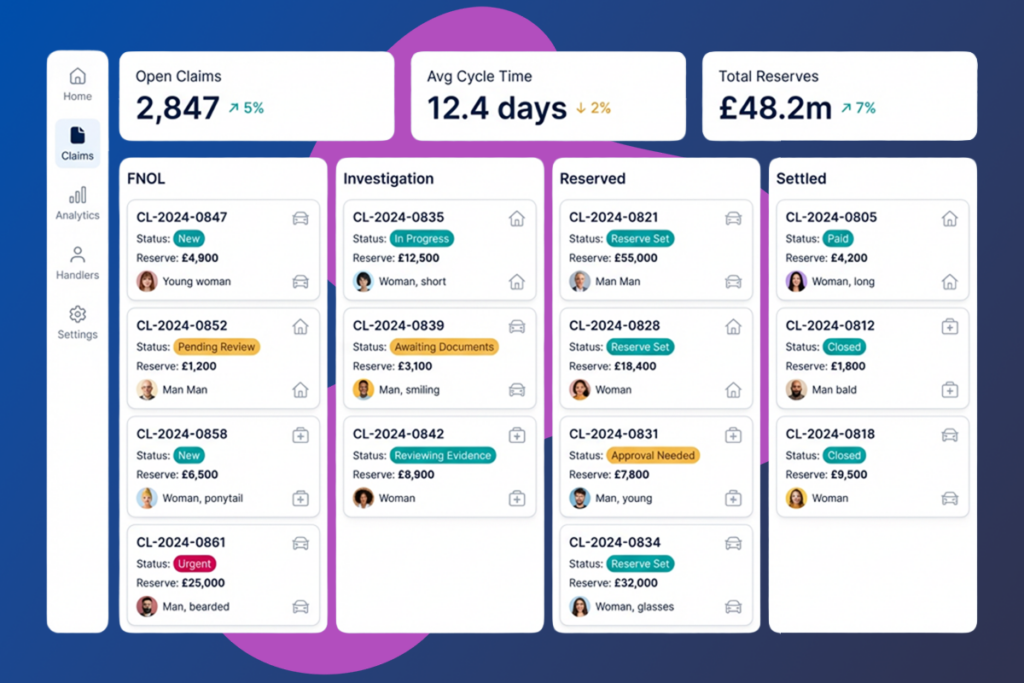
Effective claims management systems sit at the heart of insurer profitability, yet claims remains one of the most underinvested functions in the business. The technology available to manage claims has matured considerably, but a significant portion of the market still relies on fragmented, legacy infrastructure that was never designed to handle the volume, complexity or customer expectations of today's insurance environment. The consequences are visible in combined ratios, in customer churn figures and, increasingly, in regulatory scrutiny.
The scale of claims expenditure alone makes the case for attention. UK motor insurers paid out a record £11.7 billion in claims in 2024, processing 2.4 million individual claims across the year.1 Property insurers fared no better, paying out £5.7 billion in combined commercial and domestic claims, the largest annual total on record.2 Add to that £8 billion in protection claims and £4 billion in private medical insurance claims, and the total payout picture for 2024 represents an extraordinary concentration of financial exposure.3 For property insurers specifically, EY data cited by the ABI shows that for every £1 received in premium during 2023, £1.18 was paid out in claims and expenses, extending what was already a fifth consecutive loss-making year.4 Globally, the P&C sector recorded a combined ratio of 103% in 2022, meaning the average insurer paid out more than it collected before investment income was accounted for.5
Against that backdrop, the efficiency of claims handling is not an operational footnote. It is a primary determinant of whether a book of business is profitable at all. Yet technology investment in claims has historically lagged behind underwriting, pricing and distribution, where the commercial returns are more immediately visible to senior leadership. The result is a structural imbalance: the function responsible for the majority of outgoings often runs on the weakest technology.
Customer retention compounds the financial risk. Capgemini research estimates that approximately 70% of all customer churn in insurance is driven by a poor claims experience, with 67% of consumers citing an unpleasant interaction as their reason for switching carrier.6 Accenture has estimated that up to $170 billion in global premiums could be at risk over five years as a direct consequence of claims dissatisfaction.7 These are not abstract projections. They describe a measurable revenue exposure that sits directly downstream of how well or how poorly claims are managed.
This article examines why a modern claims management system has become a strategic asset rather than a back-office utility, what genuine platform capability looks like in practice, and where the technology is heading as artificial intelligence moves from pilot projects into production deployments.
The Profitability Leak Hiding in Your Claims Function
Claims spend dwarfs every other cost line
For most insurers, claims handling represents the single largest category of operational expenditure, typically accounting for somewhere between 70% and 80% of total outgoings. That concentration means even marginal inefficiency in the claims function has an outsized effect on the combined ratio. The figures from 2024 illustrate the point starkly. UK motor insurers processed 2.4 million claims and paid out a record £11.7 billion, with the average claim rising 13% year-on-year to £4,900.1 Property claims reached £5.7 billion, the highest annual total ever recorded.2 When the underlying payout volume is this large, a percentage point of unnecessary leakage translates directly into tens of millions of pounds lost.
Claims leakage is a measurable problem
Claims leakage, defined broadly as the difference between what was paid and what should have been paid under correct handling, is estimated by McKinsey and EY to account for between 5% and 10% of total claims spend across the industry.8 At the scale of the UK market alone, that range implies a material and largely avoidable financial drain. Leakage arises from multiple sources: duplicate payments, inaccurate reserve-setting, fraud that goes undetected, manual processing errors and delays that inflate settlement costs. A claims management platform that automates validation, flags anomalies and enforces workflow discipline directly reduces each of those failure points.
Poor performance extends beyond the balance sheet
The damage from weak claims management is not confined to loss ratios. Property insurers in the UK paid out £1.18 for every £1.00 of premium received in 2023, continuing a fifth consecutive loss-making year.4 Capgemini's research attributes approximately 70% of customer churn in insurance to a poor claims experience,6 which means operational failure in claims compounds into a revenue problem as well. The combined ratio and the retention rate move together, and both are sensitive to how effectively the claims function is run.
Beyond the FNOL: What a Claims Management Platform Really Covers
The gap between tracking and managing
Many insurers use the terms "claims tracking" and "claims management" interchangeably, but the distinction matters considerably. A basic tracking system records what has happened. A modern claims management platform shapes what happens next. The functional scope of a genuine claims management system extends well beyond logging a first notification of loss (FNOL) and assigning a reference number. It spans the entire claims lifecycle: intake, triage, investigation, reserving, settlement, payment and closure, with decision support and audit capability built into each stage.
What the intake and triage layer actually does
At the point of FNOL, a capable claims management platform does considerably more than capture contact details and incident information. It validates policy coverage in real time, cross-references incoming data against fraud indicators, applies rules-based triage logic to route the claim appropriately and sets an initial reserve based on comparable historical claims. For straightforward claims, this process can trigger straight-through processing without human intervention. For complex or high-value claims, it surfaces the right information to the right handler from the outset rather than leaving triage to manual judgement.
This capability matters because the quality of the initial assessment has a direct bearing on downstream costs. Errors in early reserving create volatility in reported results and can distort reinsurance calculations. Poor triage routing sends claims to handlers who lack the specialism to deal with them efficiently, extending cycle times and increasing settlement costs.
Reserving, workflow and the cost of manual processes
Reserve accuracy is one of the more consequential outputs of any claims management system. Inadequate reserving understates liabilities and distorts profitability reporting. Over-reserving ties up capital unnecessarily. A platform that applies consistent, data-informed reserving logic at each stage of the claim lifecycle reduces both risks. This is particularly relevant given current market conditions: UK property claims reached £5.7 billion in 2024,2 and motor claims averaged £4,900 per settlement,1 figures that amplify the financial consequences of systematic reserving errors.
Workflow automation within a claims management platform removes the manual handoffs that create delay, inconsistency and compliance risk. Tasks that previously required a handler to chase a repairer, request documentation or update a reserve manually can be configured as automated triggers, freeing handlers to focus on claims that genuinely require judgement. The administrative burden of claims handling is substantial. Capgemini research found that 35% of retail customers cite complicated claim application processes as a primary frustration,9 which suggests that much of this administrative weight falls on policyholders as well as handlers.
How Integration Changes the Claims Function
Connected data as a foundation for better decisions
A claims management platform does not operate in isolation. Its value depends significantly on what it connects to. Integration with policy administration systems means that coverage verification happens automatically rather than through manual cross-referencing. Integration with third-party data sources, such as weather feeds, vehicle databases, medical records platforms and building cost indices, means that handlers receive contextually relevant information at the point of decision rather than having to source it separately.
This connected architecture changes the nature of claims handling from a largely administrative function to a data-informed one. When a handler reviewing a property claim can see current reinstatement costs, local weather event data and the claimant's full policy history in a single interface, the quality and speed of their decision improves. When a motor claims handler has access to a validated vehicle valuation alongside repair cost benchmarks, settlement negotiations rest on objective data rather than competing estimates.
Fraud detection as a platform function
Fraud detection is often treated as a separate system bolted on to claims management software, but in a well-designed platform it is embedded throughout the workflow rather than applied as a retrospective filter. Pattern recognition across claim characteristics, claimant history, repair networks and third-party relationships allows the platform to flag indicators of potential fraud at the point of intake, during investigation and at settlement. The UK insurance industry estimates that detected fraud costs over £1 billion annually,1 with undetected fraud adding further pressure that is difficult to quantify precisely. A claims management system that integrates fraud analytics directly into workflow reduces both the volume of fraudulent payments and the manual investigation burden associated with fraud screening.
The regulatory dimension
Claims management software also carries a compliance function that is easy to understate. Regulatory obligations around fair treatment of customers, claims handling timeframes and documentation standards require that every decision in a claim can be evidenced and audited. A platform that maintains a complete, timestamped record of all actions, decisions and communications transforms what would otherwise be a resource-intensive compliance exercise into a routine output of normal operations. This is particularly relevant as the Financial Conduct Authority continues to scrutinise claims handling practices under the Consumer Duty framework, which requires firms to demonstrate that outcomes for retail customers are genuinely fair rather than merely procedurally compliant.1,1
The Strategic Case for Claims Technology
Claims as the primary driver of insurer costs
Most insurers direct their strategic attention toward underwriting discipline and pricing sophistication, treating these as the primary levers of financial performance. That focus is understandable but incomplete. Claims handling is where the majority of an insurer's money actually goes, and the systems that manage that spend deserve the same rigour that is applied to the front end of the business. In the UK alone, motor insurers paid out a record £11.7 billion in claims during 2024, processing 2.4 million claims across the year.1,2 Property claims for the same period totalled £5.7 billion, the largest annual payout on record.1,3 These are not marginal figures. They represent the central financial reality of running an insurance business.
The profitability consequence of underinvestment
When claims technology falls behind, the financial consequences are not abstract. EY data shows that for every £1 received in home insurance premiums during 2023, property insurers paid out £1.18 in claims and expenses, extending what has now become a fifth consecutive year of underwriting losses in that line.1,4 Globally, P&C combined ratios reached 103% in 2022.1,5 Technology does not explain all of this, but operational inefficiency, slow decision-making and poor data quality in the claims function make every other problem harder to contain.
Customer retention is a claims technology question
The connection between claims performance and customer behaviour is direct. Capgemini research attributes approximately 70% of all customer churn in insurance to a poor claims experience,1,6 with 67% of consumers citing unpleasant experiences as their reason for switching carriers.1,7 Accenture estimates that up to $170 billion in global premiums could be at risk over five years as a consequence of inadequate claims handling.1,8 These figures reframe the claims management platform from a processing tool to a retention asset, one with a measurable commercial value that sits well beyond its operational function.
The Case for Modern Claims Management Software
Defining the functional scope
Many insurers assess claims management software against a narrow brief, expecting little more than a digital record of claim events and payment processing. A modern claims management platform covers substantially more ground than that. From first notification of loss through to final settlement, a well-built system coordinates every activity across the claims lifecycle: triage and assignment, reserve setting, document management, third-party supplier instructions, fraud detection, regulatory reporting and customer communication. Each of these functions has historically operated in partial isolation, creating handover gaps that slow decisions and obscure accountability.
Automation and intelligent triage
One of the more significant shifts in modern claims management systems is the application of automated triage at the point of intake. Rather than routing every claim through the same manual process regardless of complexity, a capable platform classifies claims by type, value and risk profile from the outset. Straightforward low-value claims can move toward automated settlement, while complex or potentially fraudulent cases are escalated to specialist handlers. BCG research indicates that AI-driven automation can reduce claims processing costs by between 25% and 30%.1,9 That reduction does not come from cutting corners but from removing the administrative drag that currently consumes a disproportionate share of handler time.
Data as the foundation of better decisions
A claims management platform also functions as a data asset. Every claim processed through a modern system generates structured information about loss patterns, settlement costs, handler performance and supplier outcomes. Over time, that data supports more accurate reserving, better fraud detection and more informed negotiations with repairers and loss adjusters. Insurers without a modern claims management system are effectively making these decisions on incomplete information, which carries a direct cost to their combined ratios and their ability to price risk accurately in the future.
The Profitability Leak Hiding in Your Claims Function
Claims spending at record levels
The scale of claims expenditure in the UK insurance market makes the efficiency of claims handling a question of financial survival, not administrative preference. In 2024, motor insurers alone paid out a record £11.7 billion in claims across 2.4 million cases, with the average claim value rising 13% on the previous year to £4,900.1 Property claims across commercial and domestic lines reached £5.7 billion, the highest annual total on record.2 Protection and health lines added billions more to that figure. These are not abstract totals. They represent the single largest concentration of operational spend in the insurer's business, and the systems used to manage that spend determine, to a significant degree, whether the money goes where it should.
Combined ratios under sustained pressure
The profitability context makes the case more sharply. EY data cited by the ABI shows that for every £1 received in home insurance premium during 2023, property insurers paid out £1.18 in claims and expenses, following a ratio of £1.22 in 2022.3 That made 2024 the fifth consecutive year in which property insurers expected to pay out more than they received.4 Globally, Capgemini places the P&C combined ratio at 103% for 2022.5 In an environment where underwriting margins are already thin, operational waste inside the claims function is not a secondary concern. It is one of the most direct routes to loss.
Where inefficiency hides
Claims leakage, defined broadly as the gap between what a claim costs and what it should cost under optimal handling, is widely estimated at between 5% and 10% of total claims spend. Across a book of the size the UK market now processes, even the lower end of that range represents hundreds of millions of pounds leaving the business unnecessarily. Poor claims management systems contribute to leakage in several ways: delayed decisions inflate settlement costs, inadequate fraud controls allow inflated claims to pass, and manual processes create inconsistency in how similar cases are valued. None of this is visible in a single claim. It accumulates quietly across thousands of transactions, and it shows up eventually in the combined ratio.
Beyond the FNOL: What a Claims Management Platform Really Covers
More than a tracking tool
A common misconception among insurers evaluating technology investment is that claims management software is principally a system of record, a place to log first notice of loss (FNOL) and monitor progress. In practice, a modern claims management platform covers a far broader functional scope, touching every stage of the claims lifecycle from initial intake through to settlement, recovery and reporting. The distinction matters because buyers who underestimate the scope of modern claims management systems tend to underinvest in them, treating them as administrative tools rather than the operational core of the claims function.
FNOL and intake
The claims process begins the moment a policyholder reports a loss, and the quality of that first interaction has measurable consequences. Capgemini research finds that 35% of retail customers cite complicated claim application processes as a primary frustration, while 35% report a lack of clarity on claim status as a major source of dissatisfaction.6 A modern claims management platform replaces fragmented intake channels with a single, configurable workflow that captures structured data at the point of FNOL, routes the claim automatically based on type, value and complexity, and sends the policyholder an immediate acknowledgement. That initial routing decision, made in seconds by the system, determines which handler, which supplier and which reserve band the claim enters. Getting it wrong at that stage costs time and money at every subsequent step.
Workflow, task management and diaries
Once a claim is open, the platform manages the sequence of actions required to progress it. This includes automated task assignment, diary management, escalation triggers and SLA monitoring. These are the functions that prevent claims from stalling in handler queues, a
The Legacy System Problem
Why old infrastructure is a liability, not a foundation
Many insurers continue to run claims operations on systems built for a different era of insurance. These platforms were designed around paper-based workflows, manual intervention and linear processes, and they have accumulated layers of customisation and integration over decades that make them difficult to replace and expensive to maintain. The result is a technology base that constrains rather than supports the claims function. When Accenture surveyed more than 6,700 policyholders across 25 countries, the findings pointed to a stark commercial consequence: up to $170 billion in global insurance premiums could be at risk by 2027 due to poor claims experiences.7 Legacy infrastructure is a significant contributor to the service failures that drive that risk.
The cost of staying still
Legacy claims management systems create cost pressure in ways that are easy to underestimate. Integrating them with modern data sources, such as telematics feeds, weather data or third-party supplier networks, typically requires bespoke development work that is slow and costly. Reporting is often fragmented, making it difficult for management to see a real-time picture of claims performance. Compliance and audit requirements demand workarounds. BCG research indicates that only a small proportion of insurers have successfully scaled AI across their operations,8 and legacy system architecture is one of the primary reasons. You cannot apply modern automation to a process model built around manual handling.
The replacement hesitation
The reluctance to replace legacy claims management software is understandable. These systems hold years of claims history, they are woven into supplier relationships and they are familiar to experienced handlers. A poorly managed migration creates real operational risk. But the calculus has shifted. The longer an insurer defers modernisation, the wider the performance gap grows relative to competitors who have already moved. Staying still is not a neutral decision. It is a choice to absorb compounding inefficiency year on year.
Section 4: Automation and AI in Claims
Where automation is already delivering results
Automation in insurance claims management is no longer theoretical. Straight-through processing, rules-based triage and automated reserve setting are live capabilities in modern claims management platforms, and the performance gap between insurers that have deployed them and those that have not is measurable. BCG research found that insurers successfully scaling AI across their operations have reduced claims processing times by up to 30% and cut operational costs by a comparable margin.9 Those gains are not evenly distributed across the industry, however. The same research indicates that only a minority of insurers have moved beyond isolated pilots to deploy automation at meaningful scale.8
What AI actually does in a claims management system
Within a claims management platform, AI operates at several points in the process. At FNOL, natural language processing can extract structured data from unstructured inputs such as free-text descriptions or email notifications, removing a manual keying step that introduces both delay and error. Computer vision models can assess vehicle or property damage images submitted by policyholders and return a repair estimate or total-loss recommendation without human review for straightforward cases. Fraud detection models run continuously against incoming claims data, flagging anomalies based on patterns across the wider claims portfolio rather than individual handler judgement. Each of these applications reduces the cost and time associated with claims that previously required manual attention at every stage.
The data dependency
AI in claims management software is only as reliable as the data it is trained and run on. Insurers with fragmented claims histories, inconsistent data capture or poor integration between their claims management system and external data sources will find that model performance degrades quickly. This is one reason why the structural decisions made during system implementation, particularly around data architecture, have consequences that extend well beyond the go-live date.
- ABI, "Motor Claims Hit Record £11.7 Billion in 2024", 2025. https://www.abi.org.uk/news/news-articles/2025/2/motor-claims-hit-record-11.7-billion-in-2024/
- Insurance Journal, "UK Property Claims Totalled £5.7 Billion in 2024", 2025. https://www.insurancejournal.com/news/international/2025/02/11/811581.htm
- ABI, "Record £8bn Paid Out in Vital Protection Claims During 2024", 2025. https://www.abi.org.uk/news/news-articles/2025/7/record-8bn-paid-out-in-vital-protection-claims-during-2024/
- ABI citing EY, "Year-to-Date Property Claims Payouts Hit £4.1 Billion", 2024. https://www.abi.org.uk/news/news-articles/2024/112/year-to-date-property-claims-payouts-hit-4.1-billion/
- Capgemini, "World Property and Casualty Insurance Report 2024", 2024. https://www.capgemini.com/insights/research-library/world-property-and-casualty-insurance-report-2024/
- Accenture, "Poor Claims Experiences Could Put Up to $170B of Global Insurance Premiums at Risk by 2027", 2022. https://newsroom.accenture.com/news/2022/poor-claims-experiences-could-put-up-to-170b-of-global-insurance-premiums-at-risk-by-2027-according-to-new-accenture-research
- Capgemini, "Redefining Claims Processing in a Connected World", 2024. https://www.capgemini.com/insights/research-library/redefining-claims-processing-in-a-connected-world/
- BCG, "AI in Insurance", 2024. https://www.bcg.com/industries/insurance/ai-in-insurance
- BCG, "AI in Insurance", 2024. https://www.bcg.com/industries/insurance/ai-in-insurance