
The London Market is the world’s pre-eminent centre for global specialty insurance and reinsurance, distinguishing itself through its unparalleled capacity to underwrite complex, unusual, and high-value risks. It operates not as a single company, but as a dynamic marketplace where vast pools of risk capital converge with highly specialised underwriting expertise.
The London Market provides essential financial underpinning for global commerce, covering catastrophic exposures that standard national markets cannot absorb. Its unique strength lies in its ability to handle risks across almost every sector and geography, ensuring that risk transfer solutions remain flexible and robust in the face of evolving global threats.
The Global Speciality Insurance Hub
The London Market offers profound global reach, handling specialty insurance and reinsurance risks that originate from almost every country. This operation relies on a unique structure that blends traditional personal relationships, forged over centuries, with modern corporate efficiency and sophisticated capital modelling.
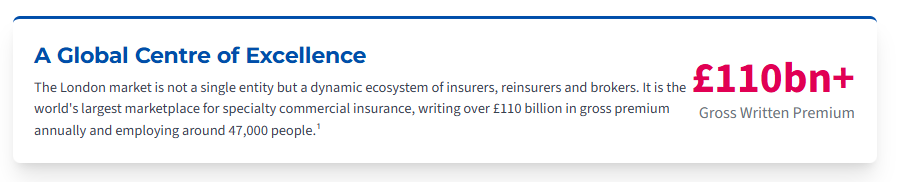
It is defined by its core mechanism of co-insurance, where a complex risk is typically shared across multiple carriers and Lloyd’s syndicate entities, thereby distributing large liabilities effectively. This essential pooling mechanism is what allows the London Market to manage exceptionally large exposures in classes like aviation, deep-sea marine, and energy.
Unique Characteristics of the London Market
Unlike centres focused primarily on handling standard commercial insurance products, the London Market is characterised by the intense geographical concentration of expert underwriters and London Market brokers. These specialists exclusively handle specialty insurance risks, such as space insurance, complex marine liabilities, and high-level political risk coverage.
This critical mass of specialised knowledge and expertise supports an exceptional degree of risk innovation. For risks that are unprecedented or defy standard actuarial modelling, the London Market is often the place where the customised coverage wording is first developed and the necessary global capacity is secured.
The Foundational Role of Lloyd’s of London
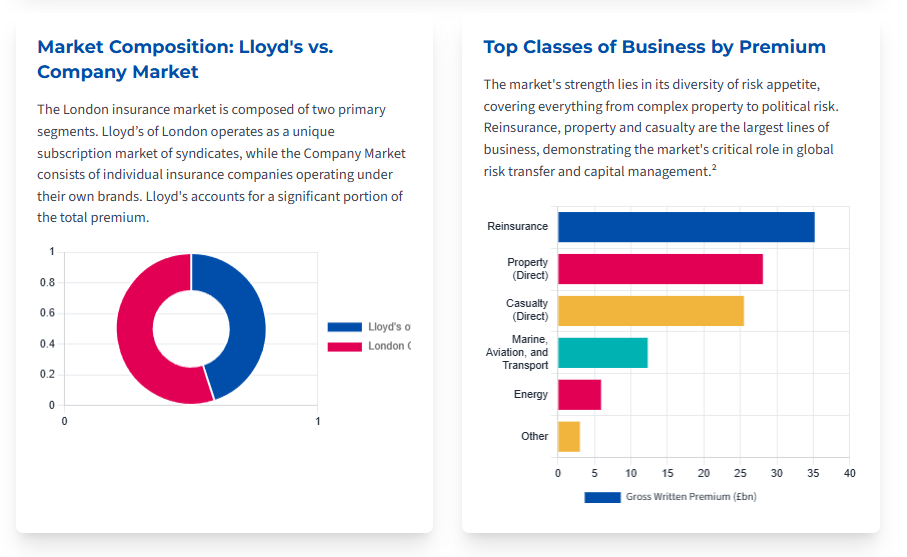
Lloyd’s of London serves as the operational heart and, crucially, the central regulatory and oversight body for a significant portion of the London Market business. While many non-Lloyd’s London Market companies also participate, Lloyd’s sets stringent operational and financial standards and drives fundamental market infrastructure changes.
Participation in the Lloyd’s system grants access to the central Lloyd’s licence platform, which allows syndicates to trade globally with minimal friction. This structure provides vital confidence to international clients seeking London Market insurance solutions for complex, cross-border exposure.
A History of Risk and Resilience
The history of the London Market is a long narrative of continuous development, inextricably linked to maritime trade, global expansion, and structured responses to catastrophic events. This evolutionary path necessitated the constant development of sophisticated risk-sharing and capital management mechanisms that define the London Market today.
Edward Lloyd’s Coffee House
The origins of the London Market trace back to the late 17th century at Edward Lloyd’s coffee house located near the docks of the River Thames. This establishment rapidly became the unofficial meeting place where merchants, ship owners, and wealthy individuals gathered to share critical intelligence about shipping movements and negotiate insurance agreements.
This informal environment established the fundamental mechanism of individual capital backing specific risks. Wealthy individuals, often called ‘Names,’ would underwrite portions of the risk, leading to a direct, personal link between risk capital and the liability underwritten.
The Formation of Lloyd’s of London
Over time, the loose agreements conducted in the coffee house formalised into the Corporation of Lloyd’s, established later by an Act of Parliament. This formalisation created the structured marketplace and officially defined the essential roles of the London Market broker (acting for the insured) and the underwriter (acting for the capital)—a structure that remains absolutely central to the operation of the London Market today.
This institutionalisation was necessary to provide reliable governance and financial stability as the scale and complexity of London Market insurance business grew throughout the 18th and 19th centuries, demanding a robust regulatory framework.
The Importance of the Lutine Bell
The Lutine Bell symbolises the London Market’s deep heritage and its historic function in ensuring rapid, synchronous risk communication. The bell was recovered from the wreck of HMS Lutine in 1858 and subsequently installed in the rostrum of the Lloyd’s Underwriting Room.
The bell was traditionally struck on the arrival of news concerning an overdue ship: once for the ship’s loss (bad news) or twice for her safe return (good news). Its original function was intensely practical: to ensure that all London Market brokers and underwriters were made aware of critical news simultaneously, preventing any information asymmetry in trading.
Key Historical Periods and Market Shocks
The London Market has been continually shaped by major catastrophes and cycles of internal financial crises. Landmark losses, such as the catastrophic San Francisco earthquake and the World Trade Center attacks in 2001, severely tested the market’s collective financial resilience and required massive capital injections.
Internal crises, most notably the “LMX Spiral” (London Market Excess of Loss market) in the late 1980s and early 1990s, forced profound structural London Market reform. These financial shocks accelerated the shift away from the unlimited liability structure of the individual Names toward the modern corporate capital model that provides financial depth to the London Market today.
The Core Participants and Functions
The depth and strength of the London Market stem from its unique ecosystem of institutional participants, which encompasses the physical marketplace (Lloyd’s), major independent London Market companies, and crucial market associations that coordinate operations and ensure regulatory alignment.
Lloyd’s of London: The Regulator and Marketplace
The Corporation of Lloyd’s operates primarily as a market operator, providing the physical and technological platform for complex transactions. Critically, it acts as a regulator for its participants, known as Managing Agents and Lloyd’s syndicate entities, setting standards for conduct and financial stability.
It does not accept insurance risk itself, but it manages the central capital structure (the Central Fund) and provides the essential shared infrastructure under which specialty insurance risk transfer occurs.
The Role of the Lloyd’s Syndicate
A Lloyd’s syndicate is the fundamental risk-bearing entity within the Lloyd’s structure. Syndicates are managed by a Managing Agent and are funded by various capital providers, operating on an annual basis to underwrite specific classes of business. The Lloyd’s syndicate is frequently the ultimate risk carrier or a co-insurer for the most complex London Market insurance contracts globally.
London Market Brokers: The Essential Intermediary
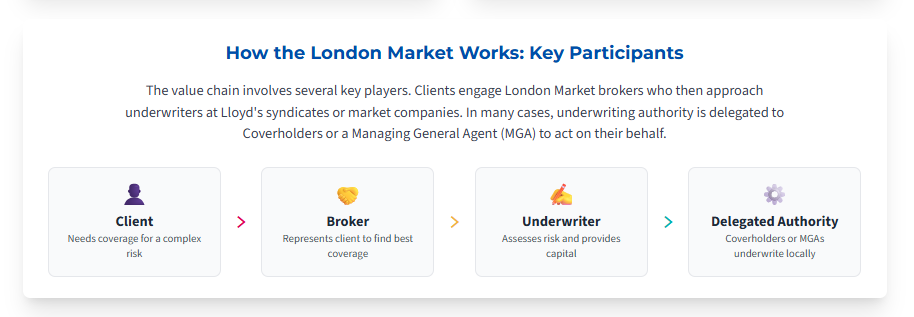
London Market brokers are highly specialised intermediaries, acting solely on behalf of the client to secure the best possible terms. They prepare the detailed risk submission, known as the slip, and negotiate the terms, conditions, and pricing directly with multiple underwriters to complete the placement.
Due to the entirely bespoke and complex nature of specialty insurance contracts, the broker’s expertise is critical in structuring the risk and presenting it in a clear, consistent manner to the market. Brokers are central to the placement process, irrespective of whether that placement is conducted physically or digitally.
London Market Companies: Insurers and Reinsurers
Outside of the physical Lloyd’s system, a significant volume of business in the London Market is transacted by independent London Market companies (insurers and reinsurers). The interests of this “company market” are unified and represented by the International Underwriting Association (IUA).
These companies often co-insure risks alongside Lloyd’s syndicates, providing essential additional capacity and maintaining the London Market’s overall financial depth and diversity. Their participation ensures effective competition and broad access to capital pools.
Market Associations and Oversight
Several key associations maintain the operational integrity of the London Market and drive collective reform efforts, ensuring alignment between sometimes competing industry interests.
-
The Lloyd’s Market Association (LMA): The LMA represents the interests of Lloyd’s Managing Agents. It focuses heavily on developing standardised wordings, claims practices, and regulatory alignment, and it plays a critical role in developing model agreements like the Binding Authority Agreement (BAA).
-
The International Underwriting Association (IUA): The IUA represents the interests of the non-Lloyd’s London Market companies. It ensures this significant sector is integrated into market-wide infrastructure changes and speaks as a unified voice on regulatory and operational matters.
-
The London Market Group (LMG): The LMG acts as a collective strategic voice for the entire London Market, coordinating and leading major industry initiatives, most notably the massive Blueprint Two modernisation programme.
The interdependence of these institutional participants is crucial for the efficient functioning of the London Market, guaranteeing standard practices and consistency in high-value, specialty insurance transactions.
Table Title: Key Institutional Participants in the London Market
| Participant | Core Function | Relationship to Blueprint Two |
| Lloyd’s of London | Central marketplace, regulator, capital management, sets standards | Drives and mandates the Blueprint Two modernisation programme. |
| London Market Association (LMA) | Represents Managing Agents, develops wordings and best practice |
Collaborates on technical standards, including Market Reform Contract (MRC) and Binding Authority Agreement (BAA) models. |
| International Underwriting Association (IUA) | Represents London Market companies (non-Lloyd’s insurers) | Acts as a unified voice for the company market, promoting shared infrastructure. |
| London Market brokers | Represents clients, places risks with underwriters | Central users of digital placing systems and data submission tools. |
Underwriting, Specialty Risks, and the Underwriting Room
The physical concentration of risk capital and expertise in the City of London historically defined the unique underwriting process. This process is essential for placing the complex Specialty insurance classes that dominate the London Market portfolio.
The Underwriting Room and Its Purpose
Historically, the Underwriting Room at Lloyd’s was the physical place where London Market brokers and underwriters met face-to-face to negotiate risk terms. Brokers would physically circulate the insurance slip, obtaining signed lines from multiple underwriters to secure the necessary capacity.
While the increasing use of electronic systems for placement has changed the workflow, this physical proximity remains deeply valuable for building and maintaining relationships, negotiating bespoke manuscript wordings, and securing capacity for risks that require immediate, collaborative human judgment.
Specialty Insurance and Niche Risks
The vast majority of the business transacted in the London Market falls under the definition of specialty insurance. These are high-hazard, complex risks that typically require deep customisation in coverage, making them entirely unsuitable for standard, automated retail insurance systems.
These specialty risks often defy standard algorithmic modelling approaches, compelling underwriters to rely heavily on decades of experience, historical market loss data, and professional judgment to accurately assess exposure and price the insurance.
Key Classes of Business Covered
The spectrum of coverage written by the London Market is exceptionally broad and technically complex, reinforcing its reputation as the centre of specialty risk transfer. Key classes of business include Marine, Aviation, Space, Energy, Political Risk, and complex Casualty lines. Further niche coverage includes Bloodstock, Fine Art, Specie and Exhibitions, Financial Loss, and Legal Expenses.
These exposures frequently involve multi-jurisdictional elements and require sophisticated risk modelling, sanctions checking, and detailed regulatory compliance checks across global territories before capacity can be bound.
Reinsurance Operations within the London Market
Reinsurance, which is the mechanism of transferring risk from one insurer to another, is an exceptionally vital component of the London Market. The market acts as a major global hub for both treaty and facultative reinsurance placement, providing essential capital management capabilities to carriers worldwide.
Reinsurance allows primary London Market carriers, including all Lloyd’s syndicate members, to manage their capital exposure effectively. It also provides a robust mechanism for the rapid deployment of capital following major global catastrophic events. Reinsurance operations contribute substantially to the financial performance and overall resilience of the London Market.
The Delegated Authority Model
The Delegated Authority (DA) model is fundamental to how the London Market successfully accesses international clients and niche sectors without the requirement of establishing a physical local underwriting presence in every territory. It is a critical distribution mechanism for London Market insurance products.
Understanding Delegated Authority (DA)
Delegated Authority involves a Managing Agent granting a third party the contractual power to underwrite contracts of insurance on its behalf. This delegation is strictly governed by predefined parameters, including specific risk appetite, class of business, geographic scope, and maximum limits.
For this system to function effectively and to satisfy stringent regulatory requirements (like SYSC 3.1.1), it requires a robust governance framework to ensure risks are priced correctly, capital is appropriately reserved, and policy issuance adheres to the precise standards of the Lloyd’s syndicate.
Managing General Agent (MGA) Functions
A Managing General Agent (MGA) is the most common and pivotal form of delegated authority entity. The MGA acts as a crucial intermediate layer, typically performing key functions such as full underwriting decision making, policy administration, and, frequently, London Market claims handling.
The MGA effectively functions as an extension of the carrier, but operating independently, bringing specialised expertise and local distribution power that the carrier or syndicate might lack internally.
Coverholder Responsibilities
A Coverholder is a firm specifically authorised by a Managing Agent to enter into contracts of insurance on behalf of the syndicate, strictly according to the terms of a Binding Authority Agreement. Coverholders are crucial for extending the global reach of the London Market, enabling it to penetrate highly specialised or local markets that demand proximity.
Coverholders may also be empowered to issue critical insurance documentation, such as certificates of insurance or temporary cover notes, that serve as evidence of the insurance contracts.
Binding Authority Agreement (BAA) Structure
The Binding Authority Agreement (BAA) is the formal, legally binding contract of delegation. This document meticulously outlines the precise risks the Coverholder can bind, the geographical scope, detailed instructions for handling premium payments, and the procedures for settling London Market claims.
The LMA produces standardised model BAAs (such as LMA 3113 for Worldwide excluding USA/Canada) which may be used for single year terms or as multi-year binding authorities, which, since the 2016 year of account, can span up to 36 months.
Operational Challenges in Delegated Authority
Historically, the DA model faced immense operational hurdles due to the heavy reliance on manual data transmission. Bordereaux, which detail risks and claims, were often inconsistent and manually exchanged via email between parties. This lack of standardised Bordereaux Data Standards led to high rates of duplicated effort and persistent versioning issues across the London Market.
Analysis demonstrates that the relationship between MGAs/Coverholders and Underwriters often prioritised core commercial terms such as “risk coverage and commissions,” while “ongoing data needs being lower priority or sometimes overlooked” at the contract outset. This historical commercial focus, which neglected operational rigour, resulted in poor data quality that actively inhibited effective risk management, such as sanctions checking, and prevented accurate claims reserving. The technological mandates of Blueprint Two are designed to shift this relationship focus towards data compliance and efficiency.
The Imperative for London Market Modernisation
Driven by significant competitive pressure, the necessity to meet evolving regulatory requirements (including the fundamental need to comply with SYSC 3.1.1), and the economically unsustainable high cost of manual processing, the London Market committed to a sweeping and mandatory modernisation agenda throughout the 21st century.
Target Operating Model (TOM) and Reform
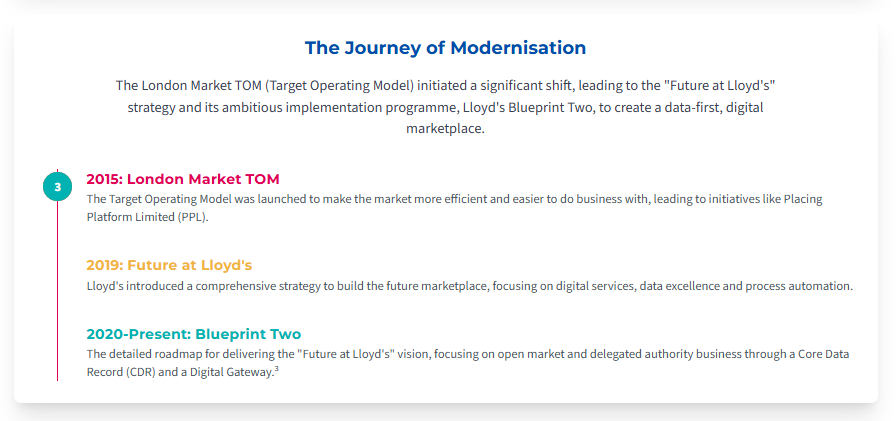
Earlier reform initiatives, known collectively as the Target Operating Model (TOM), established the initial foundation for standardisation, including the introduction of early electronic placement tools. These initial changes were vital but highlighted the deeply entrenched nature of document-centric workflows.
These early efforts demonstrated that incremental change was entirely insufficient. The complexity and volume of the London Market required a mandatory, deeper, and full end-to-end digital transformation to substantially reduce the need for manual intervention.
The Drive for London Market Reform
The core economic driver for London Market reform is the urgent necessity to reduce the estimated billions in annual operational expense associated with fragmented legacy systems, reliance on paper, and manual data handling. The ability to streamline operations is critically important for global competitiveness.
Failure to modernise efficiently threatens the London Market’s competitive position against highly digitised global reinsurers and emerging, agile insurance centres who can operate at significantly lower expense ratios. London Market modernisation is thus viewed not as an option, but as an existential strategic necessity.
Defining the Future at Lloyd’s
The Future at Lloyd’s programme articulated a comprehensive and clear vision for a digital, data-first marketplace. This vision aims to dramatically accelerate processing times, minimise manual errors, and crucially, free up capital tied up in inefficient operational structures by providing granular, real-time portfolio visibility.
The Vision of Lloyd’s Blueprint Two
Lloyd’s Blueprint Two is the definitive action plan designed to realise the Future at Lloyd’s vision, mandated for adoption by all market participants. Blueprint Two represents the transition from legacy, document-driven processes to a structured, data-led digital backbone. Successful implementation will fundamentally transform risk placement, post-bind processing, and London Market claims management.
The Digital Transformation Ecosystem
Blueprint Two centres on the establishment of several interconnected digital components designed to create a ‘Digital Spine’ capable of automated processing from the initial placement of the risk through to its final settlement and clearing.
The Market Reform Contract (MRC)
The Market Reform Contract (MRC) provides the required standardised documentation format for risk placement within the London Market. The latest iteration, MRC v3, is specifically designed to facilitate the simple and reliable extraction of necessary structured information, which is the prerequisite for any subsequent digital processing.
Defining the Core Data Record (CDR)
The Core Data Record (CDR) is the single most essential technical output of Blueprint Two. It is defined as the minimal, standardised dataset that must be captured and exchanged for every London Market risk. The CDR serves as the definitive single source of truth for the policy and aligns entirely with ACORD technical standards.
The CDR is designed to drive digital processing consistently throughout the Digital Spine infrastructure. The strategy for its adoption is flexible: the CDR can either be populated by extracting data from the MRC v3 document, or, for firms using a fully digital “data-first approach,” the CDR can be completed first and used to help create the MRC v3. This pragmatic dual approach manages the transition for participants of varying technological maturity while ensuring all parties adhere to the singular data standard.
The Digital Gateway and Digital Spine
The Digital Spine refers to the central, shared digital processing infrastructure that links all London Market participants together. It acts as the core operational engine for automated post-bind activity, including premium and claims processing, replacing historical manual workflows.
The Digital Gateway functions as the single, regulated point of entry for standardised data (the CDR) into the Digital Spine. This rigorous control ensures that only validated data that complies with ACORD GRLC standards is accepted for processing, thereby protecting data integrity.
Placing Platform Limited (PPL) and Digital Placement
Placing Platform Limited (PPL) is the electronic system used extensively by London Market brokers and underwriters for the digital negotiation and placement of risks. PPL provides a standardised, auditable workflow for the placement of documents and the secure negotiation process.
As a crucial front-end component, PPL is vital for embedding the mandatory Structured Data Capture processes required to generate the high-quality CDR at the point of trade.
DXC Digital Processing Services (DPS)
DXC Digital Processing Services (DPS) manages the essential central transaction processing functions for the London Market, including central accounting, settlement, and large-scale central data storage. The deep transformation of DPS services is critical for leveraging the CDR data and delivering the automated processing efficiencies promised by Blueprint Two.
Delegated Authority Technology and Data Flow
The Delegated Authority sector, which is characterised by high transaction volumes and dispersed data sources, required specific technological intervention to overcome historical data quality and inconsistency issues endemic to the London Market.
Delegated Data Manager (DDM) Functionality
The Delegated Data Manager (DDM), formerly known as DA SATS, is the centralised solution specifically implemented for the submission, access, and transformation of DA data. The DDM enables consistent data and information exchange across the entire Delegated Authority market, directly solving historical inefficiencies and inconsistent versioning issues caused by bordereaux being manually sent via email.
Benefits of the Coverholder Workbench
The Coverholder Workbench is a key strategic tool within the DA ecosystem designed to provide Coverholders and Managing General Agents (MGAs) with a streamlined, governed interface. This interface facilitates the efficient submission, monitoring, and management of their delegated authority business.
By promoting the direct entry of high-quality data and standardised bordereaux, the Coverholder Workbench significantly supports the DDM’s objective of improving data capture, quality, and consistency at the source.
The Integrated DA Ecosystem
Integrating the DDM into the wider Blueprint Two infrastructure creates a cohesive, integrated DA ecosystem. This integration yields several operational benefits: reduced manual transmission effort, significant improvements in data quality, and better security through controlled access rights.
Crucially, this transformation allows Managing Agents to gain usable data extracts for enhanced CAT Modelling, improved pricing strategies, and deeper market insights. This addresses the previous problem where operational data was overlooked in favour of commercial negotiation, forcing a necessary shift toward operational excellence required for effective capital management.
Data Standards and Exchange Protocols
Standardisation of data is the technical prerequisite for achieving the London Market’s digital future. This mandatory standardisation is accomplished through the enforced adoption of globally recognised messaging frameworks, ensuring seamless interoperability.
Adopting ACORD Standards
ACORD Standards are the globally recognised, non-proprietary data methodology established by the non-profit ACORD organisation. The compulsory adoption of these standards ensures the London Market’s systems are fully interoperable with international trading partners, reinsurers, and global placement platforms.
The utilisation of ACORD standards allows for substantially improved efficiency and the eventual elimination of redundant processes and technologies across the entire specialty insurance value chain.
The London Market specifically selected the ACORD GRLC Standards as the mandated method of data exchange. This decision reflects the market’s focus on complex, specialty insurance, as GRLC standards are optimally tailored for the high-value, bespoke, and cross-border risks inherent in reinsurance and large commercial lines.
Alignment with ACORD GRLC ensures that the structured data transmitted via the Digital Gateway and Core Data Record is universally consistent, validated, and machine-readable.
Structured Data Capture (SDC)
Structured Data Capture (SDC) is the necessary process by which unstructured or semi-structured data, such as custom wording or endorsements in the Market Reform Contract, is automatically converted into discrete, machine-readable, standardised data elements (the CDR). SDC is essential for automating complex post-bind operations that historically relied on manual human review.
Bordereaux Data Standards and Quality Improvement
The introduction of mandatory Bordereaux Data Standards directly addresses historic operational challenges in delegated authority. Issues arose because data requirements were often not fully agreed upon at the contract outset, particularly for long-standing contracts.
Standardised bordereaux are crucial for enabling carriers to receive real-time or near real-time data on risks and London Market claims. This rapid data flow provides clear benefits, including more effective risk management (e.g., managing sanctions exposure) and, critically, better management and reserving for claims, leading to the more effective use of capital.
Reference Data Management (RDM)
Reference Data Management (RDM) systems are necessary to ensure absolute consistency in all non-transactional data elements used across the London Market. This includes standard identifiers such as currency codes, country codes, and established classification codes. RDM forms a fundamental backbone for accurate digital processing and regulatory reporting.
Entity Reference Data Model (ERDM)
The Entity Reference Data Model (ERDM) standardises the identification and categorisation of all legal entities and firms involved in a London Market contract: syndicates, Managing Agents, London Market brokers, and third parties. Standard party identification is essential for compliance checks, regulatory reporting, and accurate financial netting.
The market uses ERDM specifically for counterparty data management, a requirement distinct from external concepts like the Electronic Discovery Reference Model (EDRM) used in legal document review.
The Central London Office Codes System (CLOCs) refers in the insurance context to a system historically used to identify and code participants’ office locations for streamlined physical document routing. While the term exists in other domains such as construction safety , in the London Market, CLOCs is being systematically replaced by the more modern digital reference models (ERDM) but remains essential for legacy system interface and historic data migration.
API (Application Programming Interface) Integration Standards dictate precisely how internal technologies, such as a firm’s Policy administration system or Claims management system, must communicate seamlessly with the central Digital Spine, PPL, and the DDM. Adhering to these API standards, which rely on the ACORD GRLC data format, ensures that internal systems can successfully plug into the unified market ecosystem.
Operational Processes and Efficiency
Beyond the initial placement and data standards, the London Market must fundamentally transform its core post-bind operations to achieve the full efficiency benefits promised by Blueprint Two and to compete globally.
Settlement and Clearing Infrastructure (SCI)
The Settlement and Clearing Infrastructure (SCI) provides the mechanism for central netting of premiums, taxes, and London Market claims payments between multiple market participants. SCI modernisation is vital for reducing the complexity, volume, and latency of financial transactions across the London Market.
The future SCI must operate based exclusively on structured CDR data inputs, rather than relying on the slower, labour-intensive interpretation of document-based financial instructions, to achieve near real-time financial reconciliation.
Claims Workflow Automation (CWA)
Claims Workflow Automation (CWA) is a major strategic goal, aimed at digitising and substantially streamlining the entire claims process. This involves migrating from reliance on manual referral and adjustment toward automated routing and payment based on predefined rules and standardised data inputs.
CWA is critically dependent on receiving accurate, high-quality, and timely data supplied by integrated Claims management system solutions that comply with ACORD standards and link directly to the Digital Spine.
DXC Digital Processing Services (DPS)
DPS continues its critical operational role by handling the central accounting and settlement functions for the London Market. Under Blueprint Two, DPS undergoes a major strategic pivot. Its core focus shifts dramatically from manually processing and reconciling paper documents to validating and manipulating the structured data that flows through the Digital Spine, all of which must strictly comply with ACORD GRLC standards.
Regulation, Governance, and Compliance Frameworks
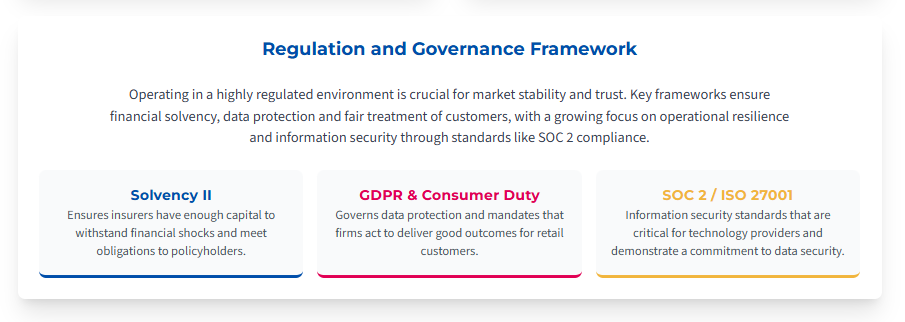
As a globally active financial centre, the London Market is subject to extremely rigorous regulatory oversight from UK and international bodies, necessitating robust internal governance structures for every participant.
Financial and Systemic Governance
Effective capital management and oversight of systemic risk are central to the stability of the London Market.
-
Solvency II Implications for Capital: Solvency II requires Managing Agents and London Market companies to hold capital reserves that are commensurate with the risks they underwrite. The structural improvements provided by CDR and DDM technologies directly support sophisticated internal capital modelling and reporting, enabling faster, more accurate risk aggregation required under Solvency II.
-
FCA SYSC 3.1.1: Systems and Controls Requirements: This foundational FCA rule mandates that a firm must take reasonable care to establish and maintain “such systems and controls as are appropriate to its business”. Given the massive nature, scale, complexity, and geographical diversity of the London Market’s operations, compliance requires ongoing, substantial investment in secure, reliable, modern technological infrastructure. Modernisation is thus not merely a strategic choice but a fundamental regulatory compliance requirement.
-
FCA PROD 4: Product Governance and Design: PROD 4 mandates that manufacturers, which includes Lloyd’s syndicate Managing Agents, must duly document their product approval processes. This requires them to explicitly specify an identified target market, assess all relevant risks, and ensure that the distribution strategy is entirely consistent with that target market. This requirement is crucial for specialty insurance where the bespoke nature of the contracts increases the risk of mis-selling or providing poor value.
The Impact of Consumer Duty on Wholesale Business
The implementation of the FCA Consumer Duty regime has introduced significant complexity, applying cross-cutting rules aimed at achieving outcomes like “fair value” and ensuring “consumer understanding,” even within the wholesale business model of the London Market.
The multi-layered distribution chain of the London Market (Syndicate MGA Local Broker Client) means accountability for the manufacturer (the syndicate) is dramatically increased. The regulation requires the firm to look beyond its immediate counterparty and consider the ultimate consumer outcome. Compliance with PROD 4’s mandates regarding target market specification and distribution appropriateness becomes the key procedural mechanism for satisfying the wider principles of Consumer Duty. Firms must therefore implement robust data collection systems, supported by Delegated Data Manager, to monitor outcomes and prove fair value throughout the entire complex distribution chain.
Data Security and Privacy Requirements
Handling immense volumes of sensitive, cross-border risk, policy, and claims data mandates strict adherence to international security and privacy protocols, which is vital for maintaining the London Market’s global reputation.
GDPR (General Data Protection Regulation) and UK Data Transfers
The UK GDPR retains the core principles, rights, and obligations of the EU framework, yet the UK’s independent regulatory position creates operational complexity for the London Market regarding international data transfers. Given the global nature of claims and policy data processing for EU and international citizens, managing data transfers, particularly between the UK and the EEA, requires precise, documented processes.
The UK GDPR also maintains broad jurisdiction, applying to non-UK controllers and processors if their activities relate to offering goods or monitoring behaviour of individuals in the UK.
SOC 2 compliance is essential for all third-party technology providers and critical operational service providers utilized across the London Market. Achieving SOC 2 provides crucial assurance to Managing Agents and London Market brokers that the vendor’s systems meet rigorous criteria regarding the security, availability, processing integrity, confidentiality, and privacy of the handled data. This compliance is a non-negotiable benchmark for critical market infrastructure.
ISO 27001 and Information Security
ISO 27001 provides the internationally recognised framework for establishing, implementing, maintaining, and continually improving an Information Security Management System (ISMS). Many London Market companies and brokers adopt ISO 27001 certification to demonstrate comprehensive, auditable control over sensitive client and proprietary risk data.
Cyber Essentials Plus Certification
As a necessary baseline standard for robust cyber hygiene, Cyber Essentials Plus is often required for vendors and smaller London Market participants. This certification helps ensure minimum protection against common internet-based threats. Adherence to this standard is vital for mitigating systemic cyber risk across the highly interconnected operational ecosystem of the London Market.
Current Dynamics and Performance Trends
The London Market operates within cyclical market dynamics, continually striving to balance the need for sustained underwriting profit against external pressures and the internal requirement to modernise processes efficiently.
Market Performance and Capital Adequacy
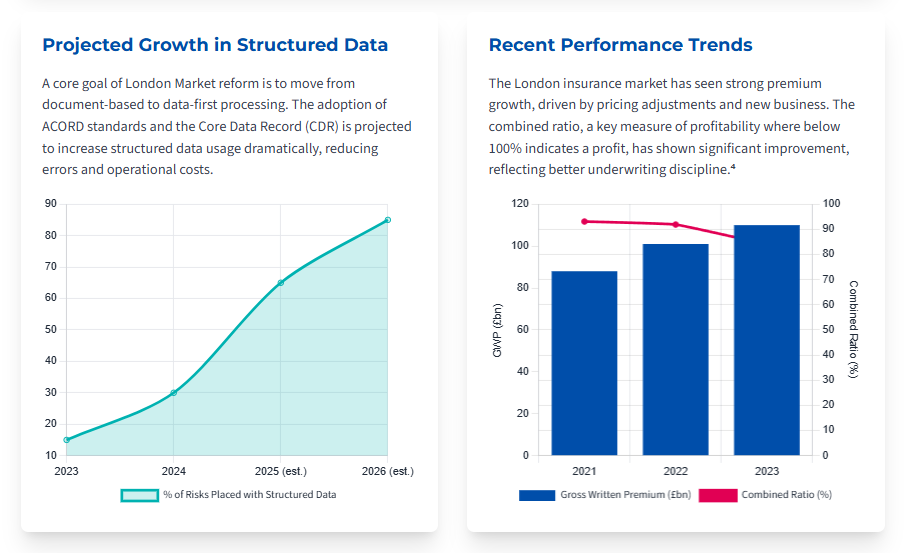
Following a challenging period marked by sustained underwriting losses (2017-2019), the London Market has demonstrated significant performance improvement. This resilience has been driven primarily by firm rate hardening across specialty insurance classes and tighter capital discipline enforced by Lloyd’s management.
Capital adequacy remains robust, strengthened by the risk-based capital calculations mandated under Solvency II, ensuring that London Market carriers, including all Lloyd’s syndicate participants, hold adequate reserves relative to their exposures.
Underwriting Performance Cycles
The London Market historically experiences distinct cycles of hard and soft markets. A hard market, characterised by sharply rising premiums and restricted capacity, typically follows catastrophic loss events or sustained regulatory pressure. Conversely, a soft market is marked by lower premiums due to excessive capital capacity entering the specialty insurance arena, which often drives down profitability.
Understanding these cycles is vital for Managing Agents seeking long-term underwriting profitability and for London Market brokers advising clients on placement strategy.
Strategic Capacity Management
Managing Agents must engage in continuous strategic capacity management, actively optimising their portfolios. This involves systematically reducing exposure to underperforming or high-volatility classes while deliberately growing capacity in emerging specialty risks, such as systemic cyber risk and sophisticated liability solutions.
The improved, rapid visibility into portfolio risk, facilitated by new technologies like the Delegated Data Manager and the Core Data Record, is essential for informed, agile strategic capacity management decisions.
While the strategic vision articulated in Blueprint Two is clear, its practical, market-wide adoption remains challenging, demanding immense capital investment from all participants across the London Market.
-
Challenges of Legacy Policy Administration System Replacement: A significant technological impediment is the pervasive presence of decades-old Policy administration system technology across many London Market firms. Replacing these core systems is inherently costly, complex, and high-risk, leading to slow and staggered adoption of the new digital standards required for full integration.
-
Data Quality and Implementation Issues: Despite the selection of ACORD standards, the fundamental operational impediment remains inconsistent data quality at the source. The practical implementation of Structured Data Capture (SDC) and ensuring London Market brokers and Coverholders accurately populate the Core Data Record requires profound cultural and process change, not merely technological deployment. The shift from focusing on commercial terms to mandatory data compliance represents a significant cultural hurdle for many long-established firms.
Future Stability of the London Market
The sustained future success and global relevance of the London Market depend entirely on achieving the promised transactional efficiencies of Blueprint Two while simultaneously navigating rapidly shifting global geopolitical and regulatory tides.
The Long-Term Vision of Blueprint Two
The successful, comprehensive execution of Lloyd’s Blueprint Two will result in a fully digital claims and premium lifecycle, dramatically reducing the frictional costs associated with manual handling and improving the speed of payments to policyholders. This overhaul is explicitly intended to attract new, efficient capital, enhance client service, and significantly increase the global competitive position of the London Market.
Future Investment in Claims Management System Technologies
The strategic pivot toward Claims Workflow Automation (CWA) necessitates substantial and coordinated future investment in modern Claims management system technologies. These systems must be engineered to be fully integrated with the Digital Spine and built to seamlessly consume and process the structured data provided by the CDR. Automated claims processing is projected to deliver substantial operational cost savings and superior client service standards across the London Market.
Maintaining Global Competitiveness
The London Market faces continuous and fierce competition from established global reinsurers and emerging, low-cost insurance centres. The market’s unique competitive advantage remains its concentration of expertise for underwriting highly complex specialty insurance risks.
However, if transactional efficiency and frictional costs are not drastically improved to match those of competitors, the London Market risks ceding substantial market share. This critical link between operational performance and global relevance confirms that Blueprint Two is an existential necessity for future stability.
The London Market’s Position in the Global Risk Environment
As the global risk environment evolves, defined by escalating challenges such as climate change, geopolitical instability, and systemic cyber risk, the London Market’s historical expertise in developing innovative Specialty insurance products (such as sophisticated political risk and parametric solutions) secures its ongoing relevance. The strategic challenge lies not in finding the capacity for the risk, but in ensuring that the new digital operational platform can efficiently support and process this innovation at the necessary scale and speed.
A Strategic Outlook for the London Market
The London Market faces a transformation that would be unthinkable to the merchants who gathered in Edward Lloyd’s coffee house three centuries ago. After building its reputation on handshakes, personal relationships, and the accumulated wisdom of underwriters who could price risks that defied standard actuarial models, the market now confronts a mandated digital reckoning. Blueprint Two and its associated technologies represent far more than an IT upgrade. They constitute a fundamental reimagining of how the world’s pre-eminent specialty insurance hub conducts business.
The transition from relationship-driven trading floors to data-first digital ecosystems, powered by ACORD GRLC standards and the Core Data Record, will determine whether London remains the definitive centre for complex risk transfer or becomes a prestigious but operationally hampered legacy market.⁶ ⁷ The expertise that built the market’s reputation remains world-class. The infrastructure supporting that expertise has spent decades falling behind.
Regulatory Pressure as Forcing Function
The regulatory environment provides no room for gradualism. SYSC 3.1.1 requirements demand that firms maintain systems and controls appropriate to their business scale and complexity.⁴ For a market handling billions in premiums across delegated authority chains spanning multiple jurisdictions, “appropriate” now means demonstrable real-time oversight. Paper-based processes and email bordereaux no longer satisfy this standard, regardless of how well they functioned historically.⁴
PROD 4 requirements for product governance add another dimension of pressure.¹² Managing agents must prove their distribution strategies align with identified target markets and deliver fair value throughout complex chains involving MGAs, coverholders, and local brokers.¹² The Consumer Duty regime extends this accountability further, requiring manufacturers to look beyond immediate counterparties and consider ultimate customer outcomes.¹³ Without robust data collection systems, ideally powered by the Delegated Data Manager, proving compliance becomes an exercise in speculation rather than evidence.⁸
The Data Quality Imperative
The bordereaux chaos that plagued delegated authority business for decades illustrates the market’s fundamental challenge.⁵ When commercial terms like risk coverage and commission rates took precedence over operational rigour during contract negotiation, the result was predictable: inconsistent data formats, manual reconciliation nightmares, and managing agents who lacked real-time visibility into risks they had legally bound.⁵
The Core Data Record addresses this problem through compulsion rather than persuasion.⁶ Every placement now requires a standardised minimum dataset, captured either through structured data extraction from MRC v3 documents or through direct digital entry.⁶ The flexibility of this dual approach acknowledges that market participants exist at vastly different stages of technological maturity whilst ensuring everyone arrives at the same destination: clean, consistent, machine-readable data flowing through the Digital Spine.
This transformation provides tangible operational benefits. Managing agents gain the portfolio visibility necessary for effective CAT modelling, accurate pricing, and responsive capacity management.⁸ Coverholders submit data once through the Delegated Data Manager rather than reformatting bordereaux for multiple carriers.⁸ Sanctions checking, claims reserving, and regulatory reporting shift from labour-intensive manual processes to automated workflows. The market that once relied on the Lutine Bell to ensure simultaneous information flow now pursues that same synchronicity through mandated data standards and centralised infrastructure.²
Technology Implementation Reality
The vision articulated in Blueprint Two remains clearer than its execution. Many London Market firms continue operating on policy administration systems built decades ago, when the internet was nascent and mobile computing unimaginable. Replacing these core systems requires massive capital investment, introduces substantial operational risk, and faces resistance from staff accustomed to familiar workflows. The slow, staggered adoption of new digital standards reflects these harsh practical realities rather than any disagreement about strategic direction.
Data quality at source presents an equally stubborn challenge. ACORD standards provide the technical framework, but no amount of elegant architecture can compensate for brokers and coverholders who fail to populate the Core Data Record accurately and completely. The cultural shift from prioritising commercial negotiation to ensuring data compliance represents a profound change for firms built on personal relationships and handshake deals. Technology deployment is straightforward compared to convincing market participants that operational excellence now determines competitive advantage as much as underwriting expertise.
Competitive Threats and Global Position
The London Market’s unique selling proposition has always been its concentration of expertise for underwriting risks that standard markets cannot handle. Space launches, deep-sea drilling operations, political risk coverage across unstable regions, pandemic bonds, cyber liability for critical infrastructure—the market’s bread and butter consists of exposures that require human judgment, decades of experience, and access to vast pools of risk capital.¹
This expertise advantage remains intact. The operational efficiency gap does not. Highly digitised global reinsurers and emerging insurance centres operate at expense ratios that London struggles to match. When clients compare the speed, transparency, and ease of doing business, the market’s historic prestige provides diminishing protection against competitors who can quote faster, bind quicker, and settle claims without manual intervention.
Blueprint Two exists because market leaders recognised this competitive threat. The billions being invested in digital transformation represent survival mechanisms, not experimental initiatives. If the market cannot reduce frictional costs to competitive levels whilst maintaining its underwriting excellence, substantial market share will flow elsewhere. The strategic question is not whether to modernise but whether the market can execute this transformation quickly and thoroughly enough to preserve its global position.
Future Risk Environment and Market Relevance
The evolving global risk landscape should favour London’s strengths. Climate change produces increasingly complex property and casualty exposures. Geopolitical instability drives demand for sophisticated political risk and trade credit solutions. Systemic cyber threats require innovative liability products that standard markets cannot provide. The London Market has historically excelled at developing specialty insurance products for emerging risks that defy conventional underwriting approaches.
The strategic challenge lies not in identifying these opportunities or marshalling the capital to underwrite them. The London Market possesses both in abundance. The challenge is ensuring that the operational platform can efficiently support innovation at the necessary scale and speed. Developing a groundbreaking parametric insurance solution for climate adaptation means nothing if the systems processing claims remain mired in manual workflows and document-based reconciliation.
The Digital Spine, Claims Workflow Automation, and integrated systems connecting policy administration to settlement infrastructure provide the foundation for operational efficiency that matches underwriting sophistication.⁶ Without this infrastructure, the market risks becoming a high-cost provider of specialist products in an environment where clients increasingly expect both expertise and efficiency.
The Existential Verdict
The London Market’s centuries of accumulated expertise, vast pools of risk capital, and global distribution networks remain formidable competitive advantages. None of these assets guarantees future relevance if the operational infrastructure cannot match the sophistication of the risks being underwritten. The market that pioneered modern insurance by pooling risk in a coffee house now faces the imperative of pooling data through centralised digital systems.
Blueprint Two, the Delegated Data Manager, the Core Data Record, and mandatory ACORD GRLC standards represent the market’s answer to this imperative.⁶ ⁷ ⁸ Success requires more than deploying technology. It demands cultural transformation across thousands of market participants, substantial and sustained capital investment in infrastructure replacement, and the discipline to maintain data quality standards when commercial pressures tempt shortcuts.
The regulatory environment provides no alternative. SYSC 3.1.1 and PROD 4 requirements make robust systems and demonstrable oversight non-negotiable.⁴ ¹² Competitive pressure from digitally native insurance centres creates urgency. The transformation currently underway will determine whether the London Market enters its fourth century as the definitive global hub for specialty risk transfer or watches that distinction migrate to more operationally agile competitors. The expertise remains unmatched. The infrastructure supporting that expertise must now catch up before the market discovers that reputation alone provides insufficient protection in an industry increasingly defined by data quality and operational speed.