
An underwriting workbench is software that brings the submission, external data, pricing, authority rules and documents an underwriter uses into one screen, from the arrival of a submission to the binding of a risk. It also records each decision and the authority under which it was made.
This entry explains what a workbench does at each step, the Lloyd's and FCA requirements its functions relate to, the survey data on artificial intelligence in UK insurance, what regulators and the actuarial profession have said about models and AI, and how a workbench differs from a policy administration system and a rating engine.
What is an underwriting workbench?
A workbench is the working environment of an underwriter. It sits between incoming submissions and the systems that hold policies, rating rules and document templates. The underwriter sees the submission, the external data gathered about the risk, the price and the authority that applies in one place, and the workbench passes the outcome to the system that holds the policy record. A workbench can also present renewals and mid-term changes that rules have referred, so that the underwriter reviews them in the same queue as new business.
A workbench applies where a person reviews a risk before it is accepted. Where a transaction is accepted by rules alone, with no person reviewing it, it is processed straight through, which is described in the entry on straight-through processing. One product can use both: rules accept the straightforward risks and refer the rest to an underwriter's workbench.
Where the submission, the data, the price, the decision and the documents sit in separate tools, such as an email inbox, a spreadsheet rating model, a data provider's website and a document system, the underwriter moves between them and rekeys data from one to the next. A workbench presents them in one place and passes data between them.
From submission to bind, step by step
How a risk moves through an underwriting workbench
Not every risk passes through every step. A risk inside appetite and inside the underwriter's authority goes from rating to quote without a referral, and a risk that rules can accept on their own may never reach the workbench queue.
What an underwriting workbench does, function by function
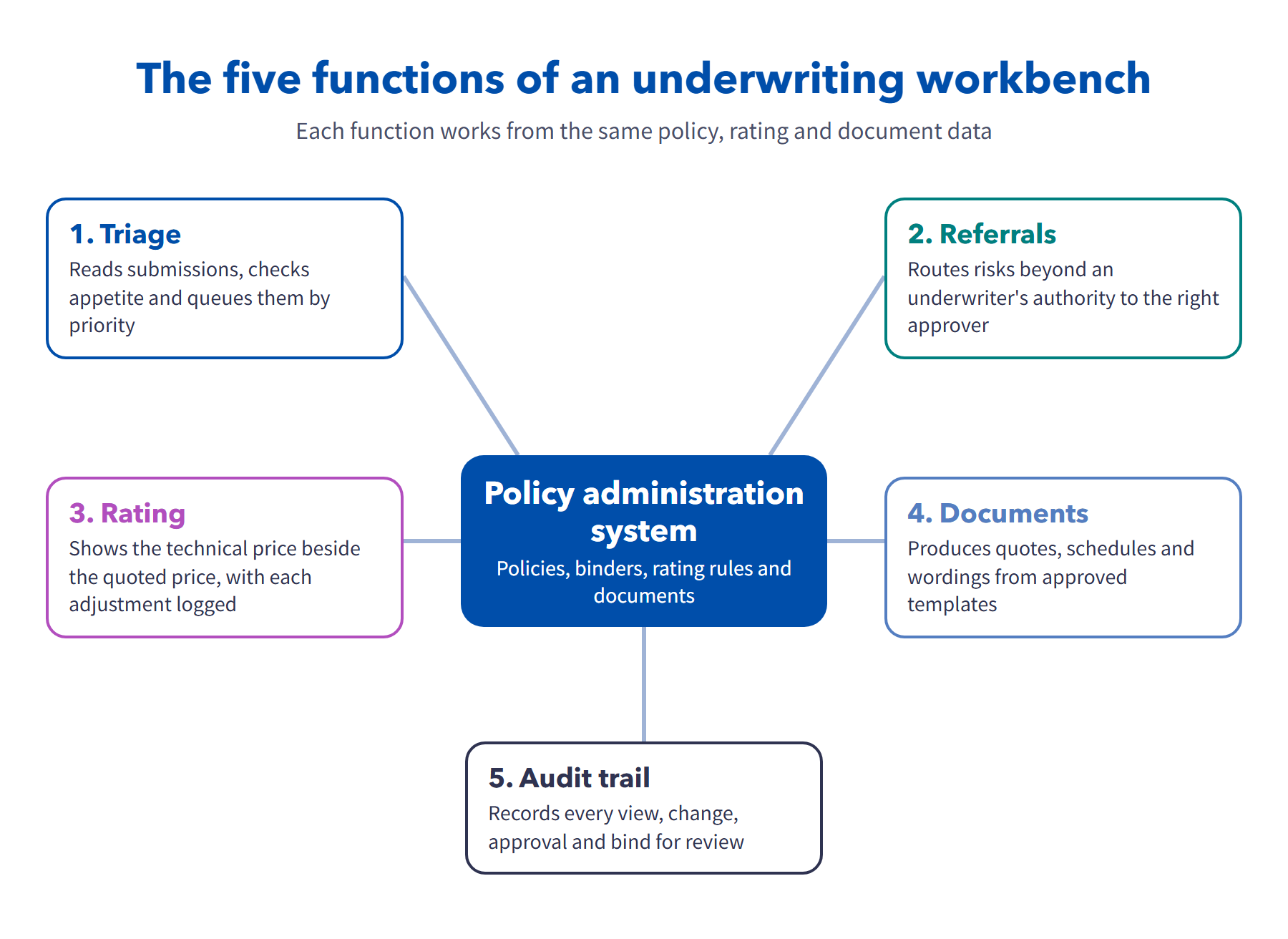
This section describes five functions as they work day to day: triage, referrals, rating, documents and the audit trail, with the data enrichment that feeds them.
Triage
Submissions arrive by email, broker portal or API, and may include attachments in different formats. The workbench reads each one, pulls out the key details, checks them against the insurer's appetite and places the submission in a queue by priority. A risk that falls clearly outside appetite can be declined at once, and the queue can be ordered so that submissions likely to bind are reviewed first.
Referrals
An underwriter works within an authority: a maximum line size, the classes and territories they may write and the conditions they may waive. When a risk goes beyond that authority, the workbench routes it to the person who can approve it, with the case file attached, and records the decision and the reason given. Referral rules can also cover the content of a submission, such as a trade outside appetite, a claims history beyond set limits or external data that contradicts the broker's answers.
Rating
The workbench sends the risk details to the rating engine and shows the technical price beside the price the underwriter intends to quote. The underwriter can apply loadings and discounts within their authority, and each adjustment is recorded with the reason for it.
Documents
Once terms are agreed, the workbench produces the quote, the schedule and the policy wording from approved templates, using the data already captured, and stores every document against the case. Documents produced from the same template share one layout, and details the system already holds are not retyped.
Audit trail
The workbench records each action: who opened a submission, what data they saw, which price the model produced, what was changed, who approved a referral and when the risk was bound. The record shows whether each underwriter stayed within their authority. The same data shows where submissions wait longest and which referral rules are triggered most.
Data enrichment and document extraction
A workbench can call external data sources, such as property databases, company registers and credit reference agencies, and show the results beside the broker's answers. Commercial and specialty submissions can arrive as broker presentations, schedules of values and loss histories in documents and spreadsheets, and natural language processing can extract fields from them into structured data, with a person checking the result before it is used to rate the risk. Each data call, the source document and any correction the underwriter makes can be stored against the case, so that a later review can see what the underwriter saw at the time of the decision.
The rule or market expectation behind each function
A workbench does not create obligations of its own. Each of its functions handles a task that a rule, a piece of guidance or a market expectation already applies to, as the table sets out for the UK and Lloyd's.
| Function | What the workbench does | Related rule, guidance or expectation |
|---|---|---|
| Triage | Checks each submission against appetite and the product's target market | PROD 4.2.15R: a manufacturer's product approval process must specify an identified target market and require reasonable steps to ensure the product is distributed to it1. Lloyd's expects syndicates to have a clearly defined and understood underwriting risk appetite2 |
| Referral | Routes risks beyond an underwriter's or coverholder's authority to an approver | Lloyd's maturity matrix: underwriting authorities properly authorised, signed and subject to annual review, with breaches escalated upwards and to Compliance3. A coverholder's binding authority agreement defines the scope of its underwriting and administrative functions4 |
| Rating | Shows the technical price beside the quoted price and records adjustments | Lloyd's maturity matrix: deviation from technical price controlled via underwriting authority or escalated, and the difference between technical and market price analysed and recorded3. Consumer home and motor renewals: ICOBS 6B.2.1R5 |
| Documents and data | Produces the quote and contract and captures the data that downstream processes need | Lloyd's Core Data Record: the transactional data to be captured at written line for premium, claims, tax and regulatory processes6 |
| Audit trail | Records who did what, when and under which authority | SYSC 3.2.20R for insurers, managing agents and the Society of Lloyd's, among others; SYSC 9.1.1R for other firms that are not common platform firms789. PROD 4.2.7R: product approval actions documented and kept for audit1 |
| Automated decisions | Accepts, declines or prices some risks by rules or models alone | UK GDPR Article 22C: safeguards where a significant decision about a person is based solely on automated processing10; Article 22B restricts such decisions where special categories of personal data are used11 |
Underwriting authority under delegated arrangements
At Lloyd's, a managing agent may authorise third parties to accept insurance risks directly on behalf of its syndicates; these businesses are known as coverholders, and there were 3,015 approved coverholders at 31 December 2025.12 Lloyd's describes delegated underwriting as a key distribution channel, accounting for approximately 45% of the market's premium income.13 The two figures come from different Lloyd's pages and measure different things: a count of approved coverholders at the year end, and a share of premium income.
A coverholder's authority is granted through a binding authority agreement, which defines the scope of the underwriting and administrative functions the coverholder is permitted to perform.4 Lloyd's also recognises digital platform providers, which use an automated online platform to bind policies and issue policy documents on behalf of a managing agent or coverholder.13 Lloyd's maturity matrix states that a binding authority agreement should include sufficient underwriting controls and referral requirements and be subject to annual review, and describes referral processes for any potential breaches of delegated authority rules.3
A workbench used under a binder can hold the agreement's classes, territories and limits as rules, so that each quote from an MGA or coverholder is checked against them. A risk outside the binder can then be referred before it is bound, rather than found later on a bordereau sent to the capacity provider under the delegated authority arrangement.
What Lloyd's expects of underwriting controls
Lloyd's assesses managing agents against 13 Principles for doing business, published with a maturity matrix in July 2024 that grades practice as foundational, intermediate, established or advanced.3 The Principles are supported by guidance in the form of the maturity matrix, whose examples and indicators, Lloyd's says, “are not exhaustive”; the more material a syndicate is to a Principle, the more sophisticated the capabilities Lloyd's expects.3
Under the Underwriting profitability principle, managing agents should ensure their syndicates have underwriting controls, monitoring and reporting appropriate to their risk profile in order to deliver the agreed business plan, and an effective pricing framework to evaluate sustainable technical price and rate adequacy.2
For underwriting authority, the matrix describes practices at different maturity levels, with the level expected rising with a syndicate's materiality, including authorities that are properly authorised, signed, reviewed each year and linked to the experience, knowledge and expertise of the individual; breaches escalated upwards and to Compliance; deviation from technical price controlled through underwriting authority; underwriters recording the difference between technical price and market price; and automated tracking and reporting against underwriting limits, aggregate exposures and pricing adequacy.3 For pre-bind work it describes detailed pre-bind analysis recorded with structured rationale for all lead business, and pre-bind usage statistics forming part of regular management information.3
Records, product governance and pricing rules
Which FCA record-keeping rule applies depends on the firm. SYSC 2 and SYSC 3 apply to insurers, UK ISPVs, managing agents and the Society of Lloyd's, and the common platform requirements in SYSC 4 to SYSC 10 apply to every other firm unless a specific rule provides otherwise.7
For insurers, managing agents and the Society, SYSC 3.2.20R requires a firm to take reasonable care to make and retain adequate records of matters and dealings which are the subject of requirements and standards under the regulatory system.8 For other firms that are not common platform firms, such as insurance intermediaries, SYSC 9.1.1R requires orderly records of the firm's business and internal organisation, including all services and transactions, sufficient for the FCA to monitor compliance with the regulatory system.9 A workbench's audit trail is one place where the underwriting part of those records is held.
Product governance rules apply before a product reaches the workbench. A firm that manufactures an insurance product must maintain, operate and review a process for approving it before it is marketed or distributed, and that process must specify an identified target market and require reasonable steps to ensure the product is distributed to it.1 Relevant actions taken in the product approval process must be documented, kept for audit purposes and made available to the FCA on request, and for a non-investment insurance product the process must identify whether the product provides fair value to customers in the target market.1 Appetite and referral rules in a workbench can carry a product's target market and distribution limits, and its records show which risks were written inside and outside them.
Pricing in a workbench is also subject to conduct rules. For home and motor insurance sold to consumers, ICOBS 6B applies where a firm sets the renewal price, and the renewal price, including any loading, must not exceed the equivalent new business price (ICOBS 6B.2.1R).145 The FCA states that the rules in the chapter are not intended to affect how risk is priced for home and motor insurance (ICOBS 6B.1.5G).14
The data a workbench captures for the London market
Lloyd's Core Data Record (CDR) holds the transactional data that must be captured at written line for four downstream processes: premium validation and settlement, claims matching at first notification of loss, tax validation and reporting, and regulatory validation and core reporting.6 The data is either captured in the Market Reform Contract (MRC v3) during placement and extracted into the CDR, or used to help create the MRC v3, and the CDR aligns with ACORD technical standards.6 The London Market Group Data Council published CDR v3.2 on 29 March 2023.6
Blueprint Two was Lloyd's digital transformation initiative. In March 2026 Lloyd's announced a new strategy and decided to transition away from Blueprint Two, and said it would refocus Velonetic, which operates the market's core processing services, on incremental technology modernisation.15 A workbench that captures CDR fields when the risk is underwritten can pass them to the systems that settle premium, match claims and report tax.
Artificial intelligence in insurance underwriting: the survey data
The Bank of England and the FCA have surveyed UK financial services firms on machine learning and artificial intelligence. In the survey published on 11 October 2022, 72% of the 71 responding firms reported using or developing machine learning applications, and the largest expected increase was in the insurance sector, where the median number of applications per firm was expected to increase by 163%.16
Among insurers, the most advanced deployment of machine learning was typically within their core business, to support either pricing or underwriting.16 In motor insurance, respondents described models that predict the frequency and severity of expected claims for all new business and renewal quotes, with some technical risk models being migrated from generalised linear models to models using gradient boosting; one insurer described pre-approving consumers for life insurance using data already available from bank accounts and credit rating.16
| Measure | 2022 survey | 2024 survey |
|---|---|---|
| Published1617 | 11 October 2022 | 21 November 2024 |
| Responses1617 | 71 firms, of 168 that received the questionnaire | 118 firms |
| Use across respondents1617 | 72% using or developing machine learning | 75% using AI, with a further 10% planning to within three years |
| Insurance sector1617 | Largest expected increase, with the median number of applications per firm expected to rise by 163% | Highest share of firms using AI of any sector, at 95% (19 insurance respondents, including life and health insurers) |
| Underwriting and general insurance1617 | Among insurers, the most advanced use is typically to support pricing or underwriting | General insurance is the third largest business area, with 10% of use cases; high materiality use cases are most common in general insurance, risk and compliance and retail banking |
| Greatest perceived constraint1617 | Legacy systems and associated technology infrastructure | Regulatory: data protection and privacy. Non-regulatory: safety, security and robustness of AI models |
The 2022 survey asked about machine learning and the 2024 survey about artificial intelligence, each as defined in its report, and the respondents differ between the two. On the 2024 report's basis, the 2022 figures were 58% using AI and 14% planning to.17
AI in UK financial services, Bank of England and FCA survey, 2024
Across all sectors, respondents reported that 55% of AI use cases had some degree of automated decision-making and 2% had fully autonomous decision-making.17 The survey does not report underwriting workbenches as a category, so these figures describe AI use across firms rather than inside underwriting tools. Where an agentic AI tool takes part in underwriting, its outputs can be recorded in the same audit trail as an underwriter's actions.
What regulators and the actuarial profession have said about models and AI
The FCA says it does not plan to introduce extra regulations for AI and will instead rely on existing frameworks, which it says mitigate many of the risks associated with AI.18 In its AI Update, the FCA wrote that if firms use AI in risk assessments, some customers will do better than others and some, depending on their individual circumstances or risk factors, might even be excluded from the market, and that firms should consider their obligations under the Consumer Duty.19
The PRA states that the expectations in SS1/23, its model risk management principles, are relevant to UK-incorporated banks, building societies and PRA-designated investment firms with internal model approval for regulatory capital; insurers are not among the firms it lists. Within that scope the principles apply to all types of model used to inform business decisions, including vendor models.20
For actuaries, the IFoA's non-mandatory guidance on data science and AI includes a case study of an AI underwriting tool that combines public and proprietary data to set a risk score for a customer, and gives as a suggested discussion point that such a system raises risks of unfairness against consumers.21
| Date | Publication or rule | What it says |
|---|---|---|
| 7 October 2019 | RSS and IFoA, A Guide for Ethical Data Science22 | Non-mandatory guide21 built on five principles of data ethics, including avoiding harm and maintaining accountability and oversight |
| 1 January 2022 | ICOBS 6B renewal pricing rules take effect5 | A renewal price for consumer home or motor insurance must not be higher than the equivalent new business price |
| 31 March 2022 | PRA SS1/21 on operational resilience takes effect in its current version23 | Expectations for important business services and impact tolerances; relevant to UK Solvency II firms, the Society of Lloyd's and its managing agents |
| 11 October 2022 | Bank of England and FCA, Machine learning in UK financial services16 | Among insurers, the most advanced machine learning typically supports pricing or underwriting |
| 17 May 2023 (current version 23 April 2026) | PRA SS1/23, first effective 17 May 202420 | Model risk management principles for banks with internal model approval; covers vendor models |
| September 2023 | IFoA AI risk alert21 | The use of AI in actuarial work may amplify existing risks and introduce new risks |
| 26 October 2023 | FS2/23, feedback on discussion paper DP5/2224 | Summarises 54 responses on AI and machine learning; contains no policy proposals |
| 2024 | FCA AI Update1819 | Sets out how existing rules, including the Consumer Duty and the Senior Managers and Certification Regime, apply to AI |
| 21 November 2024 | Bank of England and FCA, Artificial intelligence in UK financial services 202417 | 95% of responding insurance firms using AI; 2% of use cases fully autonomous |
| July 2025 | IFoA guidance on data science and AI, version 2.121 | Non-mandatory guidance with case studies, including an AI underwriting tool |
| 8 September 2025 | FCA, AI and the FCA: our approach18 | No plan to introduce extra regulations for AI; reliance on existing frameworks |
| 5 February 2026 | UK GDPR Articles 22A to 22D fully in force, substituted by the Data (Use and Access) Act 202525 | Restrictions and safeguards for significant decisions based solely on automated processing |
| March 2026 | Lloyd's new strategy15 | Lloyd's decides to transition away from Blueprint Two |
Underwriting workbench, policy administration system and rating engine
A policy administration system holds the policy record and runs the transactions on it for its whole life. A rating engine calculates the premium from the insurer's rating plan. A workbench covers the decision to accept and price a risk, and calls the rating engine and writes to the policy administration system to do it. The table sets out the differences.
| Aspect | Underwriting workbench | Policy administration system | Rating engine |
|---|---|---|---|
| Main users | Underwriters and the people who approve referrals | Operations, underwriting, finance and claims teams | Pricing teams, who maintain the rating plan; other systems call it |
| Main task | Triage, referral, the pricing decision and quote documents | Quote and bind, mid-term adjustments, renewals, cancellations and policy documents | Calculating a premium from rates, rating factors, discounts and fees |
| Part of the policy life | Submission to bind | Bind to expiry, then renewal | Each time a price is needed: quote, adjustment or renewal |
| Main records | Decisions, referrals, price adjustments and the authority used | Policies, transactions, premiums and the parties to each policy | Rating plan versions and the calculation behind each price |
| Human judgement | Central: the underwriter decides | Processes decisions already made | None in the calculation: it applies the plan it is given |
Workbench functions can be supplied as a separate product that reads from and writes to an existing policy administration system, or as part of the policy administration system itself. In the first arrangement, the rules and records are split between two systems connected by an API. In the second, the underwriting rules, the policy record and the audit trail are held in one system. In both, the rating engine may be a separate component or built in.
What the evidence shows, and what it does not
A workbench is intended to reduce rekeying and switching between systems, and to record each decision against the authority used. No regulator, Lloyd's or trade body publication cited here measures workbench outcomes such as turnaround time, loss ratio or underwriter productivity, so no figure is given. Outcome figures published by software vendors and consultancies are not used here.
Related terms
A coverholder or MGA underwrites under a binding authority agreement and reports the business written to its capacity providers through bordereaux. The underwriting entry covers how an underwriter decides whether to accept a risk, the rating engine entry covers how the price is calculated, and the policy administration software entry covers the system that holds the policy record after bind. Rules that accept or refer a risk without an underwriter are covered under straight-through processing, and AI systems that take a sequence of actions are covered under agentic AI.
Show References Hide References
- FCA Handbook. PROD 4.2: Manufacture of insurance products. Read 10 November 2026.
- Lloyd's. Principles for doing business at Lloyd's: Underwriting profitability. Read 10 November 2026.
- Lloyd's. Principles for doing business at Lloyd's: Principles and Maturity Matrix. July 2024.
- Lloyd's. Coverholders. Read 10 November 2026.
- FCA Handbook. ICOBS 6B.2: Setting renewal prices. Read 10 November 2026.
- Lloyd's. Core Data Record. Read 10 November 2026.
- FCA Handbook. SYSC 1 Annex 1: Detailed application of SYSC. Read 10 November 2026.
- FCA Handbook. SYSC 3.2: Areas covered by systems and controls. Read 10 November 2026.
- FCA Handbook. SYSC 9.1: General rules on record-keeping. Read 10 November 2026.
- UK GDPR. Article 22C: Safeguards for automated decision-making. legislation.gov.uk, revised text read 10 November 2026.
- UK GDPR. Article 22B: Restrictions on automated decision-making. legislation.gov.uk, revised text read 10 November 2026.
- Lloyd's. Lloyd's market. Coverholder figure at 31 December 2025.
- Lloyd's. Delegated authority at Lloyd's. Page figures as of 9 November 2026.
- FCA Handbook. ICOBS 6B.1: Application and purpose. Read 10 November 2026.
- Lloyd's. Blueprint Two. Read 10 November 2026.
- Bank of England and Financial Conduct Authority. Machine learning in UK financial services. 11 October 2022.
- Bank of England and Financial Conduct Authority. Artificial intelligence in UK financial services 2024. 21 November 2024.
- Financial Conduct Authority. AI and the FCA: our approach. First published 8 September 2025, last updated 2 October 2026.
- Financial Conduct Authority. AI Update. 2024.
- Prudential Regulation Authority. SS1/23: Model risk management principles for banks. First published 17 May 2023; current version April 2026. Read 10 November 2026.
- Institute and Faculty of Actuaries. Ethical and professional guidance on Data Science and Artificial Intelligence: A Guide for Members. V2.1, July 2025.
- Royal Statistical Society. RSS and IFoA publish new ethical guidance on data science. 7 October 2019.
- Prudential Regulation Authority. SS1/21: Operational resilience: Impact tolerances for important business services. Read 10 November 2026.
- Bank of England, PRA and Financial Conduct Authority. FS2/23: Artificial Intelligence and Machine Learning. Feedback statement, 26 October 2023.
- UK GDPR. Article 22A: Automated processing and significant decisions. legislation.gov.uk, revised text read 10 November 2026.
Frequently Asked Questions
Can an underwriting workbench accept or decline a risk automatically?
Where the decision is about an individual, UK data protection law sets conditions. Under Article 22A of the UK GDPR, a decision is based solely on automated processing if there is no meaningful human involvement in taking it, and it is a significant decision if it produces a legal effect or a similarly significant effect for the person. In deciding whether human involvement is meaningful, a person must consider, among other things, the extent to which the decision is reached by means of profiling. Under Article 22B, a significant decision based entirely or partly on special categories of personal data may not be taken solely by automated processing unless one of the conditions in that article is met, such as the person's explicit consent.
Where a significant decision about a person is based solely on automated processing of personal data, Article 22C requires safeguards that give the person information about the decision and enable them to make representations about it, obtain human intervention and contest it. A referral to an underwriter, with the reason recorded, is one way a workbench involves a person in a decision. In the Bank of England and FCA survey of 2024, of the 55% of AI use cases with some automated decision-making, 24% were semi-autonomous: designed to involve human oversight for critical or ambiguous decisions.
How are AI models used in underwriting explained and checked for bias?
Firms use explainability methods that show how much each input contributes to a model's output. In the 2024 Bank of England and FCA survey, 81% of firms using AI employed some kind of explainability method. Feature importance, used by 72%, gives a general ranking of the inputs, and Shapley additive explanations, used by 64%, consider all possible combinations of inputs to assess the impact of each one; more than half of firms used three or more methods. In underwriting, these methods can show which rating factors or data points drove a model's score for a risk, and the result can be stored with the case.
The risks firms report are about data and understanding. In the 2022 survey, the top risks identified for consumers related to data bias and representativeness, and the top risks for firms were the lack of explainability and interpretability of machine learning; 80% of respondents using it said their applications had data governance frameworks in place. In its AI Update, the FCA said firms using AI in a way that embeds or amplifies bias, leading to worse outcomes for some groups of consumers, might not be acting in good faith for those consumers unless differences in outcome can be justified objectively. Bias can also come from people: Lloyd's maturity matrix describes monitoring of underwriter judgement where adjustments are made to pricing, with oversight to identify, challenge and mitigate biases.
Who is accountable for decisions made through an underwriting workbench?
The firm and its senior managers remain accountable, whichever system or model produced the decision. The FCA's AI Update explains that in PRA-authorised insurance firms under the Senior Managers and Certification Regime, technology systems are normally the responsibility of the Chief Operations function (SMF24), and the Chief Risk function (SMF4) normally has responsibility for the overall management of risk controls. These dual-regulated firms and solo-regulated Enhanced SM&CR firms must also ensure that a senior manager has overall responsibility for each activity, business area and management function, which means any use of AI in an activity falls within a senior manager's responsibilities. Senior managers are subject to a conduct rule requiring them to take reasonable steps to ensure that the business they are responsible for is effectively controlled.
Responses to the regulators' discussion paper show where firms wanted clarity. In FS2/23, several respondents asked for more clarity on governance and human oversight and on where accountability for the outcome of AI applications sits within a firm, and some linked this to the use of third-party vendor solutions. For actuaries, the IFoA's guidance states that the guidance does not necessarily provide a defence to allegations of misconduct. Where authority is passed on, Lloyd's maturity matrix describes a process and controls for approving any delegated authority, with approved persons who have power to delegate recorded within underwriting authorities.
What do regulators expect when a workbench or its AI comes from a third party?
Third-party technology is now common in AI. In the 2024 Bank of England and FCA survey, a third of all AI use cases were third-party implementations, against 17% in the 2022 survey, and the top three third-party providers accounted for 73%, 44% and 33% of all reported cloud, model and data providers respectively. Respondents expected the largest increase in systemic risk over the next three years to come from critical third-party dependencies.
Using a supplier does not move the regulatory obligations. The FCA's AI Update points to the outsourcing rules and guidance in SYSC 8 and, for insurers, SYSC 13, where the requirements depend on the type of firm and the nature of the function outsourced, such as whether it is critical or important. It also notes that the operational resilience requirements in SYSC 15A would include a firm's use of AI where it supports an important business service, which must remain within impact tolerance in severe but plausible scenarios.
How long must underwriting records be kept, and in what form?
Outside the rules that set specific periods, the FCA Handbook sets a principle rather than a fixed period. Guidance at SYSC 3.2.21G, which applies to insurers, managing agents and the Society, and at SYSC 9.1.5G, for non-MiFID business of other firms, states that records should be retained for as long as is relevant for the purposes for which they are made, and that a firm should have appropriate systems and controls for the adequacy of, access to and security of its records. Some records have fixed periods: SYSC 9.1.2AR requires firms distributing insurance-based investment products to keep suitability and appropriateness records for at least five years.
On form, for insurers, managing agents and the Society, SYSC 3.2.20R(2) requires records to be capable of being reproduced in the English language on paper, unless they relate to business carried on from an establishment outside the UK, where an official language of that country or territory may be used; for other firms, SYSC 9.1.4G says records should be capable of being reproduced in the English language on paper. Product governance adds specific records: under PROD 4.2.14CR, a firm must be able to clearly demonstrate how a non-investment insurance product provides fair value and must make and retain a record of its value assessment. A workbench can store each submission, data call, price, referral and document against the case, and its retention settings decide how long they stay available.
We'd rather show you than tell you.
We'll start by getting to know your business. Then we'll show you exactly how Genasys handles it.
Insurance People
Zero Fluff
Tailored to You