
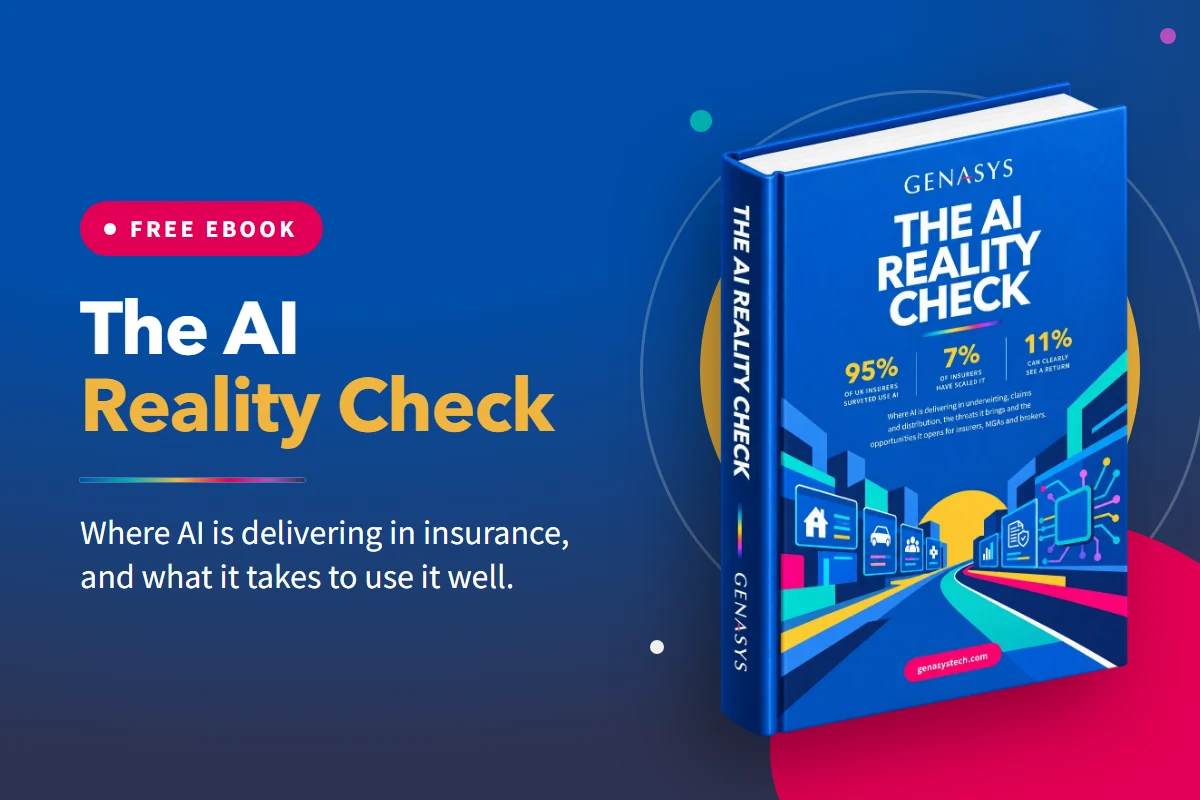
Where is AI actually delivering in insurance, and what does it take to use it well? Most insurers already use AI somewhere in the business. Few have scaled it, and fewer still can show what it returns. This free eBook sets out the evidence in 45 fully referenced pages: where AI is working in underwriting, claims and distribution in 2026, the threats it brings, the rules that govern it and a practical programme for insurers, MGAs and brokers in the UK and South Africa.
Who this eBook is for
This eBook is for the executives deciding where AI fits in an insurer, MGA or broker, particularly firms writing commercial business at £20 million to £250 million of premium. Firms of that size will not employ the data science teams that large insurers fund, so the guide is written for leaders who will buy most of their AI rather than build it. Every figure is sourced to a primary publication or to named reporting of it, and where a figure is a forecast, a consultancy estimate or a technology supplier's account of a client project, the text says so.
AI in insurance in 2026
Using AI, running it at scale and being able to show its return are three different positions. Most insurers hold the first. Only a small minority hold either of the others.
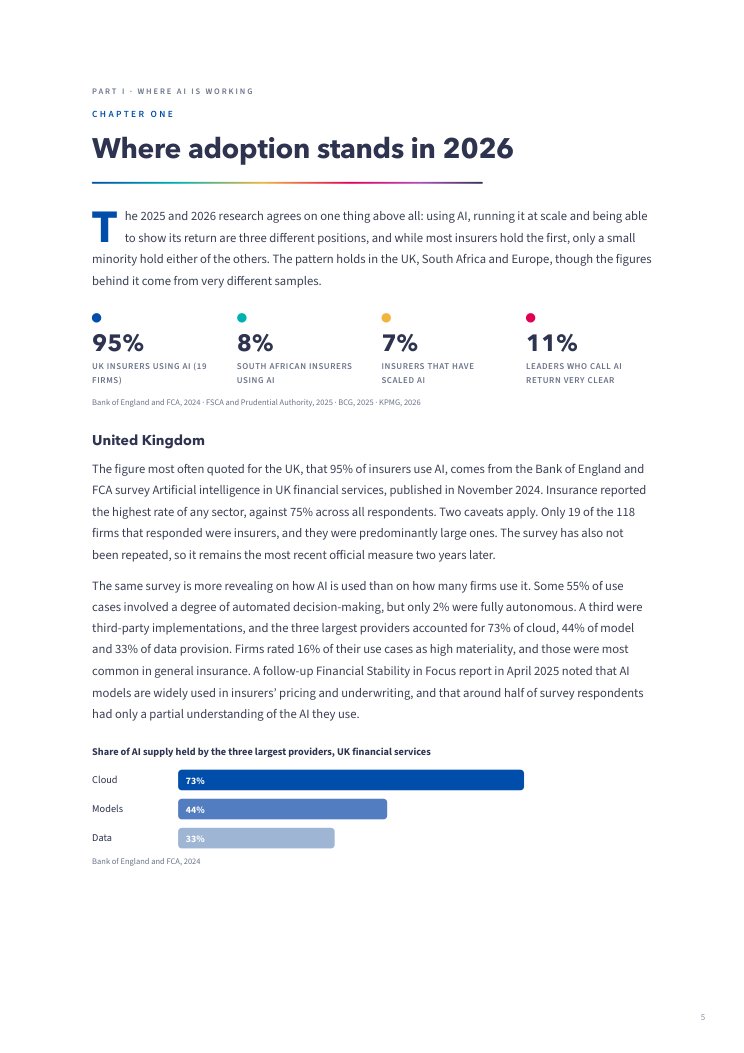
Where adoption stands
Bank of England and FCA, 2024
FSCA and Prudential Authority, 2025
BCG, 2025
KPMG, 2026
The 95% and the 8% measure very different populations. The UK figure describes 19 large insurers, while the South African base includes thousands of small financial services firms. Read together, they say that large insurers in both markets use AI and that the long tail of smaller firms mostly does not yet. BCG attributes 70% of the difficulty in scaling AI to people and process, 20% to technology and only 10% to the models themselves.
The eBook's argument is that for a mid-sized firm, the AI decision with the most effect is the choice of core systems and the state of the data held in them. Three findings run through the evidence.
Three findings
Where AI is working in insurance
Underwriting. The measured gains have come from the work around the decision rather than the decision itself. Underwriters spend 40% of their time on administration, and in commercial lines most of that sits in submission intake: reading broker emails, schedules of values and loss runs, then rekeying them. That is where AI has the clearest record. Zurich's commercial intake platform cut manual triage time from 75 minutes to 15 per submission, according to figures released with its supplier. AI that makes the underwriting decision is still rare outside narrow, standardised classes.
Claims and fraud. Claims is where insurers have published the most concrete results, and fraud is where AI now works for both sides. Aviva runs more than 80 AI models across its claims journey, which McKinsey reports cut the time to assess liability on complex cases by 23 days. Allianz's Project Nemo handles small food spoilage claims with seven AI agents and leaves every payout decision with a person. Meanwhile UK insurers detected £1.34 billion of fraudulent claims in 2025, the highest value on record, with a growing number supported by AI-generated images and documents.
Distribution and service. Customers accept AI that gets them to an answer faster and resent AI that stands between them and a person. In Gartner's survey of 5,728 customers, 64% said they would prefer companies did not use AI in customer service. The deployments with the clearest results keep a route to a person open, and the largest broking groups are now spending at a scale that will change how they deal with insurers.
Agentic AI. A small number of insurers run agentic systems on narrow, bounded processes. Gartner expects more than 40% of agentic AI projects to be cancelled by the end of 2027, and estimates that only about 130 of the thousands of vendors marketing agentic products offer genuine agentic capability. The guide sets out the four characteristics that the agent deployments that work have in common.
Six firms, measured results
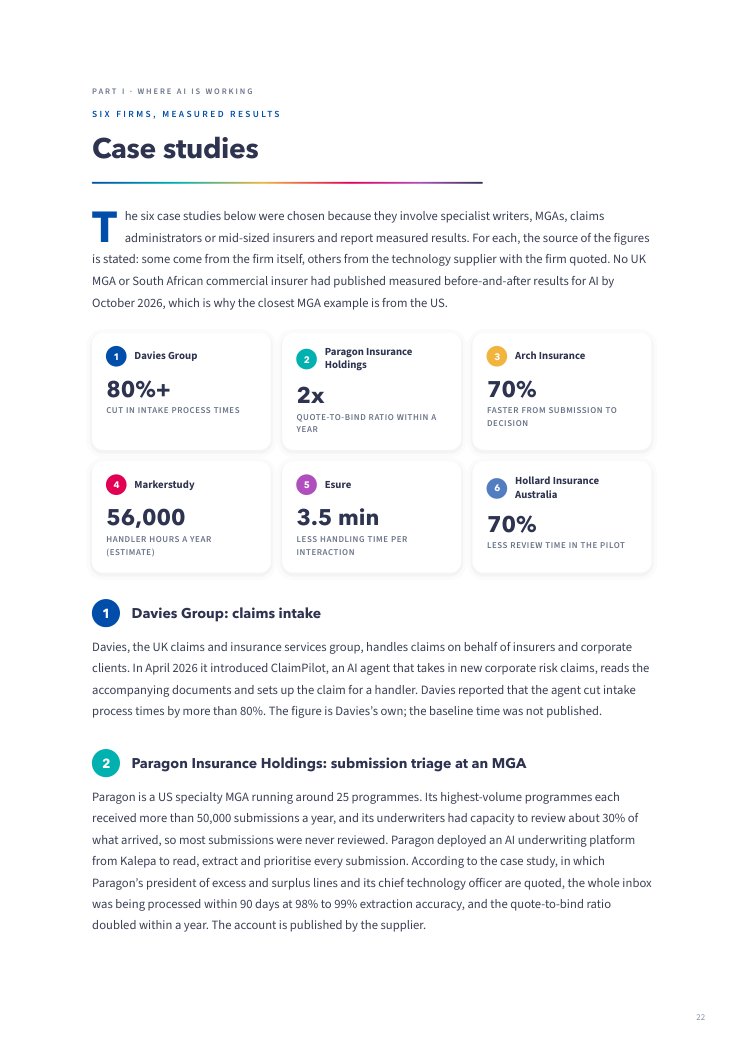
All six case studies apply AI to reading and summarising: submissions, claim documents, call recordings and claim files. In each, a person still made the underwriting or claims decision, and the measured gain was in the time it took that person to reach it.
What AI depends on
The limiting factor for most insurers' AI programmes is their data and the systems that hold it. Gartner predicted that through 2026 organisations would abandon 60% of AI projects not supported by AI-ready data, and an AI model trained on inconsistent bordereaux will reproduce the inconsistency at speed. The policy administration system is where most of an insurer's structured data is created, and the eBook names five properties it needs if AI is to be used safely and at scale:
- Structured data at the point of entry, so a model receives defined, validated fields rather than free text or a PDF.
- Open APIs and event notifications, so a model can be called at the right step and its output written back without rekeying.
- A complete audit trail recording which model or rule produced each output, what data it used and who approved the result.
- Rules the business can change through configuration, so an approval step or referral threshold needs no development project.
- Clean separation between the system of record and the AI services that use it, so a model can be replaced as better ones appear.
The regulation points the same way. No regulator in the UK or South Africa has written AI-specific rules for insurers. What applies instead is the Consumer Duty, the Senior Managers and Certification Regime, section 71 of POPIA and Articles 22A to 22D of the UK GDPR, which came into force on 5 February 2026. Each of them is met from records, which is why the guide treats the policy administration system as the foundation of an AI programme.
What's inside
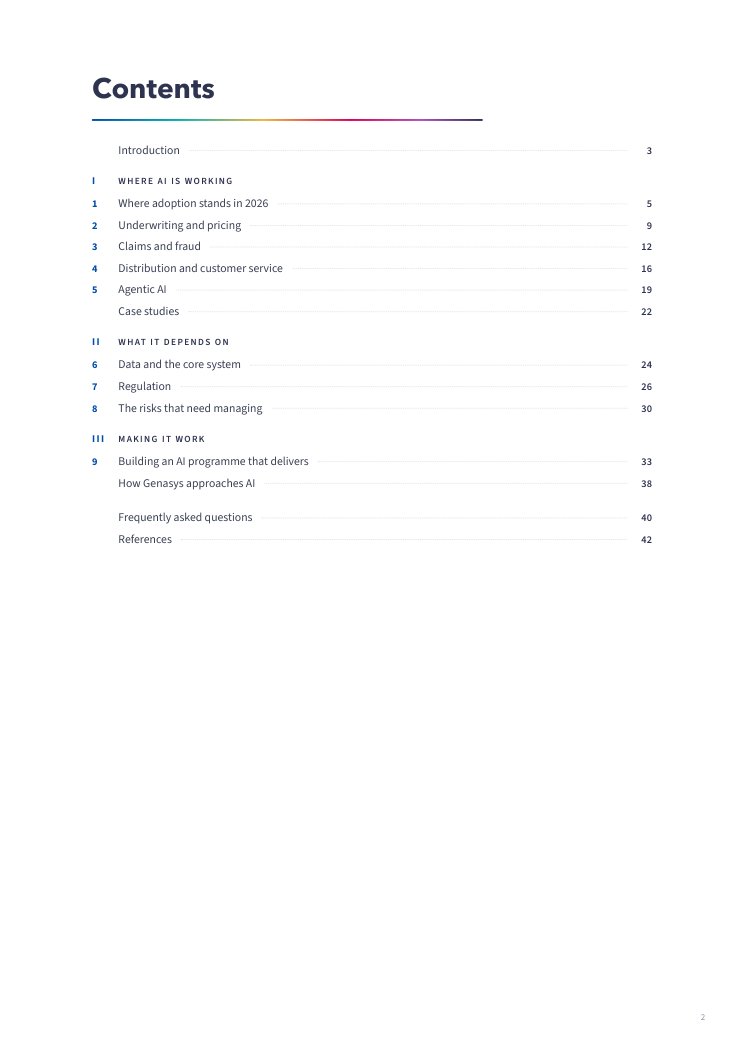
45 pages in three parts, fully referenced, with six case studies, a rating of the main AI use cases by evidence, regulatory exposure and time to payback, a readiness checklist and ten questions to put to any AI or platform supplier.
The three parts
Inside the eBook
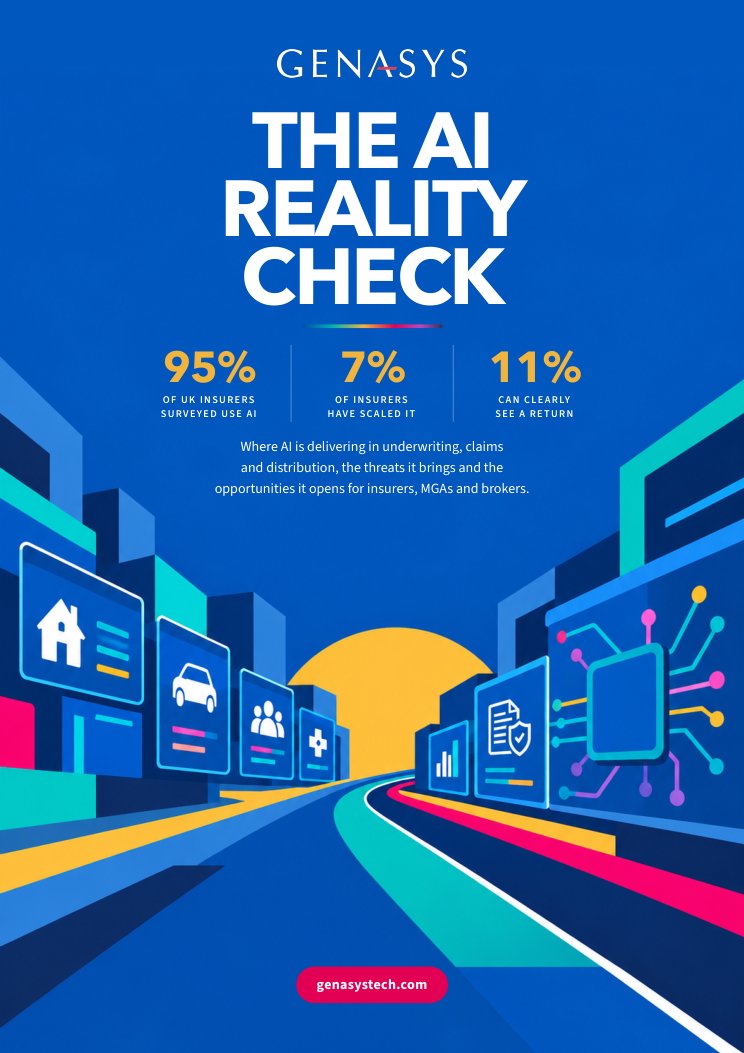
The covers and three pages from the guide: the contents, where adoption stands in 2026 and the six case studies.
Download the eBook
Fill in the form and your download link appears straight away. Please use your work email address.
Download the free eBook
Get the eBook now. Please use your work email address.
Thank you. Your copy of The AI Reality Check is ready (PDF, 3.9 MB).
Frequently Asked Questions
What the eBook says about the questions insurers, MGAs and brokers ask most about AI.
How is AI used in insurance?
Mostly to read, extract and summarise, so that people reach their decisions faster. In underwriting, AI reads broker submissions, schedules of values and loss runs, pre-fills the risk record and triages what arrives against appetite; Zurich cut manual triage time from 75 minutes to 15 per commercial submission, in figures released with its supplier. In claims, it takes first notification of loss, routes claims to the right handler, summarises calls and files and flags fraud; Aviva runs more than 80 models across its claims journey. In service, it answers routine questions and drafts documents, with the clearest results where a route to a person stays open.
Pricing is where AI has been in production longest, particularly in personal lines, while AI that makes the underwriting or claims decision itself is still rare outside simple, standardised products. All six case studies in the eBook kept a person at the decision and measured the gain in the time it took that person to reach it. For a commercial insurer or MGA, the practical order is AI that prepares the work, then AI that informs the decision and only then AI that makes it. Each step depends on the data the firm holds, which is why the core policy administration system matters as much as the model.
How many insurers are using AI?
It depends on who is counted. In the UK, 95% of the insurers in the Bank of England and FCA's 2024 survey used AI, the highest rate of any sector, though only 19 of the 118 firms that responded were insurers and most of them were large. The survey has not been repeated, so it is still the most recent official measure. In South Africa, the FSCA and Prudential Authority found 8% of insurers using AI in 2025, against 52% of banks, from a base that includes thousands of small financial services providers.
Using AI is not the same as scaling it. BCG found that 7% of insurers had scaled AI and about two thirds were still piloting. EIOPA's survey of 347 European insurers found nearly two thirds using generative AI, most of them at proof of concept. Return is where the evidence is thinnest: 11% of insurance leaders in KPMG's 2026 survey described their AI return as very clear, from a sample of 44. At the top of the market, Evident found 20 of the 30 largest insurers in North America and Europe reporting at least one AI use case with measured outcomes. The eBook does not use the widely repeated claim that 95% of organisations get zero return from generative AI, and explains why.
Are there AI regulations for insurers in the UK and South Africa?
No regulator in either market has written AI-specific rules for insurers. The FCA has said it does not plan to. Instead, AI use is governed by the existing regime: the Consumer Duty, which requires firms to deliver and evidence good customer outcomes, the Senior Managers and Certification Regime, which places accountability for a system's behaviour with a named individual. Data protection law applies too. Since 5 February 2026, Articles 22A to 22D of the UK GDPR allow significant decisions made solely by automated means on a wider range of lawful bases, provided the firm tells the individual, offers human intervention and lets the decision be contested.
In South Africa, the FSCA is developing an AI framework but had issued no guidance by October 2026. The binding constraint is section 71 of POPIA, which restricts decisions with legal consequences based solely on automated processing. The EU AI Act treats AI used to price life and health cover for individuals as high-risk, with obligations now due from 2 December 2027, while commercial property and casualty lines are outside that category. Every one of these duties is met from records: which model produced an output, what data it used and who approved it. A firm whose core systems keep that record, as claims management software with a full audit trail does, can defend each new use of AI.
What is agentic AI in insurance?
Agentic AI carries out a sequence of steps towards a goal using tools and data, rather than answering a single prompt. On a claim, an agent might read the notification, check the policy wording, pull weather data, query a fraud model, calculate a settlement and draft a decision for a person to approve. The difference from earlier automation is that the system decides the order of steps and which tools to use, which makes it more flexible and harder to test. Our glossary entry on agentic AI explains the term in more detail.
The published examples in insurance are few and deliberately narrow. Allianz's Project Nemo uses seven agents on food spoilage claims under AUD 500, cut processing and settlement time by 80% and leaves every payout with a person. Evident found that 8% of the AI use cases disclosed by the largest insurers pointed towards agentic reasoning, and Gartner expects more than 40% of agentic projects to be cancelled by the end of 2027. The deployments that work share four traits: high volume and low value per item, well-defined steps, every action logged and a person approving anything that commits money or cover. Submission intake, document chasing, bordereaux validation and renewal preparation fit that profile. A complex coverage decision or a large-loss settlement does not.
How should a mid-sized insurer or MGA start with AI?
Pick one high-volume process, measure it, make sure its data is captured in structured form at source and use AI that comes inside platforms with open APIs and a full audit trail. The programmes with published results each started with one process and one number, such as triage minutes per submission at Zurich or liability assessment days at Aviva. The best first candidates in commercial lines are document-heavy tasks where a person still makes the decision: submission intake, bordereaux validation, first notification of loss, document generation and broker servicing queries. Each has a clear measure, a low regulatory profile and a payback of two years or less in the eBook's rating.
A firm writing £20 million to £250 million of premium will not employ a data science team, and does not need to. Most of its AI will arrive inside the policy administration, claims and document systems it buys, so the selection questions move from features to architecture: whether the platform exposes its data through APIs, records which model made which decision and lets the business change the rules around a model through configuration. Governance can be light if it covers an inventory of AI systems, a named owner for each, bias testing, outcome tracking and supplier questions. For MGAs, our page on MGA software shows how Genasys connects the AI services a firm chooses to its data.
We'd rather show you than tell you.
We'll start by getting to know your business. Then we'll show you exactly how Genasys handles it.
Insurance People
Zero Fluff
Tailored to You