
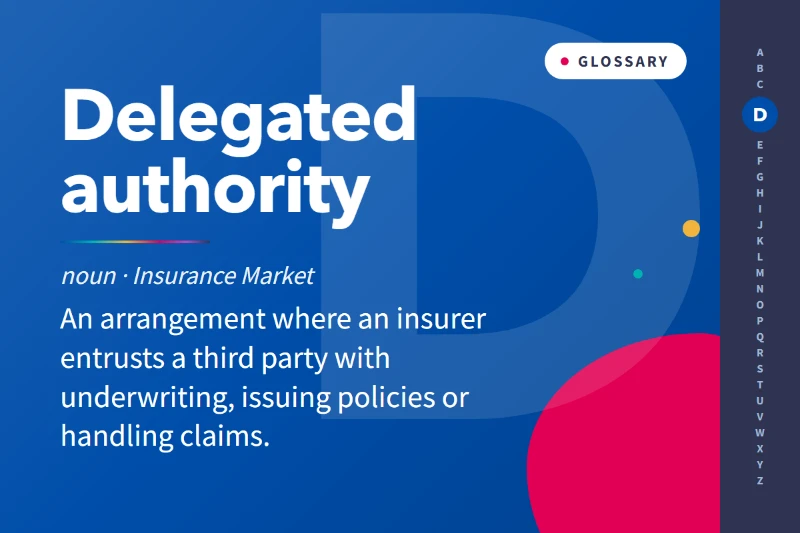
Delegated authority is an arrangement under which an insurer, or a managing agent acting for a Lloyd's syndicate, authorises another firm to carry out work on its behalf, such as accepting risks, issuing policy documents or settling claims, within limits set in a written agreement. The insurer keeps the risk and the capital.
This entry explains what an insurer can delegate and through which types of agreement, who is responsible for what along the chain, how UK regulators treat delegation and what their reviews found. It also sets out Lloyd's published figures and the binder rules in South Africa.
Delegated authority in numbers
Delegated authority at Lloyd's
Lloyd's describes delegated underwriting as a key distribution channel for the market, accounting for approximately 45% of its premium income, and gives figures as of 9 November 2026 of $26.2bn in annual premium, 3,415 coverholder global branches, 412 service companies and more than 250 territories where risks are placed.1 In the FCA's 2015 thematic review of delegated authority, the share of business the sampled insurers underwrote through delegated authority ranged from 10% to 100%, and it was the majority of business for two of them; the review has since been marked historical.2 Figures for MGAs in the UK and Europe, from Howden Re and the Managing General Agents' Association (MGAA), are set out in the questions at the end of this entry.34
What delegated authority covers
The FCA's review described delegated authority as a term widely used in the general insurance industry for a variety of arrangements, at whose core is external delegation by insurers: the outsourcing of functions to intermediaries and other third parties.2 It said these arrangements can relate to every stage of an insurance product's life cycle, from product development through underwriting, distribution and sales to claims and complaint handling.2
Lloyd's and South African law each list what can be delegated. Lloyd's Definitions Byelaw defines a contract of delegated authority as any agreement, including a binding authority, a consortium agreement, a line slip and a delegated claims administration agreement, under which authority is delegated or sub-delegated to enter into contracts of insurance for a syndicate, to issue documents evidencing those contracts or to determine claims on them.5 In South Africa, section 48A of the Short-term Insurance Act, 1998 allows a short-term insurer, in terms of a written agreement only, to let another person carry out one or more of five functions on its behalf.6
| Function | Lloyd's: contract of delegated authority | South Africa: section 48A | FCA TR15/7: functions typically outsourced by insurers |
|---|---|---|---|
| Accept risks and put cover in force | Enter into contracts of insurance | Enter into, vary or renew a policy | Underwriting |
| Issue policy documents | Issue documents evidencing contracts of insurance | Not listed separately | Not listed separately |
| Set the policy wording | Not listed separately | Determine the wording of a policy | Not listed separately |
| Set the price | Not listed separately | Determine premiums | Not listed separately |
| Decide what a policy pays | Determine claims | Determine the value of policy benefits; settle claims | Claims management |
| Handle complaints | Not listed | Not listed | Complaint handling |
Underwriting authority and claims authority are separate decisions. When a managing agent delegates underwriting authority, it must decide whether to delegate any claims handling authority as well, either to the coverholder or to an external service provider known as a delegated claims administrator (DCA).7 Lloyd's guidance says high-value, complex or contentious claims typically sit outside a coverholder's or DCA's authority and are referred back to the managing agent.7
Delegated authority, binding authority and delegated underwriting
The terms overlap. Delegated authority is the general term for work an insurer authorises a third party to do on its behalf. Delegated underwriting is the part of it that covers accepting risks, and the agreement that grants it is a binding authority, or binder. Lloyd's defines a binding authority as an agreement between a managing agent and a coverholder under which the managing agent delegates its authority to enter into a contract or contracts of insurance to be underwritten by the members of a syndicate.8 Because the Definitions Byelaw lists entering into contracts, issuing documents and determining claims as separate powers, an agreement can grant one of them without the others.5
The holder has different names in different markets. At Lloyd's it is a coverholder, and Lloyd's notes that a Lloyd's broker may act as a coverholder.8 In the UK company market, the Managing General Agents' Association sets as one of its criteria for managing general agent (MGA) membership that the firm underwrites on behalf of a UK or Ireland regulated insurance company or Lloyd's managing agency under a binding authority agreement.9 In South Africa it is a binder holder, defined in the regulations as a person with whom an insurer has concluded a binder agreement.10
How the chain of delegation works
The chain of delegation, from capital to policyholder
At Lloyd's the contents of the agreement are prescribed. Under the requirements made under the Intermediaries Byelaw, every binding authority, other than a registered binding authority for motor business, must set out, among other things, the maximum aggregate premium income limit, the maximum limits of liability, the territorial limits of the coverholder's authority, provisions requiring it to report all premiums, paid claims, outstanding claims and expenses, provisions for cancellation and termination and the basis for calculating premiums, discounts, commissions, brokerages, fees, charges and expenses.11 It must also say whether the coverholder has authority to sub-delegate and, if so, its scope.11
Lloyd's supports continuous, annual and multi-year binding authorities and treats the duration as a commercial decision between the parties; a continuous binding authority remains in force until one party terminates it under the contractual termination provisions, without the need for annual renewal.12 For continuous and multi-year binding authorities, Lloyd's says managing agents must ensure the wordings contain the mandatory contractual provisions and appropriate remediation and termination provisions.12
Delegation can run through more than one layer: a service company, which is wholly owned by a managing agent or related group company, is able to sub-delegate underwriting authority to coverholders.13 Lloyd's guidance on contract layering says managing agents, whether lead or follow, are accountable for ensuring that sub-delegation and contract layering arrangements are appropriately governed and remain within their risk appetite, and must have access to sufficient information to identify and prevent duplicate participation on the same risk.14 In a layered arrangement, the year of account is determined by the inception date of the primary contract.14
Types of delegated authority arrangement
Lloyd's lists its delegated partners as coverholders, service companies, consortia, digital platform providers and delegated claims administrators.1 The agreements differ in who delegates to whom, in what is delegated and in what Lloyd's requires before they are used.
| Arrangement | Who delegates to whom | What is delegated | Lloyd's approval or registration |
|---|---|---|---|
| Binding authority51514 | A managing agent to an approved coverholder | Authority to enter into contracts of insurance for the syndicate | The third party must be approved as a coverholder; unless Lloyd's has issued dispensation, the agreement must be reflected accurately on Lloyd's systems |
| Coverholder appointment agreement71514 | Lloyd's Insurance Company (LIC) to an approved coverholder | Coverholder activities for LIC | As for a binding authority |
| Service company agreement1314 | A managing agent to a service company that it, or a related group company, wholly owns | Authority to enter into contracts of insurance for the associated syndicate, with power to sub-delegate to coverholders | Unless Lloyd's has issued dispensation, the agreement must be reflected accurately on Lloyd's systems |
| Line slip15 | One or more managing agents to another managing agent or an authorised insurance company, for business introduced by a Lloyd's broker named in the agreement | Authority to enter into contracts of insurance; a broker may be given authority to hold cover on terms already set | No registration with Lloyd's or on its delegated authority systems |
| Consortium16 | One or more managing agents to another managing agent, the consortium manager | Authority to write risks for the follow underwriters, who are subscribed automatically at their pre-agreed share | No approval from Lloyd's Delegated Authority team; an arrangement written 100% by one syndicate is not a consortium |
| Delegated claims administration agreement51 | A managing agent to an approved delegated claims administrator | Authority to determine and settle claims | The DCA must be approved by Lloyd's |
| Digital platform provider1 | A managing agent or coverholder to a third party running an automated online platform | Automatic binding of policies and issue of policy documentation | Lloyd's publishes requirements for digital platform providers |
Line slips and consortia keep the delegation between insurers. Lloyd's says line slips must not be used to circumvent its requirements for binding authorities, and that any delegation of authority to bind risks, agree endorsements, issue documentation or handle claims to a third party other than the agreement parties is likely to require coverholder approval or, for claims, approval as a delegated claims administrator.15 Lloyd's defines a consortium as a delegation of authority between managing agents, so an arrangement involving a coverholder or a non-Lloyd's insurer is not a Lloyd's consortium.16
A narrower authority is hold cover. Under a line slip, in line with longstanding market practice, a broker may be permitted to confirm cover to the policyholder once the agreement parties have quoted a premium and finalised all terms; without coverholder approval, managing agents must not permit the broker to vary the premium, alter the terms and conditions, modify any pre-conditions or issue policy documentation.15
Who is responsible for what
Delegation moves work, not the insurer's obligations. Under the PRA's rules, a UK Solvency II insurer that outsources a function or any insurance or reinsurance activity remains fully responsible for discharging all of its obligations under the PRA rules and FSMA, and must notify the PRA in a timely manner before outsourcing critical or important functions or activities.17 The FCA's 2015 review said a firm cannot contract out of its regulatory obligations, and that an insurer's claims handling obligations under ICOBS 8.1 remain with it even if claims operations are outsourced.2
| Party | Role | Responsibilities and limits |
|---|---|---|
| Insurer or Lloyd's managing agent | Provides the capacity and carries the risk | Full responsibility for its regulatory obligations when it outsources17; its claims handling obligations2; responsibility as a co-manufacturer under PROD, which TR24/2 (2024) said it could not allocate fully to others18, and since 9 December 2025 only an insurer or managing agent can be a sole lead manufacturer19; accountability for each layer of sub-delegation14 |
| MGA or coverholder | Underwrites, binds and issues documents within its authority | Accurate and timely information on risks, premiums and claims for its underwriters7; where it leads product design and pricing, it is a co-manufacturer with the insurer under PROD 4.218 |
| Delegated claims administrator | Handles claims within the authority it is given | Claims outside that authority are handled by the managing agent; high-value, complex or contentious claims typically sit outside it7 |
| Broker | May be permitted to hold cover under a line slip | Managing agents must not permit it, without coverholder approval, to vary the premium, alter terms or issue policy documentation, and must ensure brokers are not delegated authority for claims or underwriting activities that require coverholder status15 |
| Lloyd's, the Corporation | Approves coverholders and sets market requirements | Coverholder approval under the Intermediaries Byelaw and coordinated audits where two or more managing agents lead7; mandated reporting standards20 |
In the FCA Handbook, SYSC 8.1.6R provides that a firm (other than a common platform firm) that outsources critical or important operational functions, or any relevant services and activities, remains fully responsible for discharging all of its obligations under the regulatory system; the outsourcing must not result in senior personnel delegating their responsibility or alter the firm's relationship and obligations towards its clients.21 Which firms SYSC 8 binds is set by SYSC 1 Annex 1, which applies SYSC 8 to firms other than insurers, managing agents, the Society of Lloyd's and some other categories; for most of those firms (Column B, which includes intermediaries that are not common platform firms) SYSC 8.1.6R applies as a rule and the outsourcing rule in SYSC 8.1.1R as guidance, as SYSC 8.1.1A G also says; for common platform firms SYSC 8.1.1R is a rule.2221 The holder of the authority needs its own regulatory status. Under section 19 of the Financial Services and Markets Act 2000, no person may carry on a regulated activity in the United Kingdom unless authorised or exempt.23 The FCA's Perimeter Guidance lists assisting in the administration and performance of a contract of insurance among the regulated activities that can apply to any contract of insurance, and asks a firm to consider whether it is exempt as an appointed representative.24
Is delegated underwriting outsourcing?
UK regulators classify it differently. The FCA's 2015 review, since marked historical, relied on guidance in SYSC 3.2.4 G, which describes external delegation as outsourcing, and found that some insurers did not appear to regard delegating activities such as underwriting or claims handling to third parties as outsourcing; a minority of the firms in its sample had treated externally delegated underwriting as a form of outsourcing and had a clear risk appetite in place.2 The PRA's supervisory statement on outsourcing, SS2/21, says other examples of non-outsourcing third party arrangements may include, in the case of insurers, delegated underwriting, but expects firms to assess the materiality and risks of all third party arrangements irrespective of whether they fall within the definition of outsourcing.25 It adds that boards and senior management cannot outsource their responsibilities.25 A March 2026 update to SS2/21, effective from 18 March 2027, keeps delegated underwriting in that list of examples.26
| Source | Treatment | What follows |
|---|---|---|
| FCA, TR15/7 (2015, historical)2 | Guidance (SYSC 3.2.4 G) describes external delegation as outsourcing | Guidance (SYSC 3.2.3 G and 3.2.4 G) says the firm should assess whether the delegate is suitable, make the limits of delegation clear, supervise and monitor it, and follow up when concerns arise |
| FCA Handbook, SYSC 8.12122 | Outsourcing of critical or important operational functions; under SYSC 1 Annex 1 it does not apply to insurers or managing agents | For most firms it applies to (Column B, which includes intermediaries that are not common platform firms), SYSC 8.1.6R applies as a rule, under which the firm remains fully responsible, and SYSC 8.1.1R as guidance; for common platform firms SYSC 8.1.1R is a rule |
| PRA Rulebook, Conditions Governing Business17 | Outsourcing of a function or of any insurance or reinsurance activity | The insurer remains fully responsible and notifies the PRA before outsourcing critical or important functions |
| PRA, SS2/21 (November 2024 update)2526 | Non-outsourcing third party arrangements may include delegated underwriting; a March 2026 update takes effect on 18 March 2027 | Materiality and risk assessment still expected; proportionate, risk-based controls where an arrangement is material |
| FCA, TR24/2 (2024)18 | Product governance under PROD 4.2 is separate from the outsourcing rules that apply to delegated authority | Under TR24/2 (2024), each co-manufacturer needed its own product approval process, and the insurer was always a co-manufacturer |
| FCA, PS25/21 (2025)19 | An option to appoint a single lead manufacturer | Since 9 December 2025, co-manufacturers may agree in writing that a single insurer or managing agent leads, if it has sufficiently significant involvement in manufacturing the product; an intermediary cannot be the lead firm |
The FCA explained its decision on lead manufacturers in PS25/21: the majority of respondents wanted intermediaries, in particular MGAs, to be permitted to lead, because MGA-led products are common in the commercial market, but the FCA said it remained concerned about the potential for customer harm if insurer oversight were removed completely.19 It said its product governance review had found that where products were developed and designed by intermediaries, it was more likely that firms could not demonstrate that the products delivered fair value and good outcomes.19
What the FCA found
The FCA's thematic review TR15/7 looked at 12 insurers' outsourced underwriting and claims handling arrangements and the associated activities of 19 intermediaries and third party administrators.27 It focused on products for UK retail and SME customers, 75% and 25% of the sample respectively.2 The FCA first published the review on 1 June 2015 and marked it as historical when it updated the page on 29 August 2025, so its findings describe the market at that time.28
| Finding | Scale in the FCA's sample |
|---|---|
| Share of business underwritten through delegated authority | 10% to 100% across the insurers; the majority of business for two of them |
| Firms that treated externally delegated underwriting as outsourcing and had a clear risk appetite | A minority |
| Insurers that found existing relationships inconsistent with their risk appetite | Three of the 12 visited |
| Insurers with only limited control over outsourced claims handling, the choice of claims partner and the design of claims processes | Approximately a third |
| Firms undertaking product design, insurers and intermediaries, that had not always adequately considered customer needs | About a third |
| Firms unable to demonstrate that they had analysed complaints information relating to the product | Approximately a third |
The review gave the example of a small insurer that had entered into approximately 20 new outsourced relationships over a two year period and had already exited approximately a third of them, with due diligence almost entirely confined to prudential matters.2 It also found that some insurers relied disproportionately on the audit of the third party rather than on their own internal controls, which could produce a false positive when the audit's scope or quality was insufficient.2
The FCA followed up with a multi-firm review of delegated authority arrangements, reported alongside its April 2019 review of the general insurance distribution chain, TR19/2, which the FCA has also marked as historical. It said the follow-up was performed because of the serious extent and nature of the shortcomings identified in its 2015 review of delegated authority and its 2016 review of appointed representatives, and that it had commissioned 2 s166 skilled person reviews further to that work.29
In its 2024 product governance review, TR24/2, the FCA saw several co-manufacturer arrangements in which an intermediary had entered into a delegated authority agreement with the insurer and took the lead on product approval and design, pricing, distribution strategy, product reviews and fair value assessments; most insurers in those arrangements could not demonstrate how they had met their obligations under PROD 4.2.18 Where the intermediary substantially undertook all of the product work, some insurers relied totally on it.18
In February 2026 the FCA replaced more than 40 portfolio letters with annual Regulatory Priorities reports.30 Its insurance report said it would expand its review of firms' oversight of outsourced claims processes to include different delegated authority models and remuneration arrangements, and set out an oversight review of outsourcers and delegated authority models with the aim of reporting its findings in early 2027.30
The PRA has raised delegated underwriting in its letters to insurers. In 2018 it told chief executives of specialist general insurers that some firms appeared to lack management information to monitor effectively the use or performance of material delegated underwriting arrangements, including broker facilities.31 Its 2026 priorities letter said delegated authority business looks set to grow across the London Market, raising additional risks of inadequate pricing and reserving if not properly managed or overseen, and that firms' strategies for using such arrangements are not always clear.32 It said firms should have strong oversight arrangements, including consideration of how they would exit unprofitable arrangements.32
| Date | Event |
|---|---|
| June 2015 | The FCA publishes TR15/7, its thematic review of delegated authority28 |
| 31 May 2018 | The PRA writes to specialist general insurers about oversight of delegated underwriting, including broker facilities31 |
| April 2019 | The FCA publishes TR19/2, with the findings of its multi-firm follow-up on delegated authority29 |
| 29 March 2021 | The PRA publishes SS2/21 on outsourcing and third party risk management33 |
| August 2024 | The FCA publishes TR24/2 on product oversight and governance18 |
| 29 August 2025 | The FCA marks TR15/7 as historical28 |
| 9 December 2025 | The FCA's rules allowing a single lead manufacturer come into force19 |
| 15 January 2026 | The PRA's insurance supervision priorities letter covers delegated authority underwriting32 |
| February 2026 | The FCA's Regulatory Priorities: Insurance sets out an oversight review of delegated authority models30 |
| Early 2027 | The FCA aims to report the findings of that review30 |
Delegated authority at Lloyd's
Two published measures put the share of Lloyd's premium income written through delegated authority at different levels. The FCA's 2015 review, citing Lloyd's Annual Report 2013, said the Lloyd's market received circa 30% of its premium income in 2013 through firms that held underwriting authority on behalf of syndicates.2 Lloyd's now states that delegated underwriting accounts for approximately 45% of the market's premium income.1 The two figures come from different publications and may not be measured on the same basis.
| Measure | Figure | As at | Source |
|---|---|---|---|
| Premium income received through firms holding underwriting authority | Circa 30% | 2013 | FCA, TR15/7 (historical), citing Lloyd's2 |
| Share of premium income from delegated underwriting | Approximately 45% | 9 November 2026 | Lloyd's1 |
| Annual premium | $26.2bn | 9 November 2026 | Lloyd's1 |
| Coverholder global branches | 3,415 | 9 November 2026 | Lloyd's1 |
| Approved coverholders | 3,015 | 31 December 2025 | Lloyd's13 |
| Service companies | 412 | 9 November 2026 | Lloyd's1 |
| Service companies | 409 | 31 December 2025 | Lloyd's13 |
| Territories where risks are placed | More than 250 | 9 November 2026 | Lloyd's1 |
| Property gross written premium: total class premium from all distribution channels, in sterling, from Lloyd's market results (pro forma); delegated authority is a high proportion of this class's distribution mix; not comparable with the $26.2bn | £13,026m | 2025 | Lloyd's Annual Report 20258; the $26.2bn is from Lloyd's1 |
Lloyd's does not say how the branch count and the approved coverholder count relate; separately, any additional trading location from which a coverholder wishes to carry out coverholder activities must receive separate approval from Lloyd's.7 A coverholder may enter into multiple contracts of delegation with different managing agents.7 In its pro forma financial statements, Lloyd's treats estimated premium income, in particular estimates for premiums written under delegated authority agreements, as a significant estimate, because variances between estimated and actual premium affect gross written premium and provisions for unearned premium.8
Approval comes first. Lloyd's grants coverholder approval under paragraph 11 of the Intermediaries Byelaw requirements, assigns each coverholder a unique PIN used in its ATLAS system, and makes approval conditional on the coverholder entering into a contract of delegation with a managing agent within six months.7
Reporting, audit and remediation
The insurer's view of the business comes from what the holder reports. Lloyd's mandates that all syndicates request and collect information consistent with its reporting standards, whose core requirements apply to all binding authority agreements and coverholder appointment agreements incepting since July 2017 and cover regulatory, tax, premium and claims data.20 The data is reported in bordereaux. Lloyd's and the Lloyd's Market Association developed a standardised Audit Scope for coverholders and DCAs, and where two or more managing agents hold the lead position on a contract of delegation, Lloyd's coordinates audits on their behalf, a process run since 2018 through its Delegated Audit Manager platform.7
Each year coverholders must confirm in ATLAS that core compliance information, such as professional indemnity certificates and financial statements, is accurate and up to date.7 When an arrangement falls short, the contract governs what happens next: every binding authority must provide for cancellation and termination, including termination when the Council gives a direction to the managing agent or coverholder, and Lloyd's requires continuous and multi-year wordings to contain appropriate remediation and termination provisions.1112
Delegated authority in South Africa
In South Africa, delegated underwriting is written under binder agreements. The provisions below are as published on Acts Online, read 10 November 2026; later amendments have not been reviewed. Section 48A of the Short-term Insurance Act, 1998 lets a short-term insurer allow another person, in terms of a written agreement only, to enter into, vary or renew policies, determine policy wording, determine premiums, determine the value of policy benefits or settle claims on its behalf, and requires the agreement to set out which of these the person may perform and for which kinds of policy.6 The regulations' definition of an insurer for binder agreements includes Lloyd's.10
Subject to subregulations (1A) to (4) and regulation 6.5, regulation 6.2 allows an insurer to have a binder agreement only with a non-mandated intermediary or an underwriting manager, and only if outsourcing the binder function is intended to promote the delivery of fair outcomes to customers, would not duplicate the insurer's administrative efforts or costs and would not impede its ability to identify, assess, manage and report on the risks of poor customer outcomes.34 Regulation 6.3 requires every binder agreement to provide for a termination period of at least 90 days, irrespective of the circumstances of termination, so that legislative requirements can be met and records transferred or shared.35 Under regulation 6.4, an underwriting manager may share in the insurer's profits on the policies under its binder agreement, while a non-mandated intermediary that is a binder holder may not.36
| Feature | South Africa | Lloyd's |
|---|---|---|
| Who may hold the authority | A non-mandated intermediary or an underwriting manager34 | An approved coverholder7 |
| What may be delegated | Enter into, vary or renew policies; determine wording, premiums and policy benefits; settle claims6 | Enter into contracts of insurance, issue documents and determine claims5 |
| Ending the agreement | A termination period of at least 90 days, whatever the reason35 | Provisions for cancellation and termination, including on a direction from the Council11 |
| Pay | A fee reasonably commensurate with actual costs plus a reasonable rate of return; profit share for underwriting managers only36 | The basis for calculating premiums, commissions, fees, charges and expenses must be set out11 |
Show References Hide References
- Lloyd's. Delegated authority at Lloyd's. Figures as of 9 November 2026.
- Financial Conduct Authority. TR15/7: Delegated authority: Outsourcing in the general insurance market. June 2015, marked as historical in August 2025.
- Howden Re. Howden Re publishes Filtered for quality: a refined view of Europe's MGA market. 8 May 2026.
- Managing General Agents' Association. MGAA Annual Report 2026. August 2026.
- Lloyd's. Definitions Byelaw. Requirements of the Council. Read 10 November 2026.
- Short-term Insurance Act, 1998. Section 48A: Binder agreements. Acts Online, read 10 November 2026; later amendments not reviewed.
- Lloyd's. Welcome to Lloyd's: guidance for coverholders. Last updated 8 October 2026.
- Lloyd's. Annual Report 2025. March 2026.
- Managing General Agents' Association. Join us: MGA membership. Membership criteria. Read 10 November 2026.
- Regulations under the Short-term Insurance Act, 1998. Part 6, regulation 6.1: Definitions and interpretation. Acts Online, read 10 November 2026; later amendments not reviewed.
- Lloyd's. Contracts of delegated authority (requirements made under the Intermediaries Byelaw). Requirements of the Council. Read 10 November 2026.
- Lloyd's. Continuous contracts. Market guidance. Read 10 November 2026.
- Lloyd's. The Lloyd's market. Figures at 31 December 2025.
- Lloyd's. Contract layering and sub-delegation. Market guidance. Read 10 November 2026.
- Lloyd's. Line slips. Market guidance. Read 10 November 2026.
- Lloyd's. Consortia. Market guidance. Read 10 November 2026.
- Prudential Regulation Authority. PRA Rulebook: Conditions Governing Business, chapter 7 (Outsourcing). Read 10 November 2026.
- Financial Conduct Authority. TR24/2: Product Oversight and Governance thematic review, General Insurance and Pure Protection. August 2024.
- Financial Conduct Authority. PS25/21: Simplifying the insurance rules. December 2025.
- Lloyd's. Reporting standards. Last updated 10 August 2026.
- FCA Handbook. SYSC 8.1: General outsourcing requirements. Read 10 November 2026.
- FCA Handbook. SYSC 1 Annex 1: Detailed application of SYSC. Read 10 November 2026.
- Financial Services and Markets Act 2000. Section 19: the general prohibition. legislation.gov.uk.
- FCA Handbook. PERG 5.2: Introduction (perimeter guidance on insurance distribution). Read 10 November 2026.
- Prudential Regulation Authority. SS2/21: Outsourcing and third party risk management. November 2024 update.
- Prudential Regulation Authority. SS2/21: Outsourcing and third party risk management. March 2026 update, effective from 18 March 2027.
- Financial Conduct Authority. FCA says firms not treating delegated authority arrangements as outsourcing in the general insurance market. Press release, 2 June 2015.
- Financial Conduct Authority. TR15/7: publication page. First published 1 June 2015, last updated 29 August 2025.
- Financial Conduct Authority. TR19/2: General insurance distribution chain. April 2019, marked as historical in August 2025.
- Financial Conduct Authority. Regulatory Priorities: Insurance. February 2026.
- Prudential Regulation Authority. Market conditions facing specialist general insurers: feedback from recent PRA review work. Letter to chief executives, 31 May 2018.
- Prudential Regulation Authority. Insurance Supervision: 2026 priorities. Letter to chief executives, 15 January 2026.
- Prudential Regulation Authority. SS2/21: publication page. First published 29 March 2021.
- Regulations under the Short-term Insurance Act, 1998. Part 6, regulation 6.2: Requirements, limitations and prohibitions relating to binder holders. Acts Online, read 10 November 2026; later amendments not reviewed.
- Regulations under the Short-term Insurance Act, 1998. Part 6, regulation 6.3: Requirements, limitations and prohibitions relating to binder agreements. Acts Online, read 10 November 2026; later amendments not reviewed.
- Regulations under the Short-term Insurance Act, 1998. Part 6, regulation 6.4. As substituted by Notice No. R. 1076 of 2011. Acts Online, read 10 November 2026; later amendments not reviewed.
Frequently Asked Questions
How big is the MGA market in the UK and Europe?
The MGA figures come from a reinsurance broker and a trade body, each with its own scope. Howden Re, the reinsurance broker, estimated UK MGA premium at approximately £7.2 billion in 2025 on a like-for-like basis, up around 20% year on year, and said the UK remains the largest MGA market in Europe. Howden Re says its report puts the spotlight on independent MGA activity, so it is not a total of all business written under delegated authority in the UK.
For Europe as a whole, Howden Re put MGA gross written premium at approximately US$23 billion in 2025, up 15% year on year. It estimated that scale-ready and established MGAs, which it defines as independent businesses with €25 million or more in gross written premium and a demonstrable track record, make up around 30% of the European market by entity count but generate between 70% and 85% of total premium. The MGAA's 2026 annual report counts 270 MGA members, up from 249 in 2025. That is a member count, not an estimate of the market, and not a count of every MGA, so it cannot be set against Howden Re's estimates.
Can a coverholder sub-delegate its authority to another firm?
Only within limits. Lloyd's guidance on contract layering and sub-delegation defines sub-delegation as a third party delegating the activities it has authority to carry out to another third party, including the layering of contracts of delegation. Lloyd's and Lloyd's Insurance Company (LIC) permit consortia and service companies to participate in binding authority agreements, coverholder appointment agreements and line slips without prior approval, subject to the guidance. All other forms of contract layering or sub-delegation require their prior approval, and the referral must come from a managing agent.
The same guidance sets out what the managing agent must check. Financial crime responsibilities, including sanctions screening, must be clearly allocated and documented and must not conflict between layers. A secondary contract must comply with the eligibility requirements, restrictions and conditions of the capacity under the primary contract, so capacity provided through a LIC consortium may only support contracts involving LIC-approved entities. Managing agents must also identify the regulatory and tax implications. Lloyd's says the guidance is meant to reduce the risk of sub-delegation occurring without the managing agent's knowledge or oversight.
What is the difference between a line slip and a consortium?
The main difference is where risks come from: a line slip covers business introduced by a Lloyd's broker named in the agreement, while a consortium manager writes risks from multiple brokers. Lloyd's line slip guidance distinguishes bulking line slips, where premiums from multiple risks are grouped and processed as bulk transactions by the broker, which produces premium bordereaux at set intervals, from non-bulking line slips, where each risk is processed as a separate transaction and the broker does not normally produce bordereaux. Lloyd's expects no difference in oversight between the two. Master or group policies must not be written by line slips, and Lloyd's does not expect binding authorities to be written under them.
A consortium manager writes for itself and the follow underwriters. Lloyd's consortium guidance requires consortia to specify the basis for calculating premiums, discounts, commissions, brokerages, fees and expenses, with changes communicated to followers in advance, and preferential terms such as consortium manager fees must be fully transparent to every managing agent involved. Where a non-Lloyd's company leads, Lloyd's does not recognise the arrangement as a Lloyd's consortium and its branding must be removed. Lloyd's has also introduced region-specific service company consortium agreements, with Lloyd's Market Association model wordings for Singapore, Canada, the Dubai International Financial Centre and Australia.
Who pays if a policy written under delegated authority goes wrong?
The insurer is liable on the policy. Explaining in PS25/21 why it would not let intermediaries take the lead manufacturer role, the FCA said that even where intermediaries design products, insurers are parties to the contract and responsible for ensuring claims are met, and that insurers are more highly capitalised than intermediaries to meet claims and pay redress. Where co-manufacturers do appoint a lead firm, the lead accepts liability for breaches of the PROD 4.2 requirements it has taken on, including claims for redress, though it may seek indemnities from the other firms.
How claims are handled depends on the agreement. In South Africa, section 48A (as published on Acts Online, read 10 November 2026; later amendments not reviewed) requires a binder agreement to state whether the holder may settle claims and, if so, the extent to which and the circumstances under which it may do so. The FCA's 2019 review of the general insurance distribution chain, since marked historical, gave as one example of potential harm shortcomings in claims handling, including where responsibility for handling claims had been delegated, creating the risk that legitimate claims could be rejected. It named as one cause of potential harm the failure to assess, through appropriate diligence, the suitability and ability of the parties to whom authority is delegated.
What happens when a delegated authority agreement ends?
What the agreement says. At Lloyd's, the requirements made under the Intermediaries Byelaw oblige every binding authority (other than a registered binding authority for motor business) to include provisions on the coverholder's ongoing obligations if the binding authority expires or is terminated or cancelled for any reason, and provisions on its business continuity or disaster recovery arrangements. In the FCA's 2015 review, since marked historical, some insurers that found relationships inconsistent with their risk appetite took steps to exit them because of the conduct issues identified.
South Africa's rules go into more detail. Regulation 6.3 (as published on Acts Online, read 10 November 2026; later amendments not reviewed) requires a binder agreement to provide for the transfer or sharing of all electronic and paper-based records on the policies, including the names and identity numbers of policyholders, insured persons and beneficiaries, and for business contingency processes, including continuity of service if the binder holder is placed under curatorship or business rescue, becomes insolvent or is liquidated. The agreement may allow the insurer to limit or prevent the binder holder from performing some or all binder functions during the termination period, or to take reasonable measures to limit the risks it is exposed to.
We'd rather show you than tell you.
We'll start by getting to know your business. Then we'll show you exactly how Genasys handles it.
Insurance People
Zero Fluff
Tailored to You