
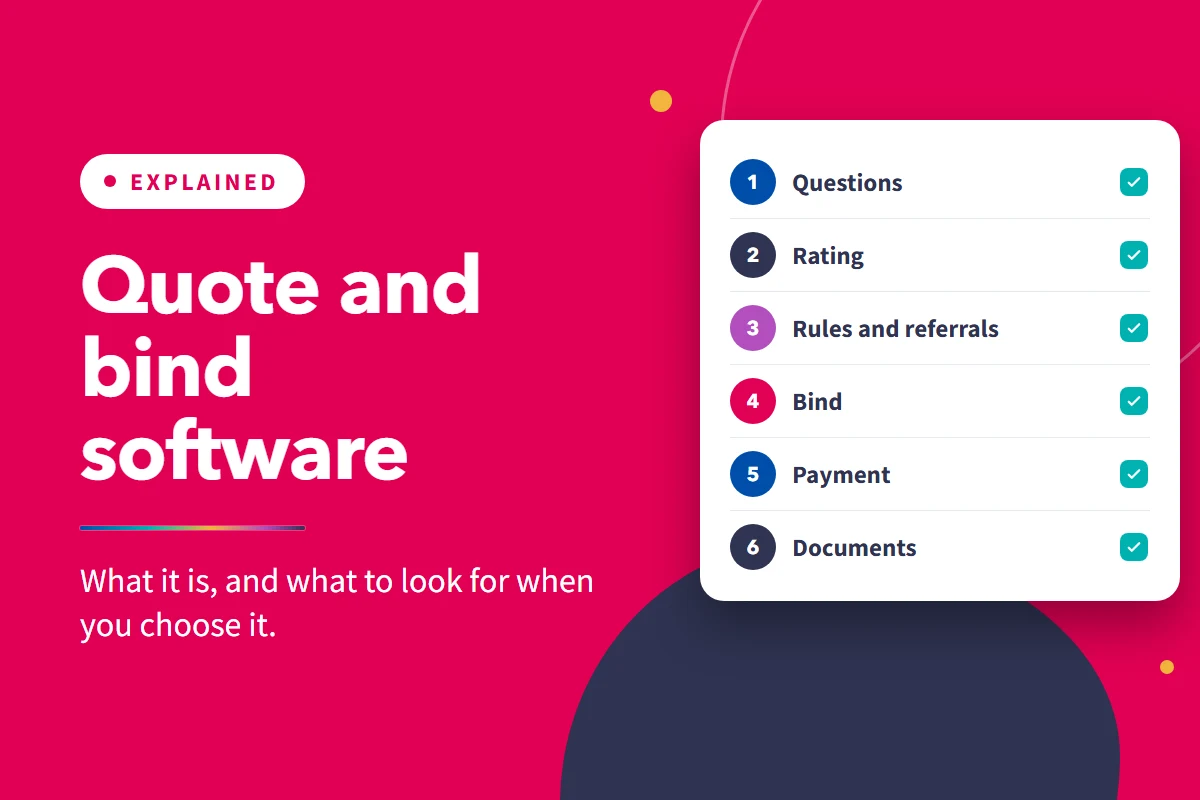
Quote and bind software lets a broker, an MGA or a customer answer a set of questions, see a priced quote and turn it into a live, paid-for policy in one sitting. It rates the risk, applies underwriting rules that accept, refer or decline it, takes payment and issues the policy documents the moment cover is bound.
This guide explains how quote and bind works, who uses it and what separates good software from an online form with a price on the end. Good quote and bind software does far more than quote: it keeps every policy inside the authority you hold, takes payment, proves you were compliant, fills your bordereaux and reconciles the money, with nothing keyed twice. Quote and bind is one capability of a policy administration system, so the guide also shows how it connects to the rest of the platform.
See how quote and bind works in Genasys policy administration
What quote and bind means
A quote is the price and terms offered for a risk. Binding puts cover in force: once a quote is bound, the policy exists and the insurer is on risk from the agreed start date. Quote and bind software joins the two, so the person asking for a price can accept it and leave with cover and documents, rather than waiting for an underwriter to review the submission and issue the policy by hand. Behind the screen, every journey follows the same eight steps.
How quote and bind works, from first question to bordereau
"Quote and buy" describes the same flow from the customer's side: a customer gets a price on a website and buys the policy. "Quote and bind" is the trade term, used when a broker, coverholder or MGA binds cover on behalf of an insurer under a binding authority. Good platforms run both from one product definition.
| Step | Without quote and bind software | With good quote and bind software |
|---|---|---|
| Gathering the risk | Proposal forms by email, re-keyed by staff | An adaptive question set, with data checked as it is entered |
| Pricing | A spreadsheet rater, updated by hand | A rating engine your underwriters change and test themselves |
| Referrals | Emails to an underwriter, decisions in inboxes | Rules that route referrals and record who decided what, and when |
| Documents | Word templates edited per policy | Documents issued at bind from versioned templates |
| Payment | Taken separately and matched later | Taken in the journey and reconciled automatically |
| Bordereaux | Rebuilt in spreadsheets each month | Produced from the policy data for each capacity provider |
| Audit | Scattered across emails and files | One audit trail for every quote, referral, bind and change |
Who uses it: brokers, MGAs, direct
| User | What they use quote and bind for | What matters most |
|---|---|---|
| Brokers trading with insurers | Quoting and binding eligible risks through an insurer's or MGA's portal or API | Speed, clear referral outcomes and documents at bind |
| Brokers with delegated authority | Running their own schemes and binders | Authority limits, bordereaux and a system that works alongside their broker management system |
| Wholesale MGAs | Giving brokers a portal to quote and bind their products | Broker experience, referral rules that mirror each binding authority, commission |
| Retail MGAs and direct insurers | Selling to customers through their own website or app | A branded journey, payments, compliance with consumer rules |
| Embedded partners | Offering cover at the point of sale through an API | A complete, documented API and fast responses |
A broker that underwrites its own schemes under delegated authority needs quote and bind for those products in policy administration software, which works alongside the broker management system that runs the brokerage. Insurers that sell through partners use the same rating and rules through an API, which is how embedded insurance works.
What good software does
Most systems can show a form and return a price. Good quote and bind software handles the whole job, from the first question to the money landing in your ledger, and proves every step was done properly.
Eight things good quote and bind software does
Asks only what it needs
Questions adapt to each answer, and third-party data fills in the rest.
Prices without developers
Underwriters change rates, test them and release them in a controlled version.
Proves authority was followed
Referral rules mirror each binding authority and record every decision.
Builds compliance into the journey
Demands and needs, product information and disclosures at the right step, every time.
Records who did what, and when
An audit trail of every quote, referral, bind, change and document.
Takes the money
Cards, direct debit, instalment plans or premium finance, inside the journey.
Fills your bordereaux
Risk and premium bordereaux built from the policy data for each capacity provider.
Reconciles and posts
Payments matched automatically and journals sent to your general ledger, with no double keying.
Payments and premium finance
A policy is not finished until the premium is paid or arranged. Good software takes payment inside the journey, by card or direct debit, and offers instalments: either an instalment plan the insurer or MGA runs itself, or premium finance, where a finance provider pays the premium and the customer repays it in instalments. It should then run collections, send reminders on missed payments and pass overdue accounts to credit control, without anyone chasing a spreadsheet.
Compliance, audit trails and proof
Every journey should be built so the customer cannot be bound without seeing what the rules require, and so the firm can prove it afterwards. That means the demands and needs statement and product information presented at the right step, documents issued on a durable medium, and an audit trail of who quoted, who referred, who approved and what the customer saw. Insurers and capacity providers audit delegated authority business, and the evidence should come straight from the system, not be reassembled from emails.
Bordereaux, reconciliation and the general ledger
Every bound policy creates data your capacity providers and finance team need. Good software builds bordereaux from the policy record automatically, in each capacity provider's format. It calculates commission across brokers, MGAs and capacity providers, including clawbacks when a policy is cancelled. It matches incoming payments to invoices automatically and sends journals to your general ledger, so finance never re-keys a premium.
Rating, referrals and rules
A rating engine turns answers into a price: base rates, then multipliers, discounts and loadings for each rating factor, then taxes and fees. Good rating lets an underwriter or pricing analyst change a table or formula, test the new premium against sample risks and release it without a developer, with every version kept so a change can be traced or rolled back. Underwriting rules then decide what happens to each quote.
| Rule type | What it does | Example |
|---|---|---|
| Eligibility | Checks the risk is one the product covers | Business type is on the accepted list |
| Validation | Checks the answers make sense | Rebuild value is above zero and below the product maximum |
| Endorsement | Adds a clause or excess automatically | Flood excess added for a property in a flood zone |
| Referral | Sends the quote to an underwriter | Sum insured above the binding authority limit |
| Decline | Stops the quote | Risk outside appetite |
What is the difference between a referral and a decline?
A decline stops the quote because the risk is outside appetite. A referral pauses it because the risk might be acceptable but sits outside the authority of the person or channel quoting. The referral goes to an underwriter with the answers and the reason attached, the underwriter accepts, amends or declines it, and the broker or customer is told the outcome. For an MGA or coverholder, referral rules are how the system respects the limits in each binding authority, and the record of each referral decision is the proof an insurer will ask for in an audit.
Documents and binding
When a quote is bound, the customer should receive the schedule, certificate, policy wording and any endorsements straight away, built from templates merged with the policy data so a change to a template applies to every document produced after it. In the UK, what the customer sees before binding is also a regulatory matter.
| What | When | FCA rule |
|---|---|---|
| Demands and needs | Before the contract is concluded, with a statement to the customer | ICOBS 5.2.2R and 5.2.2DR1 |
| Product information | In good time before the contract is concluded | ICOBS 6.1.5R2 |
| Insurance Product Information Document | Before conclusion, for each general insurance policy sold to a consumer, on paper or another durable medium | ICOBS 6.1.10AR and 6.1.10BG2 |
| Applicable law and complaints | Before conclusion, for a customer who is a natural person | ICOBS 6.2.2R2 |
The FCA says demands and needs information can be gathered by questionnaire (ICOBS 5.2.2AG), which is what a quote and bind question set does. The IPID is drawn up by the manufacturer of the policy and follows a standard layout set out in ICOBS 6 Annex 3, on two sides of A4 when printed.2 A quote and bind system should present each item at the right point and record that it was given.
Questions to ask vendors
Take these into every demonstration, and ask the vendor to show the answer in the system rather than describe it.
| Area | Question | Why it matters |
|---|---|---|
| Product build | Can our own team build a question set, change a rate and add a rule without your developers? How long does each take? | Speed to market and the cost of every future change |
| Product build | How do you test and version a change before it goes live, and can we roll it back? | A bad rate change can mis-price a book overnight |
| Journeys | Do broker, customer and partner journeys run from one product definition? | Different channels should never quote different prices |
| Journeys | Can we quote and bind several risks on one policy and change them mid-term in one transaction? | Fleets, portfolios and packages depend on it |
| Referrals | How do referral rules mirror each binding authority, and how do we prove to an insurer they were followed? | Binding outside authority is a serious breach |
| Compliance | Where do the demands and needs statement and the IPID appear in the journey, and how is it recorded? | You must be able to evidence what each customer saw |
| Audit | Show us the audit trail for one policy, from first quote to renewal. | Insurer and regulator audits rely on it |
| Documents | Which documents are issued at bind, and who can edit the templates? | Wording changes should not need a release |
| Payments | Which payment methods are built in, and how do instalments and premium finance work? | Customers expect to pay in the journey |
| Finance | How are payments reconciled, commissions and clawbacks calculated, and journals sent to our ledger? | Double keying is where finance errors start |
| Bordereaux | Can you produce bordereaux in each of our capacity providers' formats from the policy data? | Late or wrong bordereaux damage capacity relationships |
| Integration | Is the full journey available by API, and where is the documentation? | Partners, aggregators and your own front end need it |
| Data | Which third-party data and payment providers are already integrated? | Fewer questions for customers, faster launches |
| Lifecycle | Does the bound policy flow into mid-term changes, renewals and claims on the same record? | A standalone front end means a second system to reconcile |
| Hosting | Where is our data hosted, and is our environment shared or dedicated? | Security, resilience and data residency |
| References | How long did your last three customers take from contract to first bound policy, and can we speak to them? | Published launch times describe the fastest projects |
Genasys runs quote and bind inside its policy administration system for insurers, MGAs and brokers. Its low-code product builder covers drag-and-drop question sets with conditional questions, rating tested live while configuring, eligibility and referral rules, an endorsement library and document templates, with every product tested and versioned before release. The same product runs through broker portals, customer journeys, widgets and more than 450 documented REST API endpoints, and the bound policy flows into billing and finance, where instalment plans, direct debit and card payments, multi-tier commission, payment matching and general ledger integration run on the same record. Hayes Parsons had a multi-section yacht product with auto-rating, referrals and declines operational in ten days.
Show References Hide References
- FCA Handbook. ICOBS 5.2: Demands and needs.
- FCA Handbook. ICOBS 6: Product information, including ICOBS 6 Annex 3 (Insurance Product Information Document).
Frequently Asked Questions
What is quote and bind software in insurance?
Quote and bind software is the part of an insurance platform that takes a risk from first question to live policy without manual handling. The broker, MGA or customer answers a question set, the rating engine prices the answers, underwriting rules accept, refer or decline the risk, and on acceptance the policy is bound, payment is taken or arranged and the documents are issued. In insurance, "bind" means putting cover in force, so the moment of binding is when the insurer goes on risk. The software records that moment and everything that led to it, which matters for audit and for the reporting MGAs and coverholders send to their capacity providers.
Quote and bind can be bought as a standalone front end or as part of a policy administration system. The difference shows after the bind. A standalone tool has to pass the policy to other systems for payment, mid-term adjustments, renewals, bordereaux and accounting, and each hand-off is a place where data can be lost or keyed twice. When quote and bind sits inside the policy administration system, the bound policy is already the policy of record. Genasys works this way: quote and bind, mid-term adjustments, renewals, billing and bordereaux run on one record, and the same product can be sold through broker portals, customer journeys and APIs.
What does it mean to bind an insurance policy?
To bind a policy is to put cover in force. Once a quote is bound, the insurer is on risk from the agreed start date, even if the full documents follow later. Binding is done by the insurer itself, or by an MGA, coverholder or broker acting under a binding authority, the agreement in which an insurer delegates the right to accept risks on its behalf within set limits. Those limits cover the classes of business, territories, sums insured and premium the agent can write without referring back.
In quote and bind software, the bind is the point at which a quote becomes a policy. The system checks the risk against the underwriting rules one last time, confirms payment or credit terms, creates the policy record and issues the schedule, certificate and wording. For a firm binding under delegated authority, the software also has to stop any bind that falls outside the authority it holds, usually by referring the risk to an underwriter, and record the decision. A coverholder or MGA that binds outside its authority creates a problem for its capacity provider, so referral rules that mirror the binding authority, and the audit trail that proves they were followed, are among the most important things to test when choosing a system.
What is the best quote and bind software for an MGA?
The best quote and bind software for an MGA lets its own team launch and change products quickly while keeping every bind inside each capacity provider's authority. That means a product builder underwriters can use without code, rating that can be changed and tested without a release, referral rules that mirror each binding authority with a record of every decision, broker and customer journeys from one product definition, payments in the journey, and bordereaux, commission and reconciliation produced from the same data. A wholesale MGA needs a strong broker portal; a retail MGA needs a customer journey it can brand and embed; many need both.
Test any shortlist on time to market and on what happens after the bind. Ask each vendor to build one of your products during the evaluation, and ask for the time recent customers took from contract to first bound policy. On Genasys, Hayes Parsons had a multi-section yacht product with auto-rating, referrals and declines operational in ten days, and Genasys delivered Arma Karma's policy administration platform in one week. Then check that payments, mid-term adjustments, renewals, claims and bordereaux run on the same record, so the MGA is not maintaining a second system. The Genasys MGA software page covers how this works for wholesale and retail MGAs.
How long does it take to set up quote and bind for a new product?
It depends on the platform, the complexity of the product and how much of the work is configuration rather than custom development. On a legacy system, a new product can take many months, because question sets, rates, rules and documents are written in code and every change goes through a development cycle. On a configurable platform, a straightforward product can be live in weeks or less, because product teams build the question set, rating, rules and documents themselves using the vendor's tools.
Published Genasys examples give a sense of the range. Hayes Parsons had a multi-section yacht product, including legal expenses, operational in ten days after a five-day on-site sprint. GENRIC went from concept to a live parametric product in 50 days, of which ten days were spent configuring and deploying it on Genasys. King Price launched its first product on Genasys in six weeks. What slows a launch is usually the work around the software: agreeing the rating with the capacity provider, finalising wordings, and connecting payment and data providers. Ask any vendor for the median time across recent launches as well as the fastest. The Genasys product builder page explains how each part is configured.
What rules apply to selling insurance through a quote and bind journey in the UK?
The FCA's Insurance: Conduct of Business sourcebook (ICOBS) applies whether a policy is sold by a person or a website. Before the contract is concluded, the firm must specify the customer's demands and needs from information obtained from the customer, give the customer a statement of them and propose only a contract consistent with them (ICOBS 5.2.2R and 5.2.2BR). The FCA notes that this information can be gathered by questionnaire, and for non-advised sales the statement can be built into the application form so it reflects the customer's answers (ICOBS 5.2.2AG and 5.2.4G). In a quote and bind journey, the question set does this work.
Product information also has to reach the customer in good time before the contract is concluded, so they can make an informed decision (ICOBS 6.1.5R). A consumer buying general insurance must receive an Insurance Product Information Document for each policy, on paper or another durable medium (ICOBS 6.1.10AR and 6.1.10BG). The IPID is drawn up by the manufacturer of the policy, follows the standard headings and layout in ICOBS 6 Annex 3 and fits on two sides of A4. A natural person must also be told the law that applies to the contract and how to complain before it is concluded (ICOBS 6.2.2R). Good quote and bind software presents each item at the right step, records that it was given and issues evidence of cover promptly after the bind.
Quote and bind on Genasys
Genasys runs quote and bind inside its policy administration system: question sets, rating, referral rules, documents, payments and bordereaux your own team can configure, with broker and customer journeys from one product.
B2B Commercial
B2C Retail