
If you run an insurer or an MGA and you are replacing your core platform or choosing one for the first time, the policy administration system you pick will shape how quickly you launch products, how cleanly you report to capacity providers and how much you spend on IT for the next decade. The market is crowded, and vendor websites tend to describe very different products in very similar language.
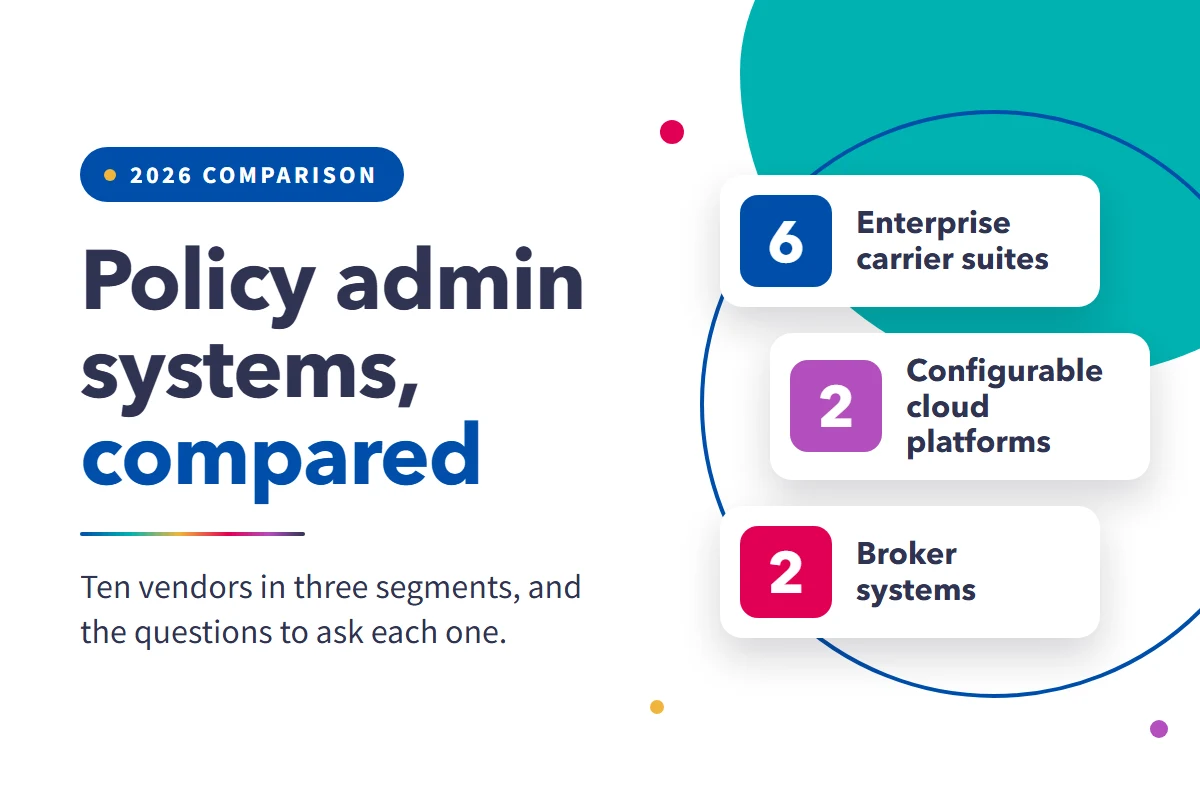
This comparison sorts the vendors that insurers and MGAs most often shortlist into three segments according to who each one is built for. Enterprise carrier suites sit at one end and configurable cloud platforms for the mid-market sit in the middle, followed by two broker systems that buyers often mistake for policy administration. For each vendor you will find what it is, who it suits and the trade-off worth weighing. Every vendor fact was checked against that vendor's own website in October 2026, and the guide closes with the criteria and questions that separate one system from another.
How we grouped the market
Enterprise carrier suites. These are full core platforms covering policy, billing and claims, sold mainly to large and mid-sized carriers with their own IT teams and multi-year transformation budgets. Most are now owned by private equity, offer cloud delivery alongside older deployment options and support a wide range of lines, sometimes including life and group benefits. They suit carriers that need breadth and scale more than speed.
Configurable cloud platforms. This group is younger and sold as software as a service, with product building done through configuration rather than custom code. The vendors here target MGAs, smaller insurers and new product lines that need to reach market in weeks or months. They usually cost less to license and implement, and the trade-off tends to be narrower coverage of lines or modules.
Broker systems. Broker management systems run the distribution side of insurance: clients, quotes from many insurers, documents and accounts. Buyers often confuse them with policy administration systems because both handle policies, but a broker system records policies that insurers have issued, while a policy administration system is where the insurer or MGA builds, rates and issues the product.
Policy administration systems compared
| Vendor | Segment | Best suited to | Deployment model | Typical buyer size |
|---|---|---|---|---|
| Guidewire | Enterprise carrier suite | P&C carriers wanting a full core suite; separate InsuranceNow offering for MGAs | Guidewire Cloud on AWS | Large and mid-sized carriers |
| Duck Creek | Enterprise carrier suite | P&C carriers in personal, commercial and specialty lines | Cloud-native SaaS | Large and mid-sized carriers |
| Sapiens | Enterprise carrier suite | Multi-country P&C insurers | SaaS, with AWS and Azure support | Tier one and enterprise insurers |
| Majesco | Enterprise carrier suite | P&C carriers; MGAs through a pre-configured model office | On-premises, hosted or cloud | Mid-sized to large carriers and MGAs |
| EIS | Enterprise carrier suite | Insurers combining P&C with life, annuities or group benefits | SaaS, on-premises or hybrid | Large carriers |
| Insurity | Enterprise carrier suite | US P&C carriers and MGAs writing complex commercial books | Cloud-native | Mid-sized to large carriers and MGAs |
| Genasys | Configurable cloud platform | MGAs and insurers writing general insurance under delegated authority | Cloud-based SaaS | Mid-market MGAs and insurers |
| Socotra | Configurable cloud platform | Insurers wanting an API-led core | SaaS on AWS | Mid-sized to large insurers |
| Acturis | Broker system | UK brokers, plus MGAs and insurers trading through brokers | SaaS in a private cloud | Brokers of all sizes |
| Applied Epic | Broker system | Agencies and brokerages | Browser-based SaaS | Mid-sized to large brokerages |
Segment 1: enterprise carrier suites
Guidewire
Guidewire PolicyCenter is the policy administration system within Guidewire InsuranceSuite, which also includes BillingCenter, ClaimCenter, PricingCenter and UnderwritingCenter. Guidewire's about page puts its customer base at more than 570 insurers and 1,700 implementations, and the PolicyCenter page lists over 155 PolicyCenter customers in 20 countries, including Aviva and Macif. Product configuration is designed to need little coding, and Guidewire publishes API documentation and SDKs for integration.
Guidewire also has an offering for MGAs built on InsuranceNow, which covers submissions, underwriting, policy, billing and bordereaux for delegated authority business on AWS.
Guidewire suits P&C carriers that want one vendor across the whole core, backed by a long record of implementations. The trade-off is the size of the programme: a full InsuranceSuite project is a multi-year transformation, and smaller insurers should check whether the InsuranceNow route or a lighter platform fits their budget better.
Duck Creek
Duck Creek Policy is part of what Duck Creek calls its Intelligent Core of Insurance, alongside rating, billing and claims. It is delivered as cloud-native SaaS and covers commercial and personal auto, homeowners, workers' compensation, medical professional liability, specialty and embedded insurance. Duck Creek reports more than 390 customers and 1,200 implementations, with over 33 of the top 50 North American carriers among them, and says it exposes more than 2,600 APIs.
Vista Equity Partners completed its acquisition of Duck Creek in March 2023. In July 2026 Duck Creek acquired Send, the commercial and specialty underwriting workbench, which remains available on its own.
Duck Creek suits P&C carriers in North America, EMEA and APAC that want an evergreen SaaS core with a large integration library. Its footprint is heaviest among North American carriers, so UK and European buyers should ask for local references and partner capacity.
Sapiens
Sapiens sells several P&C platforms. Its main suite, IDITSuite for Property & Casualty, combines PolicyMaster, ClaimsMaster, BillingMaster and a digital layer for personal, commercial and specialty lines. Sapiens describes it as cloud-delivered software with hybrid support for AWS and Azure, low-code configuration and an API layer it calls the API Conductor. Sapiens also maintains other P&C products, including TIA Enterprise, on its P&C hub.
Advent International completed its acquisition of Sapiens in December 2025, when the company reported more than 600 customers in over 30 countries.
Sapiens suits insurers running books in several countries and currencies that want a single vendor with local presence. Because it has more than one P&C platform, buyers should confirm which product a proposal is based on and what the roadmap for that product looks like.
Majesco
The Majesco P&C Intelligent Core Suite includes Policy, Billing and Claims for personal, commercial, workers' compensation and specialty lines. It can run on-premises, hosted or in the cloud through Majesco's CloudInsurer service, and Majesco describes it as cloud-native with an open API catalogue.
For MGAs, Majesco launched an MGA Model Office in October 2025: a pre-configured system with ready-built personal and commercial products. Majesco is a Thoma Bravo portfolio company and in January 2026 closed its acquisition of Vitech, which added pension and benefits administration. It reports more than 350 insurer, reinsurer and MGA customers.
Majesco suits carriers that want deployment choice, including on-premises, and MGAs that would rather start from a pre-built model office than a blank configuration. UK buyers should ask for references from UK customers of a similar size.
EIS
EIS PolicyCore is a SaaS policy administration system with an event-driven architecture. It sits within EIS OneSuite alongside billing, claims and a customer data module, and includes a product studio and a rating engine built on OpenL Tablets. EIS covers P&C, group benefits, life and annuities, protection and pet insurance. Its OneSuite launch announcement in October 2025 says the suite can run cloud-native, on-premises or hybrid.
EIS lists Allstate, Nationwide and Liberty Mutual among the carriers on its homepage, and holds MACH Alliance, ISO 27001 and ISO 42001 certifications.
EIS suits large insurers that want P&C and life or benefits lines on one modern architecture. It does not publish a customer count or an MGA offering, and the carriers named on its homepage are mostly large US insurers, so smaller insurers should test whether the commercial model fits their scale.
Insurity
Insurity's policy administration system is Policy Decisions, which Insurity describes as cloud-native and built for large, complex commercial books. It covers more than 25 lines of business with bureau content for rates, rules and forms updated automatically, and includes geospatial analytics in quoting, role-based workflows and RESTful APIs. Insurity says more than $7bn of premium is written on Policy Decisions each year.
Insurity is based in Hartford, Connecticut, and is owned by GI Partners and TA Associates. Its press releases say it serves carriers, brokers and MGAs, with more than 400 cloud deployments, and count 22 of the top 25 US P&C carriers and seven of the top ten US MGAs among its customers. The MGA N2G Worldwide went live on the latest version, Policy Decisions Evolution, in 2025.
Insurity suits US carriers and MGAs writing commercial lines where bureau rates and state filings drive much of the workload. Its bureau content and customer base are US-focused, so UK and European buyers should ask how much of the product applies outside the US and which local customers they can speak to.
Segment 2: configurable cloud platforms for mid-market insurers and MGAs
Genasys
Genasys is a cloud-based policy administration system for insurers and MGAs writing general insurance, including business under delegated authority. It covers quote and bind, mid-term adjustments, renewals and documents, with a no-code product builder and rating engine, claims, billing and finance, bordereaux, broker and customer portals and reporting. Genasys publishes more than 450 documented REST API endpoints and supports multiple currencies, tax regimes and languages.
The company was founded in Cape Town in 1997, opened in London in 2018 and is now headquartered at 24 Lime Street, with offices in Johannesburg and Cape Town. Published launch times include King Price's first product in six weeks and a Hayes Parsons product in ten days, and Genasys delivered Arma Karma's policy administration platform in one week.
Genasys suits MGAs and mid-market insurers in commercial and personal general insurance lines that want to launch products without custom development. It does not cover life or group benefits, and it is not a broker management system, so carriers needing either alongside general insurance will need another platform as well.
Socotra
The Socotra Platform is a SaaS core for insurers covering policy, billing, rating, reporting and portals, with AI tools for product building and underwriting. Socotra supports personal, commercial, specialty, life and health, telematics, embedded and parametric products. It runs on AWS, in shared or dedicated environments, and every client runs on the same version.
Socotra's company page puts its customer base at more than 50 insurers in ten countries, and its homepage lists AXA, Berkley, MS Amlin and Mutual of Omaha. It raised a $50m Series C led by Insight Partners in 2022 and has released a series of AI features through 2025 and 2026.
Socotra suits insurers that want a modern, API-led core and have the technical staff to configure it. Its site does not describe the platform as no-code or position it for MGAs, and claims is not listed as a module, so buyers should ask what skills configuration requires and how claims will be covered.
Segment 3: broker systems often confused with a PAS
A policy administration system belongs to the business that carries or underwrites the risk. It holds the product definition, the rating rules and the policy record of truth, and it produces the documents and bordereaux that go to capacity providers. A broker management system belongs to the intermediary. It manages clients, places business with many insurers, stores the policies those insurers issue and runs client money accounting. The two exchange data constantly, which is why buyers sometimes shortlist one when they need the other.
Acturis
Acturis is a cloud platform run as SaaS in its own private cloud, with e-trading, CRM, policy administration, claims, accounting and business intelligence. Its group reports more than 100,000 users in over 40 countries and 32,000 users in the UK. Acturis is best known as broker software, but it also offers product build, automated underwriting and policy administration for MGAs and insurers, with the advantage of reaching more than 30,000 UK brokers already on the system. An MGA whose distribution runs mainly through UK brokers may find that a strong reason to look at it.
Applied Epic
Applied Epic is a brokerage management system from Applied Systems, covering P&C and benefits management, sales and process automation, documents, insurer connectivity and reporting. Applied describes it as the most widely used management platform of its kind. In June 2025 Applied announced plans to withdraw Applied Epic from the UK over several years, while keeping other products such as Applied TAM and Rating Hub in the UK market. Epic is for brokers rather than insurers or MGAs.
How to compare policy administration systems
Configuration versus customisation. Configuration means changing a product, a rule or a screen through the vendor's own tools, so the change survives upgrades. Customisation means writing code against the core, which gives more freedom but has to be retested and maintained each time the platform moves on. Ask what share of a typical implementation is done each way and who in your team will make changes after go-live.
Rating and product build. Look at how a new product is defined, how rating tables and referral rules are loaded and whether an underwriter or product manager can make a rate change without a release. A good test is to bring one of your own products to a demonstration and watch it being built.
Bordereaux and delegated authority data. Capacity providers judge MGAs and coverholders on the accuracy and timeliness of their reporting. Check whether the system produces risk, premium and claims bordereaux in the formats your carriers and Lloyd's require, and whether one product can report to several capacity providers on a split line.
Integration and API. Count the published APIs, but also read the documentation and ask how many integrations to rating services, payment providers, document tools and data enrichment sources come ready-built. Event-based integration matters if you want other systems to react to policy changes in real time.
Hosting and security. Confirm which cloud the platform runs on, where your data is held, whether you are on a shared or dedicated environment and which certifications the vendor holds, such as ISO 27001 or SOC 2.
Implementation time. Ask for the time from contract to first live policy on recent projects of your size, with customer names you can call. Published case studies tend to describe the fastest launches, so ask for the median as well.
Total cost of ownership. Licence fees are only part of the cost. Add implementation services, integration work, internal staff time, hosting, upgrades and the cost of each future product change over five to ten years before you compare quotes.
Questions to ask every vendor
- Which of your current customers are closest to us in size, lines of business and distribution model, and can we speak to two of them?
- How long did those customers take from signed contract to first live policy, and how long to their tenth product?
- Which parts of our requirements are handled by configuration, and which would need custom code?
- Can our own staff build a new product or change a rate without your involvement, and what training do they need?
- Which bordereaux formats do you produce as standard, and how do you handle a product backed by several capacity providers?
- Which cloud provider and region will host our data, and is our environment shared or dedicated?
- How often do you release upgrades, and what testing falls to us when you do?
- Which integrations to rating, payments, documents and data sources come ready-built, and which would we build?
- What is the full five-year cost, including implementation, hosting, support and change requests?
- Who owns the data and the product configuration if we leave, and in what format do we get them back?
Software versus outsourced policy administration services
Some insurers hand policy administration to a third party administrator or business process outsourcing provider, which runs the system and the staff who process transactions. This makes sense for closed books in run-off, for products too small to justify their own team and for businesses entering a market where they have no operations yet. Running your own policy administration software makes more sense when products are central to your growth, when you want to change rates and wordings yourself and when the data is something you want to own and use directly. Many MGAs combine the two, licensing a platform and outsourcing parts of the back office such as credit control or claims handling.
Frequently Asked Questions
Who are the leading policy administration system vendors?
The vendors most often shortlisted by large carriers are Guidewire, Duck Creek, Sapiens, Majesco, EIS and Insurity, each of which sells a full core suite covering policy, billing and claims. For MGAs and mid-market insurers, configurable cloud platforms such as Genasys and Socotra are common choices, and Insurity serves both carriers and MGAs in the US.
What is the best policy administration software for an MGA?
The best choice depends on your lines, your capacity providers and how you distribute. An MGA should look for a no-code product builder, bordereaux that match its carriers' formats, support for several capacity providers and a short route to the first live policy. Genasys sells directly to MGAs. Insurity counts seven of the top ten US MGAs as customers, and Guidewire and Majesco offer MGA-specific packages within larger suites.
Which policy administration systems are cloud-native?
Duck Creek, Sapiens, Majesco, EIS, Insurity and Socotra all describe their platforms as cloud-native on their own websites. Genasys is delivered as a cloud service. Majesco and EIS also offer on-premises deployment, so check which version a proposal is based on.
What should I consider when selecting a policy administration provider?
Compare how much of your requirement is met by configuration rather than custom code, how products and rates are built, the quality of bordereaux and delegated authority reporting, the integration library, hosting and security, the realistic implementation time and the total cost of ownership over five to ten years. Speak to customers of a similar size before you sign.
How long does it take to implement a new policy administration system?
A single product on a configurable cloud platform can go live in weeks: Hayes Parsons had a product ready for market in ten days and King Price's first product took six weeks, while Genasys delivered Arma Karma's policy administration platform in one week. Replacing the full core of a large multi-line carrier usually runs as a programme of a year or more. The figures that matter most are the time to your first live policy and the time each new product takes after that.
Talk to Genasys
If you are an MGA or insurer weighing up a new core platform, see how the Genasys policy administration system handles product build, rating and bordereaux, or contact Genasys to arrange a demonstration built around one of your own products.
MGAs
Insurers