
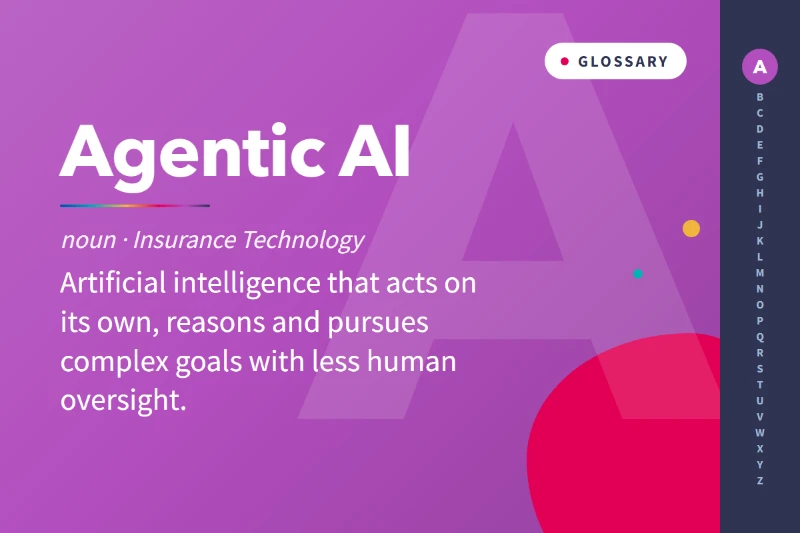
Agentic AI is artificial intelligence that can take a sequence of actions towards a goal, rather than only producing a single response.1 An agentic system plans steps, uses software tools such as databases and APIs, checks the results and decides what to do next; the degree of human oversight varies.
This entry compares the definitions regulators use, explains how an AI agent works and how it differs from generative AI and rules-based automation, sets out what the Bank of England, the FCA and the Lloyd's Market Association have found about AI in financial services and insurance, and summarises how the UK, EU and US rules treat AI in insurance.
What is agentic AI?
The Financial Conduct Authority's glossary in its October 2026 publication on AI in financial services defines agentic AI as AI that can take a sequence of actions towards a goal, rather than only producing a single response, and adds that it may need stronger controls because it can operate more independently.1
The Bank of England and FCA's 2026 survey of AI in UK financial services used definitions drawn from the OECD. It describes AI agents as a subset of AI systems that perceive and act on their environment with a degree of autonomy, using tools as needed to achieve specific goals. It says agentic AI generally refers to systems of multiple co-ordinated AI agents that can break down tasks, collaborate and pursue complex objectives autonomously over extended periods, and that are designed to function with minimal human supervision.2 The survey's wording separates a single agent from agentic AI; the FCA's glossary definition does not draw that line.
The EU AI Act defines an AI system as a machine-based system designed to operate with varying levels of autonomy, which may exhibit adaptiveness after deployment and which infers from its input how to generate outputs such as predictions, content, recommendations or decisions.3 The definition does not mention agents; it describes autonomy as varying.
| Source | Term | Definition, in summary | Date |
|---|---|---|---|
| FCA1 | Agentic AI | AI that can take a sequence of actions towards a goal, rather than only producing a single response; may need stronger controls because it can operate more independently | October 2026 |
| Bank of England and FCA survey2 | AI agent | A subset of AI systems that perceive and act on their environment with a degree of autonomy, using tools as needed to achieve specific goals | October 2026 |
| Bank of England and FCA survey2 | Agentic AI | Generally, systems of multiple co-ordinated AI agents that break down tasks, collaborate and pursue complex objectives autonomously over extended periods, with minimal human supervision | October 2026 |
| EU AI Act, Article 3(1)3 | AI system | A machine-based system designed to operate with varying levels of autonomy that infers from its input how to generate outputs such as predictions, content, recommendations or decisions | Consolidated text as at 27 July 2026 |
| NIST AI RMF 1.04 | AI system | An engineered or machine-based system that can, for a given set of objectives, generate outputs such as predictions, recommendations or decisions; designed to operate with varying levels of autonomy | January 2023 |
| NAIC model bulletin5 | AI System | A machine-based system that can, for a given set of objectives, generate outputs such as predictions, recommendations or content influencing decisions made in real or virtual environments | 4 December 2023 |
How an AI agent works
An agentic system can be built around a large language model, the type of generative AI the FCA describes as trained on large amounts of text to produce, summarise or interpret language-based content.1 The model is given an objective, breaks it into steps and calls a tool to carry out each one. A tool can be a search, a calculation, a query against a database or a call to another system's API. The agent reads the result before choosing its next action.
How an AI agent works: the plan, act and check loop
The FCA describes controls at these points. In its review of firms' AI use, the FCA describes firms that considered which tasks AI can support or automate, which should remain staff-led and where the AI tool should abstain, redirect or escalate to a person.1 It describes building proportionate technical checks and continuous monitoring into the AI system, rather than only relying on a person to review, approve, challenge or override its outputs or decisions.1
Agentic AI compared with generative AI and rules-based automation
Generative AI produces content in response to a prompt. Agentic AI uses a model to decide on and take actions. Rules-based automation, such as straight-through processing, follows rules a person has written in advance and takes the same path every time the same conditions are met. The table sets the approaches side by side, using the regulators' own definitions where they give one.
| Approach | Definition | Who decides the next step | Insurance illustration |
|---|---|---|---|
| Rules-based automation | Follows rules a person wrote in advance (general description, not a regulator's definition) | The person who wrote the rules | A renewal is issued automatically when no claim has been made and the risk details are unchanged |
| Machine learning | A type of AI that learns patterns from data to make predictions, recommendations or decisions, rather than being explicitly programmed for every task (FCA) | A person or a process acts on the prediction | A model scores a claim for the likelihood of fraud |
| Generative AI | AI that can create new content, such as text, images, summaries, code or recommendations, based on patterns learned from data (FCA) | The user, one prompt at a time | A summary of a loss adjuster's report |
| AI agent | Perceives and acts on its environment with a degree of autonomy, using tools as needed to achieve specific goals (Bank of England and FCA) | The model, within limits people set | Gathering a claim's documents, checking them against the policy and drafting a recommendation for a handler |
| Agentic AI | AI that can take a sequence of actions towards a goal, rather than only producing a single response (FCA) | The model or several co-ordinated agents, within limits people set | Several agents handling intake, document checks and correspondence on one claim, with a person approving the outcome |
Examples of agentic AI in insurance
As an illustration, an agent handling a first notification of loss could read the customer's description, look up the policy, request missing photographs, check the claim against the cover and pass a draft decision to a claims handler. In underwriting, an agent could extract the data from a broker's submission, load it into an underwriting workbench, call a rating engine for a technical price and assemble a file for the underwriter to review. In each case the agent prepares and a person decides.
Reported uses are narrower than these illustrations. The Lloyd's Market Association's April 2026 survey of its members found that AI use cases remain limited and mainly focus on generative AI tools for summarising reports and creating meeting notes.6 Respondents described uses being experimented with, including underwriting uses such as virtual assistants for document and wording review, compliance uses such as marine sanctions tracking and wording analytics for slip-level exclusions, and claims uses such as summarisation for board reporting.6
Across UK financial services, the Bank of England and FCA's 2026 survey found that 16% of respondents used agents for automated customer communications, rising to 34% when planned deployment was included. For creating or modifying records in core systems the figures were 8% and 25%. Even including plans for the next 12 months, no more than 9% of respondents expected agents to perform tasks including approving or declining customer outcomes, executing trades, initiating, executing or blocking payments, and changing limits, thresholds and controls.2
How many financial firms and insurers use AI agents
AI and AI agents in UK financial services, 2026
The Bank of England and FCA's fourth survey received 196 responses, 105 of which completed the full questionnaire; firms with fewer than 100 employees could complete a shorter form.2 86% of respondents reported using AI, up from 75% in 2024, although the report says the two figures do not relate to the same population of firms and should be compared with caution. All responding UK and international banks reported using AI, followed by 93% of responding insurers.2 Among full-survey respondents, the median number of AI systems in production was 18 for insurance, against 22 for UK banks.2
The survey asked firms to report their agents by level of autonomy. Decision support means agents recommend actions and humans decide and execute. Constrained execution means agents execute actions within predefined limits and rules. Conditional autonomy means agents act independently but require human approval for certain actions, and broad autonomy means agents can initiate and execute actions with limited real-time human involvement.2
| Business area | Decision support only | Constrained execution | Conditional autonomy | Broad autonomy |
|---|---|---|---|---|
| All business areas | 80% | 46% | 22% | 2% |
| Operations and IT | 53% | 34% | 14% | 1% |
| Risk and compliance | 30% | 10% | 3% | 1% |
| Life insurance | 5% | 3% | 1% | 0% |
| General insurance | 3% | 3% | 1% | 0% |
The insurance rows are shares of all full-survey respondents, not of insurers alone, so they show how few respondents reported agents in insurance business areas rather than what proportion of insurers use them. The previous survey measured something different: in 2024, 55% of all AI use cases had some degree of automated decision-making and 2% had fully autonomous decision-making, counted by use case rather than by firm.7
| Measure | 2022 | 2024 | 2026 |
|---|---|---|---|
| Published | 11 October 20228 | 21 November 20247 | 26 October 20262 |
| Subject | Machine learning8 | Artificial intelligence7 | Artificial intelligence and machine learning2 |
| Responses | 71, from 168 firms asked8 | 1187 | 196, of which 105 completed the full survey2 |
| Headline adoption | 72% using or developing machine learning applications8 | 75% using AI, with a further 10% planning to7 | 86% using AI2 |
| Insurers | 100% of insurance respondents had a machine learning strategy; 74% of insurers' machine learning applications ran on cloud platforms8 | 95% of insurance respondents using AI, the highest of any sector7 | 93% of responding insurers using AI; median of 18 AI systems in production2 |
The populations differ between surveys, and so do the questions. The 2024 report gives 58% as the share of firms using AI in 2022, while the 2022 report itself gave 72% for firms using or developing machine learning.78 The 2022 sample was skewed towards larger firms, with no responses from smaller fintech firms or start-ups.8
AI in the Lloyd's market
AI governance among Lloyd's Market Association respondents, 2026
The LMA's survey was distributed to LMA members, with responses from managing agents and syndicates, and received 39 responses representing over 60% of the market's stamp capacity; 11 participants were interviewed. Its figures are on a base of 39 completed responses, with multi-select questions shown as the share of respondents selecting each item.6 In the LMA's previous survey, published in May 2025 (a survey of Chief Risk Officers and Chief Actuaries, so the groups differ), only 25% of participants reported using AI; in 2026 the majority of participants had adopted it. 72% had an AI framework in place, 37% had specific provisions for generative AI and 21% were developing a framework.6 The LMA concluded that the market remains at an early stage of its AI adoption journey.6 The survey measures AI in general and gives no separate figure for AI agents.
Consumers and agentic AI
The FCA reported in July 2026 that research it commissioned for the Mills Review, a survey of more than 5,000 UK retail financial services consumers carried out by Yonder Consulting in April 2026, found that 20% of consumers would be likely to use AI capable of acting autonomously within pre-set goals, which the FCA put at the equivalent of 11 million UK adults.9 It also reported that consumers in the survey were concerned about trust and control of AI.9
How AI in insurance is regulated
In the UK, AI in financial services is regulated through existing law and existing regulators. The government's March 2023 white paper set five principles for regulators to apply within their remits and said they would not initially be put on a statutory footing.10 Its February 2024 response said a non-statutory approach currently offered critical adaptability and would be kept under review; later government statements are not reviewed here.11 The FCA states that it does not plan to introduce extra regulations for AI and will rely on existing frameworks.12
| Regime | Where | Status and date | How it treats AI in insurance |
|---|---|---|---|
| Government AI white paper and response1011 | UK | 29 March 2023; response 6 February 2024 | Five principles applied by existing regulators on a non-statutory basis, kept under review |
| FCA AI Update and approach to AI1312 | UK | 2024; page updated 2 October 2026 | Existing rules apply, including the Principles for Businesses, the Consumer Duty and the Senior Managers and Certification Regime; no extra AI regulations planned |
| FCA good practice publication1 | UK | 19 October 2026 | Examples of good practice and areas for improvement, including agentic AI; creates no new requirements |
| PRA SS1/23 model risk management14 | UK | First in effect 17 May 2024, amended April 2026 | Applies to UK banks, building societies and PRA-designated investment firms with internal model approval for regulatory capital; credit unions, insurers and reinsurers are not in scope |
| FCA AI Lab15 | UK | First published October 2024 | AI Live Testing and the Supercharged Sandbox let firms test AI with regulatory support |
| UK GDPR Articles 22A to 22C161718 | UK | Fully in force from 5 February 2026 | Safeguards for significant decisions based solely on automated processing, with tighter limits where special category data is used |
| Code of practice on AI and automated decision-making1920 | UK | Regulations in force from 12 May 2026 | A statutory code to be prepared, a duty now held by the Information Commission |
| EU AI Act, high-risk systems2122 | EU | High-risk rules for Annex III systems apply from 2 December 2027 under the consolidated text | AI for risk assessment and pricing of natural persons in life and health insurance is high-risk |
| EU AI Act, scope and general duties23242522 | EU, and some non-EU firms | Chapter I from 2 February 2025; general application from 2 August 2026 | Reaches providers and deployers outside the EU where an AI system's output is used in the EU; AI literacy and transparency duties are not limited to high-risk systems |
| EIOPA Opinion on AI governance26 | EU | 6 August 2025 | Supervisory expectations for insurance AI systems that are neither prohibited nor high-risk; sets no new requirements |
| NAIC model bulletin5 | US, state by state | Adopted 4 December 2023 | A model for state regulators: insurers expected to keep a written programme for the responsible use of AI systems |
| NIST AI RMF 1.04 | US | January 2023 | Voluntary, non-sector-specific risk management framework |
Firms cite international frameworks alongside UK ones. In the 2026 survey, the EU AI Act was cited as shaping firms' AI development and deployment by 71% of respondents and the NIST framework by 60%, while 65% cited the FCA AI Update and 63% the Consumer Duty. UK data protection and privacy was the most cited regulatory constraint: 42% of respondents saw it as a high compliance burden.2
UK conduct and governance rules
The FCA's 2026 publication lists the rules that apply under each of the government's principles: for safety, security and robustness, the Principles for Businesses, the Threshold Conditions, SYSC, operational resilience, outsourcing and the critical third parties regime; for fairness, transparency and explainability, the Principles, the Consumer Duty, the Threshold Conditions, guidance on vulnerable customers, related ICO guidance and the Equality Act 2010; for accountability, the Senior Managers and Certification Regime; and for contestability and redress, the complaints rules in DISP.1 It says firms deploying AI-supported tools remain responsible for consumer outcomes.1 It also notes that firms in scope of SYSC 15A must consider their dependence on AI models when assessing how severe but plausible scenarios could affect their business services.1
Data protection
The Data (Use and Access) Act 2025 inserted new automated decision-making rules into the UK GDPR, fully in force from 5 February 2026. Under Article 22A, a decision is based solely on automated processing if there is no meaningful human involvement in taking it, and it is significant if it produces a legal or similarly significant effect for the person.16 Where such a decision is based entirely or partly on personal data, Article 22C requires safeguards that give the person information about the decision and let them make representations, obtain human intervention and contest it.18
Prudential rules
The PRA's supervisory statement on model risk management, SS1/23, applies to UK banks, building societies and PRA-designated investment firms with internal model approval for regulatory capital, and states that credit unions, insurers and reinsurers are not in scope; it first came into effect on 17 May 2024 and was amended in April 2026.14 EIOPA's opinion, which covers EU insurers rather than UK ones, notes that insurance legislation requires adequate and proportionate governance and risk management when using mathematical models, whether or not they are considered AI systems.26
European Union
Annex III of the EU AI Act lists AI systems intended to be used for risk assessment and pricing in relation to natural persons in life and health insurance as high-risk, subject to Article 6(3).21 The Act applies generally from 2 August 2026. Under the consolidated text published on the European Commission's AI Act Service Desk, which includes amendments made by the Digital Omnibus on AI, the high-risk requirements for Annex III systems apply from 2 December 2027.22 Other insurance AI systems that are neither prohibited nor high-risk continue under existing sectoral legislation, which EIOPA's August 2025 opinion interprets for AI in six areas: fairness and ethics; data governance; documentation and record keeping; transparency and explainability; human oversight; and accuracy, robustness and cybersecurity.26
United States
The NAIC model bulletin, adopted on 4 December 2023, is a template for state insurance regulators to issue. It says decisions made by insurers using AI systems must comply with the legal and regulatory standards that apply to those decisions, and expects insurers to develop a written programme, which it calls an AIS Program, covering governance, risk management controls and internal audit.5 It is addressed to insurers licensed in a jurisdiction whose name the issuing state inserts, and its drafting note says individual states may have adopted different definitions.5 The NIST framework is voluntary and organises AI risk management into four functions: govern, map, measure and manage.4
Human oversight and controls
The FCA states that effective oversight is not simply about reviewing AI outputs, but about ensuring people have the right authority, information, capability and escalation routes to challenge or intervene where needed.1 It lists as areas for improvement excessive reliance on staff to oversee AI outputs, noting that human review may mask weaknesses in the model, and the risk of human review becoming a box-ticking exercise rather than meaningful oversight.1 In one case study, a firm's reviewers assessed affordability cases without being shown the AI's proposed outcome, so it could compare human and AI judgements and reduce the risk of reviewers deferring to the system.1
For agents in particular, the FCA describes firms that designed a governance structure, with escalation routes and compliance controls, before deploying more autonomous agentic systems, and firms that registered their agents in a central inventory showing which agents are live, who owns them, what systems and data they can access and what controls apply.1 For high-risk systems under the EU AI Act, Article 14, which applies from 2 December 2027 for Annex III systems, requires oversight measures commensurate with the risks, level of autonomy and context of use, and design that enables the people overseeing a system, as appropriate and proportionate, to understand its limitations, stay aware of automation bias, disregard or reverse its output, and interrupt it through a stop button or similar procedure.2722
| Control | Share of respondents |
|---|---|
| Firm-wide AI policies, principles or standards | 94% |
| Centralised AI or model risk governance fora | 84% |
| Central inventory of AI systems | 68% (92% including partial or in development) |
| Formal AI materiality classification | 62% (87% including partial or in development) |
| Review of AI systems at least annually | 61% |
| Human approval, pre-deployment review and vendor due diligence for data risk | More than 90% each |
| Ongoing monitoring, leakage testing and periodic review or recertification | Around half each |
| Incident management and response playbooks | Fewer than half |
The same survey found pre-deployment controls more widely reported than monitoring after deployment, and that 77% of respondents relied on deep knowledge of internally developed high-materiality systems against 24% for third-party systems, where 81% relied instead on vendor assurance and contractual arrangements.2 In the LMA's survey, 54% of respondents had assigned clear ownership of each AI system to specific individuals or teams, and 36% had not yet fully defined accountability for AI systems.6
Show References Hide References
- Financial Conduct Authority. AI in financial services: good practice and areas for improvement. Published 19 October 2026, updated 20 October 2026.
- Bank of England and Financial Conduct Authority. Artificial intelligence in UK financial services 2026. 26 October 2026.
- European Commission, AI Act Service Desk. Regulation (EU) 2024/1689, Article 3: Definitions. Consolidated text as at 27 July 2026.
- National Institute of Standards and Technology. Artificial Intelligence Risk Management Framework (AI RMF 1.0), NIST AI 100-1. January 2023.
- National Association of Insurance Commissioners. NAIC Model Bulletin: Use of Artificial Intelligence Systems by Insurers. Adopted 4 December 2023.
- Lloyd's Market Association, with Barnett Waddingham. LMA Survey on AI Risk Management. 16 April 2026.
- Bank of England and Financial Conduct Authority. Artificial intelligence in UK financial services 2024. 21 November 2024.
- Bank of England and Financial Conduct Authority. Machine learning in UK financial services. 11 October 2022.
- Financial Conduct Authority. FCA publishes landmark review into impact of AI on retail financial services. Press release, 6 July 2026.
- Department for Science, Innovation and Technology. A pro-innovation approach to AI regulation (white paper). Presented to Parliament 29 March 2023; later government statements not reviewed.
- Department for Science, Innovation and Technology. A pro-innovation approach to AI regulation: government response. Presented to Parliament 6 February 2024; later government statements not reviewed.
- Financial Conduct Authority. Our approach to AI. First published 8 September 2025, updated 2 October 2026.
- Financial Conduct Authority. AI Update. 2024.
- Prudential Regulation Authority. SS1/23 Model risk management principles for banks. Current version published 23 April 2026; first in effect 17 May 2024, amended April 2026.
- Financial Conduct Authority. AI Lab. First published 13 October 2024, updated 3 July 2026.
- UK GDPR. Article 22A: Automated processing and significant decisions. legislation.gov.uk.
- UK GDPR. Article 22B: Restrictions on automated decision-making. legislation.gov.uk.
- UK GDPR. Article 22C: Safeguards for automated decision-making. legislation.gov.uk.
- The Data Protection Act 2018 (Code of Practice on Artificial Intelligence and Automated Decision-Making) Regulations 2026. SI 2026/425. legislation.gov.uk.
- The Data (Use and Access) Act 2025 (Commencement No. 9 and Transitional and Saving Provisions) Regulations 2026. SI 2026/1015. legislation.gov.uk.
- European Commission, AI Act Service Desk. Regulation (EU) 2024/1689, Annex III: High-risk AI systems. Consolidated text as at 27 July 2026.
- European Commission, AI Act Service Desk. Regulation (EU) 2024/1689, Article 113: Entry into force and application. Consolidated text as at 27 July 2026, including amendments by the Digital Omnibus on AI.
- European Commission, AI Act Service Desk. Regulation (EU) 2024/1689, Article 2: Scope. Consolidated text as at 27 July 2026.
- European Commission, AI Act Service Desk. Regulation (EU) 2024/1689, Article 4: AI literacy. Consolidated text as at 27 July 2026.
- European Commission, AI Act Service Desk. Regulation (EU) 2024/1689, Article 50: Transparency obligations. Consolidated text as at 27 July 2026.
- European Insurance and Occupational Pensions Authority. Opinion on Artificial Intelligence governance and risk management (EIOPA-BoS-25-360). 6 August 2025.
- European Commission, AI Act Service Desk. Regulation (EU) 2024/1689, Article 14: Human oversight. Consolidated text as at 27 July 2026.
Frequently Asked Questions
Does the EU AI Act apply to UK insurers?
It can, depending on where an insurer's AI is used and by whom. Under Article 2 of the AI Act, the Regulation applies to providers placing AI systems on the market or putting them into service in the EU wherever they are established, to deployers established or located in the EU, and to providers and deployers in a third country where the output produced by the AI system is used in the EU. A provider is the body that develops an AI system or has one developed and places it on the market under its own name; a deployer is a body using an AI system under its authority, other than for personal non-professional activity, as defined in Article 3.
The tests turn on where a system is placed on the market, where the deployer is established and where the output is used, so a UK group with an EU subsidiary, or a UK firm whose AI outputs are used in the EU, may fall within them. Some duties are not limited to high-risk systems. Article 4, as amended, requires providers and deployers to take measures to support the AI literacy of their staff and others operating AI systems on their behalf. Article 50 requires providers to design AI systems that interact directly with people so that those people are informed they are interacting with an AI system, unless that is obvious to a reasonably well-informed person.
Can an insurer use AI to make automated decisions about customers?
UK data protection law allows it with conditions, and the first question is whether a person was meaningfully involved. Article 22A says a decision is based solely on automated processing if there is no meaningful human involvement in taking it, and that when deciding whether there was such involvement, a person must consider, among other things, the extent to which the decision is reached by means of profiling.
A tighter rule applies to special category data, which includes health data used in life and health insurance. Under Article 22B, a significant decision based entirely or partly on special category data may not be taken based solely on automated processing unless one of the conditions in the article is met, the first of which is that the decision is based entirely on data the person has explicitly consented to. SI 2026/425 requires a statutory code of practice on AI and automated decision-making, now a duty of the Information Commission (until 30 September 2026, the Information Commissioner's Office) under SI 2026/1015.
Who is accountable when an AI agent makes a mistake?
The FCA says smaller firms remain accountable for how they use AI even where third-party providers are involved, and describes practices for showing who is accountable: mapping AI responsibilities across senior management functions under the Senior Managers and Certification Regime, assigning accountability from the design stage, and keeping auditable records of decisions, challenge and escalation. It lists as areas for improvement poor documentation and senior managers delegating AI development entirely to technical teams without sufficient understanding or challenge.
In the EU, EIOPA's opinion says insurance undertakings are ultimately responsible for the AI systems they use, whether developed in-house or with third-party providers, and that the board, compliance, audit, data protection and actuarial functions each have oversight roles. Surveys show how firms allocate this in practice. In the Bank of England and FCA's 2026 survey, business area owners or users were identified as accountable for AI systems and outputs by 94% of respondents and executive leadership by 90%. In the LMA's 2026 survey, 44% of respondents said the Chief Technology Officer was responsible for the AI governance framework, and 10% had integrated AI governance into the Senior Managers and Certification Regime.
What are the risks of agentic AI for insurers?
Neither survey measures the risks of agentic AI separately. Across AI in general, firms' own ratings point to data, suppliers and cyber security. In the Bank of England and FCA's 2026 survey, covering all respondents and not insurers alone, the highest-rated current risks to firms were data protection and security, third-party and supply chain risk, and generative AI risks such as hallucinations, prompt injection and data leakage. Cyber risk amplification was the systemic risk of greatest concern: 57% of respondents rated it high or severe, rising to 80% for the next one to three years. For critical third-party dependencies the figures were 40% and 63%. Separately, 88% assessed evolving frontier AI cyber capabilities as having a moderate or high impact on their risk profile over the next two years.
Dependence on a small number of suppliers is the other recurring theme. The same survey, again across all respondents, found third-party implementations made up 39% of reported AI systems and 53% of high-materiality ones, and that the three largest providers accounted for 79% of cloud and compute relationships and 54% of model API and hosting relationships. Integration with existing business processes and legacy systems were the largest non-regulatory constraints, cited by 23% and 22% of respondents. In the LMA's survey, most respondents rated data privacy and security as the highest area of concern, and a fair share expressed high concern about data quality, bias and hallucination. The FCA warns of automation bias, the tendency to place too much trust in an automated output even where it may be wrong.
How can a firm test agentic AI with the FCA?
Through the FCA's AI Lab. Its AI Lab page, first published in October 2024, lists the Supercharged Sandbox, AI Live Testing, AI Spotlight, AI Sprint and the AI Input Zone. AI Live Testing is for firms that are further along in AI development and ready to use it in live markets, and provides a place to test AI systems in real-world conditions with regulatory support and oversight. Applications for its second cohort were open from 19 January to 24 March 2026, with testing starting from late April 2026. The FCA hosted a Supercharged Sandbox event on 28 and 29 January 2026 and says it will share information about future cohorts.
An independent review for the FCA, led by Sheldon Mills and published in July 2026, made seven recommendations for the FCA Board and Executive to consider, according to the FCA's press release. They include monitoring the transition to autonomous models and adapting regulatory frameworks, scaling up the AI Lab, and enabling the foundations for agentic finance; they are recommendations, not rules. In the 2026 survey, multi-agent systems had the largest planned increase of any agent type over the next 12 months.
We'd rather show you than tell you.
We'll start by getting to know your business. Then we'll show you exactly how Genasys handles it.
Insurance People
Zero Fluff
Tailored to You