
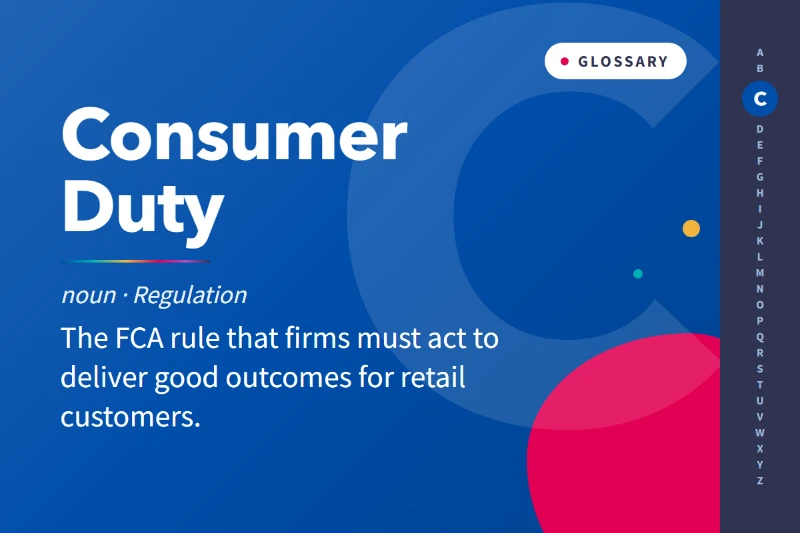
The Consumer Duty is the Financial Conduct Authority's rule that authorised firms must act to deliver good outcomes for retail customers. In insurance it applies to insurers, brokers, managing general agents and other firms whose role in a distribution chain shapes what consumers and smaller commercial customers buy, pay, understand and experience.
This entry explains how the Duty is built, when it took effect, which of its parts apply to general insurance and which are replaced by the FCA's existing product governance rules, how responsibility is shared along a distribution chain, what boards must sign off, what the FCA has found in its insurance reviews, and the changes it has made and proposed in 2025 and 2026. It covers the United Kingdom only.
What the Consumer Duty is
The Duty is Principle 12 of the FCA's Principles for Businesses: a firm must act to deliver good outcomes for retail customers.1 The detailed rules sit in chapter PRIN 2A of the FCA Handbook. The FCA made them in July 2022 in Policy Statement PS22/9, after the Financial Services Act 2021 required it to consult on whether firms should owe consumers a duty of care and to make any final rules by 31 July 2022.2 The FCA described the package as a new Consumer Principle, three cross-cutting rules and rules on four outcomes.2
How the Consumer Duty is built
The cross-cutting rules require a firm to act in good faith towards retail customers, to avoid causing them foreseeable harm, and to enable and support them to pursue their financial objectives.3 Good faith is defined as honesty, fair and open dealing and acting consistently with customers' reasonable expectations. Guidance says it does not stop a firm pursuing legitimate commercial interests or a profit, and does not make it a fiduciary where it was not one already.3 If a firm finds that customers have suffered foreseeable harm from its acts or omissions, it must take appropriate action to put it right, including redress where appropriate.3
Who counts as a retail customer depends on the sector. For insurance, the FCA's guidance says the scope follows the Insurance: Conduct of Business Sourcebook (ICOBS), and that the Duty does not apply to reinsurance, to contracts of large risk sold to commercial customers or where the risk is outside the UK, or to the distribution of group insurance policies.4 Since December 2025 the large risks concept has been split into specialist risks contracts and larger commercial customers.5
When the Consumer Duty came into force
The FCA consulted on a nine-month implementation period ending on 30 April 2023 and phased it instead after almost all firms and their trade bodies said nine months was highly challenging.2 The Duty is not retrospective: the FCA said it would not require firms to consider whether past actions breached it, and that firms are held to the standards that applied at the time of a problem.2
| Date | Milestone |
|---|---|
| July 2022 | Final rules and guidance published in PS22/9 and FG22/524 |
| End of October 2022 | Firms' boards expected to have agreed their implementation plans2 |
| End of April 2023 | Manufacturers to aim to finish reviewing existing open products and share information with distributors2 |
| 31 July 2023 | The Duty applies to new products and to existing products open to sale or renewal2 |
| 31 July 2024 | The Duty applies to closed products and services2 |
| 9 December 2025 | Insurance simplification rules from PS25/21 take effect, including changes to PRIN 2A.3 and PRIN 2A.45 |
| 26 June 2026 | Targeted Clarifications of Handbook Materials Instrument 2026 takes effect, amending PRIN 2A and Principles 6 and 7 references6 |
| 29 June 2026 | Consultations CP26/22 and CP26/23 published7 |
| Q1 2027 | Policy statement and any new rules from CP26/23 expected8 |
The four outcomes and how they apply to insurance
Two of the four outcomes do not apply in the usual way to general insurance, because the FCA already had product governance rules for it in PROD 4. PRIN 2A.4.32R says the rules in PRIN 2A.4 do not apply to a firm that manufactures or distributes a non-investment insurance product or a legacy non-investment insurance product, and that such a firm must continue to apply PROD 4.9 PRIN 2A.3.24R says the products and services outcome does not apply to a firm subject to PROD 4 for any product within PROD 4's scope, or to a bespoke insurance contract.10 The FCA's guidance puts it this way: firms that meet the value rules in PROD 4 for non-investment insurance "will meet the price and value outcome".4
| Part of the Duty | Handbook | What it requires | Non-investment insurance |
|---|---|---|---|
| Cross-cutting rules | PRIN 2A.2 | Good faith, avoiding foreseeable harm, enabling customers to pursue their financial objectives3 | Applies |
| Products and services | PRIN 2A.3 | A product approval process and a target market specified at a sufficiently granular level2 | Disapplied for products within PROD 4 and for bespoke insurance contracts (PRIN 2A.3.24R); PROD 4 applies instead10 |
| Price and value | PRIN 2A.4 | Products and services offer fair value2 | Disapplied (PRIN 2A.4.32R); the PROD 4 fair value rules at PROD 4.2.14AR and PROD 4.2.14BR apply instead911 |
| Consumer understanding | PRIN 2A.5 | Communications meet customers' information needs, are likely to be understood and equip them to make effective, timely and properly informed decisions12 | Applies |
| Consumer support | PRIN 2A.6 | Support that meets customers' needs, with no unreasonable barriers to submitting a claim, making a complaint, switching or cancelling13 | Applies |
The consumer understanding outcome applies to every firm within the Duty involved in producing, approving or distributing communications to retail customers.12 Among its examples of poor practice, the FCA's guidance describes an insurance product updated over several years whose policy summary lists some exclusions while newer, equally important exclusions appear only in the full conditions.4 The consumer support outcome names submitting a claim among the points in a product's life where customers must not face unreasonable barriers.13 The guidance gives the example of an insurer that requires hard copies of all evidence and will not waive the requirement, which it says would be unlikely to count as acting in good faith.4
How the Duty works along an insurance distribution chain
The Duty applies to every firm that can determine or materially influence retail customer outcomes, whether or not it deals with the customer directly. The FCA gave as examples firms that influence product design or price, distribution, communications or customer support, and said the Duty would not apply to a firm whose role is limited to providing factual information to another firm in the chain or providing IT systems.2 Foreseeable harm can be caused through a firm's role in a distribution chain even where another firm in that chain also contributes to it, and a firm that becomes aware that another firm in its chain is not, or may not be, complying with the Duty must notify the FCA.314
| Role | Provisions that apply |
|---|---|
| Insurer or Lloyd's managing agent (manufacturer) | Product approval and fair value assessment under PROD 4.2; may be chosen as sole lead firm for PROD 4.2 where several firms manufacture a product11 |
| Managing general agent or other intermediary that helps design the product | May be a co-manufacturer under PROD 4.2; cannot be the lead firm, which must be an insurer or a managing agent115 |
| Broker or other distributor | Must identify the impact of its distribution arrangements and remuneration on the product's value, and give the manufacturer remuneration information on request15 |
| Firm that outsources customer service or claims handling | Consumer support outcome still applies to it where it outsources interactions with retail customers13 |
| Any firm in the chain to which the Duty applies | Cross-cutting rules, monitoring and the duty to notify the FCA about another firm's non-compliance; consumer understanding where it is involved in communications with retail customers31214 |
| Firm limited to providing IT systems | The FCA said the Duty would not apply to such a firm2 |
The lead firm option came in on 9 December 2025. Where more than one firm manufactures a non-investment insurance product, they may agree in writing that one firm, which must be an insurer or a managing agent with sufficiently significant involvement, is solely responsible for the PROD 4.2 manufacturer requirements and accepts liability for breaches.11 Most respondents to the consultation supported the lead firm option but were divided on extending it to intermediaries, and many wanted managing general agents to be allowed to lead, saying intermediary-owned products are common in the London market. The FCA kept the restriction for now, saying the risk of customer harm outweighed the benefits, and that it may revisit this.5 The question arises in delegated authority arrangements, where a managing general agent underwrites on an insurer's behalf.
Fair value assessments in insurance
Because PRIN 2A.4 is disapplied, the fair value test for general insurance is the PROD 4 one. PROD 4.2.14AR requires the product approval process to identify whether a non-investment insurance product provides fair value to customers in the target market, and whether it will continue to do so for a reasonably foreseeable period, including following renewal.11 Where the product is sold with additional products, PROD 4.2.14BR requires the firm to assess each component and the package as a whole, taking into account the overall price to the customer and the proposed distribution arrangements.11 Distribution arrangements must enable the distributor to understand the outcome of that value assessment and any group of customers for whom the product is not expected to provide fair value.15
Distributors carry their own value obligation. PROD 4.3.6AR requires a distributor to identify the impact of its distribution arrangements, including any remuneration it or another person in its chain receives, on the overall value of the product, and to consider whether that remuneration would result in the product ceasing to provide fair value.15 On request, a distributor must tell the manufacturer about its remuneration and about any ancillary product it sells alongside, including add-ons and retail premium finance.15 Until December 2025 products had to be reviewed at least every 12 months. Under PROD 4.2.36AAR a manufacturer now decides the review interval on an ongoing basis according to the potential for customer harm, and must record the interval and its reasons.115
GAP insurance before the FCA's 2024 intervention
Guaranteed asset protection (GAP) insurance is one insurance case where the FCA has acted on fair value. In February 2024 firms accounting for 80% of the GAP market agreed with the FCA to pause sales, after its value measures data showed that only 6% of the amount customers paid in premiums was paid out in claims and it had seen some firms paying 70% of premiums in commission.16 From May 2024 the FCA allowed several firms to restart, on the basis that they could demonstrate fair value; those that resumed did so with materially lower commission. In 2022 there were over 2.4 million GAP policies in force.17
Monitoring and the annual board report
A firm must regularly monitor the outcomes retail customers receive from its products, communications and customer support, identify whether any group of customers gets different outcomes from another group with the same product, and have processes to find the root causes of failures.14 A firm must prepare a report for its governing body on the results of that monitoring. At least once a year the governing body must review and approve it, confirm whether it is satisfied that the firm is complying with the Duty, and assess whether the firm's future business strategy is consistent with it, agreeing any actions needed.18 The Duty must also be reflected in the firm's strategy, governance, leadership and people policies, including incentives at all levels.18
The FCA's guidance expects a champion at board level who, with the Chair and the Chief Executive, makes sure the Duty is discussed regularly, and says the champion should be an independent non-executive director where possible.4 In the review of 180 firms' first board reports, published on 11 December 2024, the FCA listed five areas for improvement: data quality, a view across distribution chains, analysis of different customer types including those with characteristics of vulnerability, challenge from the board, and action plans with timescales and owners.19 The FCA's 2024 review of larger insurance firms' monitoring criticised thresholds that were arbitrary or insufficiently granular, such as loss ratio or claim timeliness targets identical across a wide range of products whose performance would normally vary.20
What the FCA has found in insurance
| Published | Review | Sample | Main findings |
|---|---|---|---|
| 9 February 2024 | GAP insurance sales pause16 | Firms with 80% of the GAP market | Value measures data showed 6% of premiums paid in claims; sales paused until firms could show fair value1617 |
| 26 June 2024 | Outcomes monitoring under the Duty20 | 20 larger insurance firms, information requested in December 2023 | Some approaches focused on processes completed rather than outcomes; few firms showed monitoring leading to proactive action; little monitoring of claim settlement outcomes20 |
| August 2024 | TR24/2, product governance in general insurance and pure protection21 | 28 manufacturers and 39 distributors, 10 products | Most manufacturers had strengthened governance, but many could not ensure and evidence fair value; shortcomings in fair value assessments, including the impact of remuneration; the review did not independently assess product value21 |
| 11 December 2024 | Consumer Duty board reports, all sectors19 | 180 firms | Five areas for improvement, including data quality and a view across distribution chains19 |
| 22 July 2025 | Home and travel claims handling22 | 15 home and 8 travel insurers | Unclear storm definitions, poor management information and poor oversight of cash settlements22 |
Storm claims at the home insurers in the FCA's 2025 review, 2024
In the claims review the FCA said the evidence it saw indicated that, in most cases, rejected or abandoned storm claims had valid reasons under the policy terms, but that a payment rate under a third suggested poor consumer understanding.22 It asked trade bodies to consider further action on storm claims by winter 2025.22 On 18 December 2025 the FCA responded to a super-complaint from Which? about home and travel insurance, partly disagreeing with it and expanding its planned work on claims handling and on consumers' understanding of their cover.2324 TR24/2 is a review of compliance with PROD 4 rather than the Duty itself, but the FCA noted that the Duty set a higher standard of conduct for retail customers from 2023.21
How the Consumer Duty differs from TCF, PROD 4 and the pricing rules
| Treating Customers Fairly (Principle 6) | PROD 4 fair value rules | General insurance pricing rules (ICOBS 6B) | Consumer Duty | |
|---|---|---|---|---|
| Core requirement | Pay due regard to customers' interests and treat them fairly1 | Products provide fair value to the target market, including after renewal11 | Renewal price no higher than the equivalent new business price25 | Act to deliver good outcomes for retail customers1 |
| In force | Principle in the FCA Handbook; no longer applies where the Duty applies26 | 1 October 202111 | 1 January 202225 | 31 July 2023, closed products 31 July 20242 |
| Who it reaches | A firm's own customers | Manufacturers and distributors of insurance products1115 | Firms setting renewal prices in home and motor insurance2527 | Firms in the distribution chain even where the retail customer is not their client26 |
PRIN 3.2.10R, as amended from 26 June 2026, says Principles 6 and 7 do not apply to a firm's activities to the extent that the Duty applies; they still apply, for example, to services for professional clients.26 In the same package the FCA confirmed it was going ahead with removing historic Treating Customers Fairly material from its website, including the 2006 paper on fair outcomes for consumers and the 2007 guide to management information.6 PROD 4 and the pricing rules continue to apply alongside the Duty (PRIN 2A.4.32R(2)).9 The FCA's 2025 evaluation of the pricing rules found that the gap between prices for existing and new home insurance customers had almost halved, from £95.38 to £49.17, although it found no statistically significant evidence of a causal link between its rules and price changes in home insurance.27
Changes made and proposed in 2025 and 2026
PS25/21, published in December 2025, finalised changes that took effect on 9 December 2025: the optional lead firm under PROD 4, a wider exclusion for bespoke contracts, review intervals set by risk instead of every 12 months, and the new split between specialist risks contracts and larger commercial customers.5 It said the FCA would review core definitions, including retail customer, during 2026.5
On 29 June 2026 the FCA published two consultations; both are proposals, not rules.7 CP26/23 proposes removing business for customers outside the UK from the Duty, clarifying how firms can rely on each other in distribution chains, and saying that firms need not produce a stand-alone Consumer Duty board report, while board reporting would still take place at least annually.8 For non-investment insurance it proposes that the Duty's territorial scope follow CP26/22, under which ICOBS and PROD 4 would apply only where customers are habitually resident in the UK or the insured risk is in the UK.8 CP26/22 also proposes removing ICOBS 4.2, the extra disclosure rules for pure protection, on the ground that the Duty now covers retail customers' information needs.28 Comments on CP26/22 closed on 4 September 2026 and on CP26/23 on 18 September 2026; the FCA expects to publish its policy statement on CP26/23 in Q1 2027.288
Show References Hide References
- FCA Handbook. PRIN 2.1: The Principles. Read 11 November 2026.
- Financial Conduct Authority. PS22/9: A new Consumer Duty, Feedback to CP21/36 and final rules. July 2022.
- FCA Handbook. PRIN 2A.2: Cross-cutting obligations. Read 11 November 2026.
- Financial Conduct Authority. FG22/5: Final non-Handbook Guidance for firms on the Consumer Duty. July 2022.
- Financial Conduct Authority. PS25/21: Simplifying the insurance rules, feedback on CP25/12, final rules and options for future changes. December 2025.
- Financial Conduct Authority. Handbook Notice No 142. June 2026.
- Financial Conduct Authority. Non-UK business removed from Consumer Duty scope to reduce burdens on wholesale businesses. Press release, 29 June 2026.
- Financial Conduct Authority. CP26/23: Consumer Duty, scope and proportionality. June 2026.
- FCA Handbook. PRIN 2A.4: Consumer Duty: retail customer outcome on price and value. Read 11 November 2026.
- FCA Handbook. PRIN 2A.3: Consumer Duty: retail customer outcome, products and services. Read 11 November 2026.
- FCA Handbook. PROD 4.2: Manufacture of insurance products. Read 11 November 2026.
- FCA Handbook. PRIN 2A.5: Consumer Duty: retail customer outcome on consumer understanding. Read 11 November 2026.
- FCA Handbook. PRIN 2A.6: Consumer Duty: retail customer outcome on consumer support. Read 11 November 2026.
- FCA Handbook. PRIN 2A.9: Monitoring of consumer outcomes. Read 11 November 2026.
- FCA Handbook. PROD 4.3: Distribution of insurance products. Read 11 November 2026.
- Financial Conduct Authority. GAP insurers agree to suspend sales following FCA concerns over fair value. Press release, 9 February 2024.
- Financial Conduct Authority. Firms to recommence GAP insurance sales following FCA action. Press release, 24 May 2024.
- FCA Handbook. PRIN 2A.8: Governance and culture. Read 11 November 2026.
- Financial Conduct Authority. Consumer Duty board reports: good practice and areas for improvement. Published 11 December 2024, last updated 9 March 2026.
- Financial Conduct Authority. Insurance multi-firm review of outcomes monitoring under the Consumer Duty. Published 26 June 2024.
- Financial Conduct Authority. TR24/2: Product Oversight and Governance thematic review, General Insurance and Pure Protection (PROD 1.4 and PROD 4). August 2024.
- Financial Conduct Authority. Home and travel claims handling arrangements: good practice and areas for improvement. Published 22 July 2025.
- Financial Conduct Authority. FCA expands insurance work in response to Which? super complaint. Statement, 18 December 2025.
- Financial Conduct Authority. Response to Which?'s super-complaint on addressing poor consumer outcomes in home and travel insurance. December 2025.
- FCA Handbook. ICOBS 6B.2: Setting renewal prices. Read 10 November 2026.
- FCA Handbook. PRIN 3.2: What?. Read 11 November 2026.
- Financial Conduct Authority. Roadmap for retail insurance. Published 22 July 2025.
- Financial Conduct Authority. CP26/22: Simplifying the insurance rules, a package of proposals on the scope of our rules, disclosure and advice. June 2026.
Frequently Asked Questions
Does the Consumer Duty apply to commercial insurance and SMEs?
It can. The FCA's guidance says the Duty's insurance scope follows ICOBS, which covers commercial customers as well as consumers, subject to the exclusions for insurance. A small business buying general insurance can therefore be a retail customer for Duty purposes. In PS25/21 the FCA also reminded firms that in 2023 it changed the PROD rules so that firms must look through the main policyholder and design products that meet the needs of all policyholders and policy stakeholders acting outside their trade or profession, and that firms must consider whether a product has, or could have, retail consumers in that position, such as residential leaseholders.
PS25/21 replaced the contracts of large risks definition from December 2025 with two concepts. Specialist risks contracts cover railway rolling stock, aircraft, ships, goods in transit, aircraft liability and liability of ships, and certain credit and suretyship contracts, and are excluded because of the nature of the risk. Larger commercial customers are commercial customers of any general insurance product who exceed thresholds aligned with the Financial Ombudsman Service's eligible complainant definition, applied to the main policyholder only. Separate proposals on customers outside the UK are in CP26/23.
Does the Consumer Duty apply to closed books and older insurance policies?
Yes, a year later than for open products, according to PS22/9. The FCA's guidance says the Duty applies in full to closed products, those no longer sold or renewed, but the products and services outcome does not apply in the same way: with no further sales there is no need for a target market or distribution strategy. Firms are still expected to review closed products against the cross-cutting rules, considering whether any aspect of the design could cause foreseeable harm or frustrate customers pursuing their financial objectives, and to meet the consumer understanding and consumer support outcomes for those customers, as set out in FG22/5.
FG22/5 suggests ways to review a closed book proportionately: an initial review of why the product was closed, prioritising products with a higher risk of harm, for example those attracting complaints, building the review into existing cycles, and grouping similar products where the customer base, complexity and risk of harm are similar enough. The legal instrument in PS22/9 explains that a closed product is already subject to PROD if it is an insurance product manufactured on or after 1 October 2018 or a legacy non-investment insurance product, and closed products of that kind follow PROD rather than the separate closed product rules in PRIN 2A.3.
Can a customer sue an insurer for breaching the Consumer Duty?
Not directly. The FCA decided in PS22/9 not to attach a private right of action to any part of the Duty at this time, so a breach of the Duty does not in itself give a customer a right to sue the firm for damages. Some respondents pointed out that this creates an asymmetry, because existing PROD rules carry a private right of action while equivalent Duty rules would not. Consumer organisations also noted that, as the FCA had said in its consultation, without one it could not introduce an industry-wide consumer redress scheme under section 404 of the Financial Services and Markets Act 2000, and the Financial Services Compensation Scheme could not compensate for breaches of the Duty.
The FCA said in PS22/9 that any future decision to attach a private right of action would be subject to further consultation, and that a future review could consider whether there was a stronger case for attaching it to the four outcome rules but not to Principle 12 or the cross-cutting rules. It pointed to changes that consumer organisations had said would help replicate the benefits of a private right of action, namely stronger governance, accountability and redress requirements, including the duty on firms to put right foreseeable harm they identify. The FCA also noted that it can still require restitution from firms in breach of the Duty under section 384 of FSMA.
How has the FCA acted on insurers since the Duty came in?
Through a mix of supervisory tools and enforcement. In its statement of 18 December 2025 the FCA said that since its July 2025 claims review it had opened 2 enforcement cases, stopped 1 firm from growing its business until it fixed the problems identified, launched 3 independent reviews into firms' systems and controls, and made 3 senior managers agree to fix problems and consider whether redress was due. The FCA did not say which rules each action concerned. It said 79% of consumers who make an insurance claim are satisfied with how it was handled, while 31% say there is not enough information to judge the quality of different policies.
The FCA's full response described other action taken without enforcement, under its product governance rules, the Duty and its wider requirements. After its work on insurers' valuation of vehicles in motor total loss cases, it said it secured approximately £200 million in redress for around 270,000 customers. Following its review of outcomes monitoring at 20 large insurance firms, several completed risk mitigation plans and senior managers gave attestations. The response also set out claims acceptance rates from value measures data: in 2024, 99% of motor claims were accepted, against 80% for stand-alone single trip travel insurance, 74% for contents only home insurance and 63% for buildings only home insurance. The FCA said lower rates may indicate worse claim outcomes or lower consumer understanding; the data counts any loss a customer raises, even one the policy does not cover, as a declined claim.
Does the Consumer Duty apply to outsourced claims handlers?
The insurer stays responsible either way. In its 2025 claims review the FCA said firms may outsource elements of claims handling but cannot outsource their regulatory responsibilities, and must take reasonable care to supervise outsourced activities so that third parties deliver good outcomes for customers that are consistent with those delivered in-house. Every insurer in its sample of 23 outsourced some part of claims handling, from first notification of loss to the whole process, and 5 insurers, all of which substantially outsourced their claims operations, had limited control over those arrangements or material weaknesses in their oversight. The FCA said it saw limited control more frequently at UK branches of overseas insurers and firms serving the UK from abroad.
The same review found that 18 of the 23 firms had a written claims strategy, while 5 had no clear or articulated strategy, of which 2 were UK branches of overseas firms and 1 provided services into the UK from overseas. Eleven of the 23 could evidence appropriately set tolerances, subject to review, for monitoring performance and outcomes. Under PS22/9, an FCA-authorised outsourcer, such as a claims-handling TPA, is subject to the Duty only where it can determine or materially influence retail customer outcomes; otherwise the insurer remains responsible.
We'd rather show you than tell you.
We'll start by getting to know your business. Then we'll show you exactly how Genasys handles it.
Insurance People
Zero Fluff
Tailored to You