
How do you choose the right MGA software for today and tomorrow? This free eBook answers that question in insurance terms for the people who will live with the decision. An MGA earns its living by delivering specialist underwriting quickly and cheaply on someone else's balance sheet, and every part of that depends on the platform underneath it. In 42 fully referenced pages and twelve chapters, the guide sets out why the platform decision matters more to an MGA than to a carrier, what good looks like in 2026 and how to run a selection that finds the right platform before you sign.
Who this eBook is for
This buyer's guide is for founders and chief executives of managing general agents, chief underwriting and operating officers, heads of finance and IT, as well as the capacity providers who need to understand how a delegated partner runs. It assumes you know insurance and want the technology question answered in insurance terms. Every figure is attributed to its source, and where a figure is a projection or a correlation, the guide says so.
The MGA market in 2026
MGAs now write a large and growing share of the world's specialist insurance, and the carriers, reinsurers, investors and regulators behind that business are asking harder questions of how MGAs run.
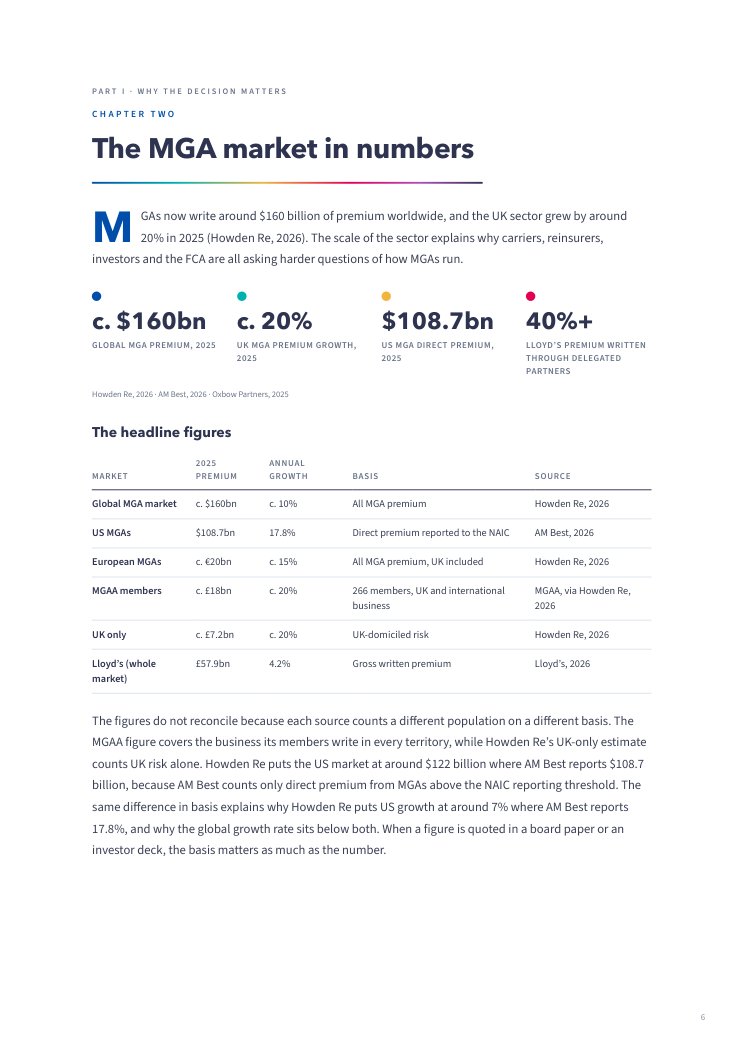
The MGA market in numbers
Howden Re, 2026
Howden Re, 2026
Oxbow Partners, 2025
Accenture, via Insurance Journal, 2022
Three things have made 2026 a harder year to get the platform wrong. Capacity has become more selective, with carriers asking for steadier loss ratios and more rigorous due diligence before they renew. The FCA has widened its review of delegated authority to cover oversight and remuneration. And Lloyd's has sunset Blueprint Two, its market-wide digital programme, which leaves each MGA more responsible for the quality of its own data.
Margins leave little room for a rigid or expensive system. In the guide's worked example, a UK MGA writing £30 million of premium earns about £1.4 million of EBITDA, so a platform that costs £150,000 a year more than an alternative absorbs a tenth of it. A 4% fall in rates, roughly what Lloyd's recorded in 2025, takes about £140,000 off commission income with no matching fall in costs.
Why MGA software is its own category
An MGA underwrites like a carrier, distributes like a broker and often administers claims, and it does all three with a small team across several capacity providers at once. That pulls its technology needs away from anything an insurer or a broker would buy. Business users need to change the product themselves. Several binders have to run side by side, each with its own limits, commission, taxes and reporting format. Authority has to be enforced in the system before a risk is bound, with a record that proves it. And the bordereaux each carrier receives are part of what the carrier is buying, so their quality affects whether capacity renews.
The guide boils the decision down to three tests. Everything else on a vendor's slide comes second to these.
The three tests of the best MGA software
The eight capabilities that matter
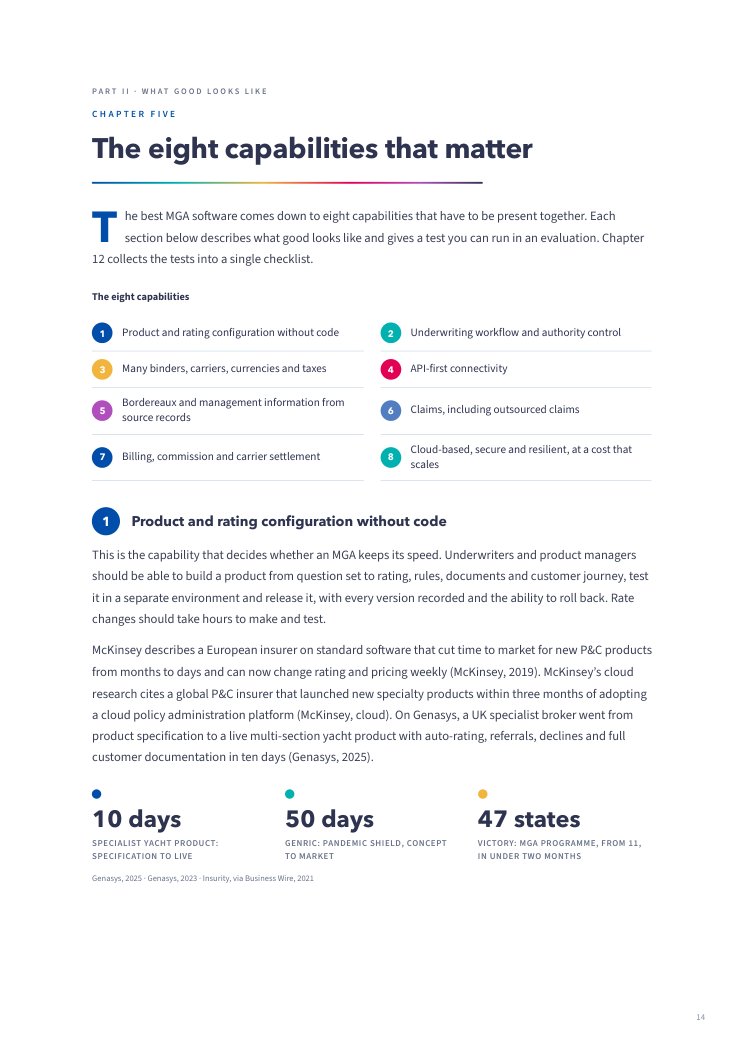
The best MGA software comes down to eight capabilities that have to be present together. For each one, the eBook describes what good looks like and gives a test you can run during an evaluation, so the vendor shows you rather than tells you.
What to test on every shortlist
Configuration is the capability that decides whether an MGA keeps its speed. The guide draws a hard line between configuration, where the business adapts what the platform already does through settings, rules and rating tables, and customisation, where someone writes new code. Each customisation has to be tested at every upgrade and paid for, and three years of them leave an MGA owning a bespoke system at a package price. On Genasys, a UK specialist broker took the other path: it went from product specification to a live multi-section yacht product with auto-rating, referrals, declines and full customer documentation in ten days.
The platforms on the shortlist
An MGA running a serious procurement will meet five kinds of platform, each built for a different buyer. Vendor names change through acquisition and rebranding, and most vendors describe themselves as suitable for MGAs, so the guide asks a more reliable question: which category does a platform belong to, and was that category designed for a business like yours?
- Enterprise carrier suites, such as Guidewire, Duck Creek and Majesco, built for large property and casualty insurers. Deep and mature, with licences and implementations sized for carriers. They usually fit an MGA inside a carrier group or one writing several hundred million of premium across many lines.
- Agency and broker management systems, such as Vertafore, built around clients, placements and broker accounting. They suit a distribution-led MGA, with limited rating, authority control and carrier bordereaux.
- No-code insurance platforms, built for business-led change, with policy administration, claims and billing in one system and subscription pricing. They usually fit an MGA that underwrites its own products with a lean team. Genasys sits in this category.
- API-first headless cores, built for engineering-led insurtechs that treat the customer experience as their product and have the engineers to build it.
- Delegated authority and bordereaux tools, built for carriers and managing agents overseeing MGAs. They sit alongside a policy platform rather than replacing one.
The guide sets out the strengths and watch-outs of each, the case for building your own and the circumstances in which a heavier enterprise suite is the right answer. You can see how Genasys approaches the brief on our page about MGA software.
What's inside
42 pages in three parts, fully referenced, with a glossary of delegated authority terms. Every capability comes with a test to run in a demonstration, and the final chapter collects them into a checklist to take into every vendor meeting.
The three parts
Inside the eBook
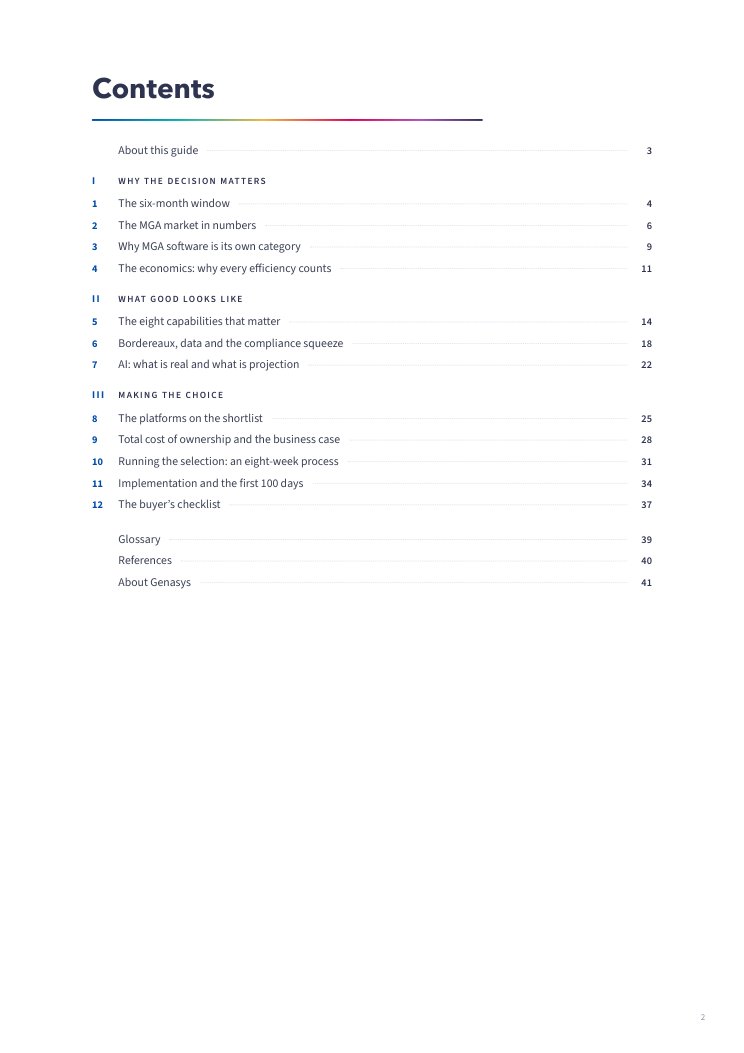
The covers and three pages from the guide: the contents, the MGA market in numbers and the eight capabilities that matter.
Download the guide
Fill in the form and your download link appears straight away. Please use your work email address.
Download the free eBook
Get the eBook now. Please use your work email address.
Thank you. Your copy of MGA Software: The Complete Buyer’s Guide is ready (PDF, 4.2 MB).
Frequently Asked Questions
What the eBook says about the questions MGAs ask most when choosing a platform.
How do you choose MGA software?
Decide what you need before you meet a vendor, then make every vendor prove it on your products rather than theirs. The eBook sets out an eight-week selection process. In week one, agree weighted criteria and pick two test cases: your hardest current product and your most demanding carrier's reporting format. In week two, screen the market by category and cut to three vendors. Weeks three and four are scripted demonstrations, where each vendor works through your test cases on your script with your data. Weeks five and six are a hands-on proof of concept, references and commercials follow in week seven and the decision comes in week eight.
The proof of concept is the most valuable fortnight. A platform that is configurable by business users in principle and by the vendor's consultants in practice shows itself the moment your underwriter tries to change a rating table, so time each task and note every point at which the vendor's staff take over. Put the chief underwriting officer, operations, finance, compliance and IT in the room, and invite your main capacity provider to say what it needs from your data in week one rather than at renewal. Our page on MGA software shows how Genasys meets the brief.
What types of MGA software are there?
Five, and each was built for a different buyer. Enterprise carrier suites such as Guidewire, Duck Creek and Majesco run many of the world's largest insurers and earn their cost on large, complex books, though licences, implementations and change are sized for carriers. Agency and broker management systems such as Vertafore are built around clients, placements and broker accounting, and suit an MGA whose work is mainly distribution. No-code insurance platforms let business users configure products, rating, documents and workflow, run policy administration, claims and billing in one system and price by subscription. API-first headless cores give an engineering team a modern data model and leave the front end to the customer. Delegated authority and bordereaux tools help carriers and managing agents analyse bordereaux from many MGAs, alongside a policy platform rather than instead of one.
Most MGAs shortlist from the enterprise suites and the no-code platforms, with headless cores for engineering-led start-ups. The broker systems and bordereaux tools are usually complements to a core platform rather than alternatives. Genasys is a no-code platform, used by MGAs such as Arma Karma in the UK, and the eBook is clear about when a heavier suite is the better choice: for example, an MGA inside an insurance group that already licenses and develops on one.
What is the total cost of ownership of MGA software?
The licence or subscription is one cost line of seven. A sound five-year comparison also counts implementation, data migration, integrations, change and customisation after go-live, your own team's time and the cost of getting your data back when the contract ends. Each line has somewhere it hides: price steps at volume thresholds, day rates outside a fixed scope, every new carrier bordereaux format after go-live and underwriters pulled off live business during build and testing.
The eBook's worked comparison models a £30 million MGA over five years. A platform with a heavy implementation and developer-led change costs £4 million in the model, a no-code subscription platform £1.65 million and doing nothing £2.65 million, most of it in people's time spent rebuilding bordereaux and rekeying data. The figures are illustrative, so build the model with your own quotes. Ask every vendor to price your business today and at three times its size, and to say what happens if a binder is lost and premium falls. Seat-based pricing penalises an MGA for giving brokers and TPAs access, while a fee tied to premium or policy count keeps the platform in proportion to the book.
How long does it take to implement MGA software?
For a first product on a configurable platform, about 100 days from signing to go-live is a realistic plan, and much less is possible. The eBook's 100-day plan configures the first product on one binder in days 0 to 30, migrates in-force policies and open claims and runs user acceptance testing in days 31 to 60 and goes live in days 61 to 100, with old and new bordereaux run in parallel for one cycle and the second product built by the MGA's own team. Genasys delivered Arma Karma's policy administration platform in one week, and a UK specialist broker went from specification to a live yacht product in ten days.
What slows an implementation down is size and control rather than technology. McKinsey and the University of Oxford found that IT projects with budgets above $15 million ran 45% over budget on average. Start with one product on one binder, agree the plan, milestones and acceptance criteria in the contract, and name a product owner in the business with authority over what is configured. Reconcile premium, claims and commission to the penny before the old system is switched off, and share sample bordereaux with each carrier early, so better data reaches them before their next renewal. The Arma Karma case study shows a phased launch in practice.
What questions should an MGA ask software vendors?
Ask questions that make the vendor show you, and ask references what broke. In a demonstration, ask to see a risk that breaches a binder limit and the referral and audit trail it triggers, one product written on two binders with different commission and tax, a mid-term adjustment on an instalment policy flowing through to broker, MGA and carrier balances and a bordereau produced in your carrier's format from data entered during the demo. Ask for the public API documentation before the demonstration, current ISO 27001, SOC 2 or Cyber Essentials Plus certificates and the last three months of uptime.
Then check the vendor as well as the software. Ask for audited accounts, the ownership structure and any change of control in the last three years, since an acquisition can change pricing, roadmap and support. Ask for the release history of the last two years alongside the roadmap, and agree in writing how your data and configuration come back if the vendor is sold, fails or leaves your market. Speak to two MGAs of your size that have been live for at least two years, and ask them how long implementation took against the plan, who built the product the vendor had not anticipated and whether they would choose the same platform again. The eBook's checklist turns all of this into a scorecard for every vendor meeting.
We'd rather show you than tell you.
We'll start by getting to know your business. Then we'll show you exactly how Genasys handles it.
Insurance People
Zero Fluff
Tailored to You