
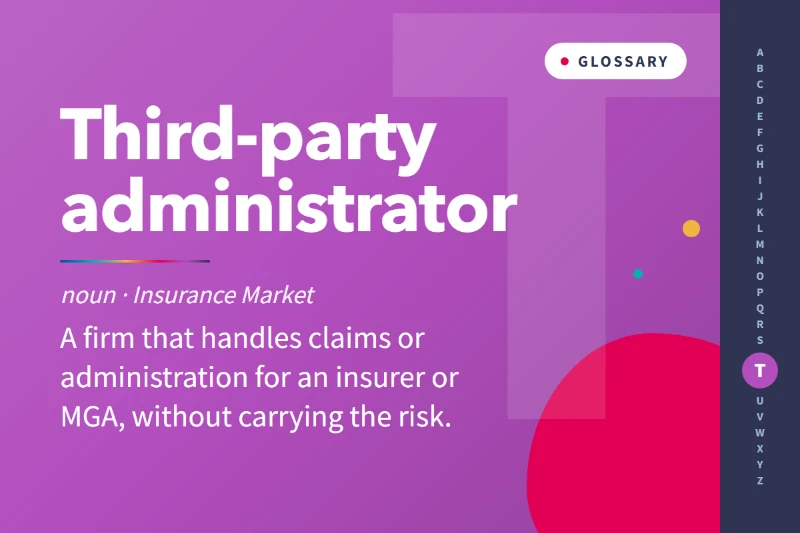
A third-party administrator (TPA) is a firm that handles claims or policy administration on behalf of an insurer, MGA or self-insured organisation, without carrying any of the insurance risk itself. It works within authority limits set by its client, which remains responsible for the business.
This guide is for claims, delegated authority and operations teams at insurers and MGAs. It covers what TPAs do, how they differ from MGAs and coverholders, how delegated claims arrangements work, how insurers oversee them and how claims data gets back from the TPA to the insurer or MGA.
What a TPA is
A TPA is an outsourced service provider. It sells administration and claims expertise, and it is usually paid a fee per claim, per policy or for the programme as a whole. The client, whether an insurer, a Lloyd's managing agent, an MGA or a corporate with a self-insured programme, decides what the TPA may do and on what terms, and the TPA carries out that work in the client's name.
The term is used across the market. At Lloyd's, a TPA that has authority to decide claims is called a delegated claims administrator, or DCA, and needs Lloyd's approval before a managing agent can appoint it. In the UK company market and internationally, "TPA" is the more common label for the same role.
What TPAs do: claims handling, policy administration and other outsourced services
Claims handling is the core of most TPA businesses. A claims TPA takes first notification of loss, validates cover, sets and updates reserves, appoints loss adjusters, repairers and solicitors, negotiates and pays claims within its authority, pursues recoveries and produces claims reporting for the client. Some specialise by class, such as motor, property, liability or travel, and some by territory.
Policy administration TPAs handle the other end of the policy lifecycle: issuing documents, processing mid-term changes, managing renewals, collecting premium and running credit control. This is more common in life, health and affinity business than in commercial lines, although some MGAs outsource their back office in the same way.
Other services TPAs offer include complaints handling, subrogation and recovery work, run-off management for closed books and data and bordereaux management on behalf of insurers that receive reports from many delegated partners.
TPA, MGA and coverholder: how the roles differ
The difference comes down to underwriting. A managing general agent has authority to underwrite and bind risks for an insurer and is usually paid a commission on the premium it writes. A coverholder is the Lloyd's term for a firm approved to bind risks on behalf of syndicates. Both are distributors with underwriting authority.
A TPA has no underwriting authority. It does not choose which risks are written or at what price, and it does not take commission on premium. Its authority covers administration and, most often, claims.
The roles do overlap in practice. An MGA may hold claims authority and handle its own claims, in which case it does not need a TPA. A coverholder at Lloyd's that handles claims on policies it underwrote does not need separate approval as a DCA, according to Lloyd's guidance on delegated claims administrators. Some groups own both an MGA and a TPA and route the MGA's claims to the TPA, which raises its own conflict-of-interest questions for the insurer.
Why insurers and MGAs use TPAs: capacity, specialist expertise and geographic reach
Capacity is the most common reason. Building an in-house claims team takes time and fixed cost, and claims volumes are uneven. A TPA lets an insurer or MGA handle claims from day one of a new programme and absorb surges after a catastrophe event without hiring for the peak.
Specialist expertise is the second reason. Some classes need technical handling skills that few firms hold in house, such as cyber incident response, complex liability, marine cargo or overseas travel medical claims. A TPA that handles those claims for many clients can sustain the expertise in a way a single insurer often cannot.
Geographic reach is the third. An insurer or MGA writing in territories where it has no office needs someone on the ground who knows local law, language and suppliers. Many Lloyd's and London market programmes rely on DCAs in the territory where the risks are located.
For new MGAs the case is often decisive. A start-up MGA usually has an underwriting team and a distribution plan but no claims function, and its capacity provider will want an experienced claims handler in place before the binder starts.
How a delegated claims arrangement works: claims authority, reserving limits and referral
The arrangement is set out in a claims agreement between the insurer or MGA and the TPA. At Lloyd's, the Delegated Claims Administrator Register guidance for managing agents (May 2025) describes the authority a DCA can hold as the power to accept or deny a claim in whole or in part, agree any amount payable and resolve the claim by agreement or, if necessary, dispute resolution. Lloyd's says that loss adjusters and others who only advise or support claims handling, without authority to determine claims, do not need DCA approval.
The agreement sets the limits of that authority. A financial limit sets the largest claim the TPA can settle without referral. Reserving limits set the largest reserve it can post, and many agreements require the TPA to notify the insurer of any claim reserved above a lower threshold, so that large losses are visible early. The same Lloyd's guidance lists denials, complaints and referral thresholds alongside the financial limit as matters the managing agent should define.
Referral rules list the claims the TPA must pass to the insurer for a decision, whatever their value. Typical triggers include coverage disputes, suspected fraud, claims involving litigation or regulators, claims likely to attract media attention and any declinature of a claim by a retail customer. The agreement also covers the bank account from which claims are paid, how funds are replenished, data protection, service standards and the client's audit rights.
Oversight of a TPA: claims bordereaux, audits and service standards
The insurer remains responsible for claims a TPA handles in its name. The FCA's 2015 thematic review TR15/7 on delegated authority stated that a firm cannot contract out of its regulatory obligations and that the claims handling obligations in ICOBS remain with the insurer even when claims operations are outsourced. Those obligations include the requirement in ICOBS 8.1.1R to handle claims promptly and fairly.
The same review found that about a third of the insurers in its sample had only limited control over outsourced claims handling, and that conflicts of interest were not always identified where claims handlers were paid through profit commission linked to loss ratios. It also found that insurers commonly set clear requirements for bordereaux and financial data but few equivalent requirements for information on customer outcomes.
Oversight therefore runs on three tools. The claims bordereau, usually monthly, lists every open and closed claim with payments, reserves and status. At Lloyd's, the Lloyd's Coverholder Reporting Standards set the core data set that coverholders and DCAs report to syndicates. Audits, carried out by the client or a specialist audit firm, test files against the agreement and good practice. Service standards, such as time to first contact, time to settle and complaint rates, are reported against agreed targets and reviewed in regular meetings.
The data problem: getting TPA claims data back into the insurer's or MGA's own system
The TPA runs claims on its own system. The insurer or MGA holds the policy on another. The link between them is often a monthly spreadsheet.
That gap causes several problems. The insurer's view of its claims is up to a month out of date, so a large loss reserved on the second day of the month may not reach the insurer's reserving team until the following month. Claims data has to be mapped to the insurer's policy records, which fails when policy numbers or risk references are keyed differently. Each TPA formats its bordereau differently, so an insurer or MGA using several TPAs spends time normalising data before it can compare them. And the TPA cannot see the live policy, so it validates cover against a copy that may not reflect recent endorsements.
The commercial effect is felt in reserving, reinsurance recoveries, loss ratio reporting to capacity providers and the customer outcome information the FCA expects insurers to see. For an MGA it also affects the conversation at binder renewal, where claims experience drives the terms.
How software supports TPA arrangements
The fix is to connect the systems so that policy and claims data flow both ways as events happen. Open APIs let the TPA's system query the policy record at FNOL to confirm cover, excess and endorsements, and push claim events, reserves and payments back to the insurer's or MGA's system as they are recorded. The monthly bordereau then becomes a reconciliation of data the insurer already holds.
Where an insurer or MGA brings some claims handling in house, or uses a TPA for some classes only, the same platform needs to hold both its own claims and those reported by the TPA, so that loss ratios and reserves can be seen in one place. Genasys has open APIs for connectivity with TPAs and other partners, alongside its own claims management.
Frequently Asked Questions
What does a TPA do in insurance?
A TPA handles claims or policy administration on behalf of an insurer, MGA or self-insured organisation. Claims TPAs take notifications, validate cover, set reserves, appoint adjusters, settle claims within their authority and report to the client. Policy administration TPAs issue documents, process changes and collect premium. The TPA carries no insurance risk and is usually paid a fee.
What is the difference between a TPA and an MGA?
An MGA has authority to underwrite and bind risks on behalf of an insurer and is usually paid commission on the premium it writes. A TPA has no underwriting authority. It administers policies or handles claims for its client within agreed limits and is paid a fee. An MGA may use a TPA to handle the claims on the business it writes.
Why do MGAs use TPAs for claims?
MGAs use TPAs because building a claims team takes time and fixed cost, and many start without one. A TPA gives the MGA experienced handlers from the first day of a programme, specialist skills for technical classes and local presence in territories where the MGA has no office. Capacity providers often expect an experienced claims handler to be in place before a binder starts.
How do insurers oversee a TPA?
Insurers oversee TPAs through claims bordereaux, file audits and service standards set in the claims agreement. The agreement fixes financial, reserving and referral limits, and the insurer checks performance against them in regular reviews. Under FCA rules the insurer remains responsible for claims handling even when the work is outsourced, so oversight needs to cover customer outcomes as well as financial data.
What is a claims bordereau?
A claims bordereau is a regular report, usually monthly, listing every claim handled under a delegated arrangement. It typically includes the claim and policy references, date of loss, date reported, cause, amounts paid, outstanding reserves and status. At Lloyd's, the Coverholder Reporting Standards set the core claims data that coverholders and delegated claims administrators report to syndicates.
We'd rather show you than tell you.
We'll start by getting to know your business. Then we'll show you exactly how Genasys handles it.
Insurance People
Zero Fluff
Tailored to You